Primary & Middle School Biology · Grades 1–9
9From Seed to Plant
Shake a dried bean pod and little hard beans rattle out — dry, dull, apparently as lifeless as gravel. Yet plant one in the earth and water it, and within days something extraordinary happens underground. A whole plant was folded up inside, waiting for its signal.
9.1 What a seed is
Definition 9.1 (Seed)
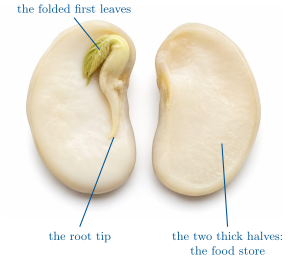
A seed is the beginning of a new plant, made by the parent plant. Inside its protective coat, a seed holds:
Example 9.2 (Opening a soaked bean)
Soak a big white bean overnight, and its coat slips off easily. The bean opens into two thick halves — the food store — and there, nestled at one edge, lies a tiny pale plant, root tip and folded first leaves, small as a grain of rice. The new plant was there all along.
Remark 9.3 (Seeds travel through our kitchens)
Beans, peas, lentils, rice, sunflower seeds, the pips in the apple and the stone in the peach: the kitchen is full of seeds. Some are tiny, like poppy seeds; the coconut is a giant one. Each of them, given the chance, would try to become a plant.
9.2 Germination
Definition 9.4 (Germination)
Germination is the moment a seed wakes and starts to grow: it swells with water, its coat splits, the little root comes out first and dives downward, then the shoot rises, carrying the first green leaves toward the light. We say the seed germinates.
Proposition 9.5 (What a seed needs to germinate)
To germinate, a seed needs water and warmth. It does not yet need light: the food store feeds the seedling at first, even under the soil, in the dark. Without water, or in the cold, a good seed simply waits.
Proof. Admitted at this level. ∎
Example 9.6 (Why sowing waits for spring)
Gardeners sow beans in spring, not in winter: the seed in cold earth would wait — or rot — instead of germinating. Warm days and watered soil are exactly the two signals of Proposition 9.5.
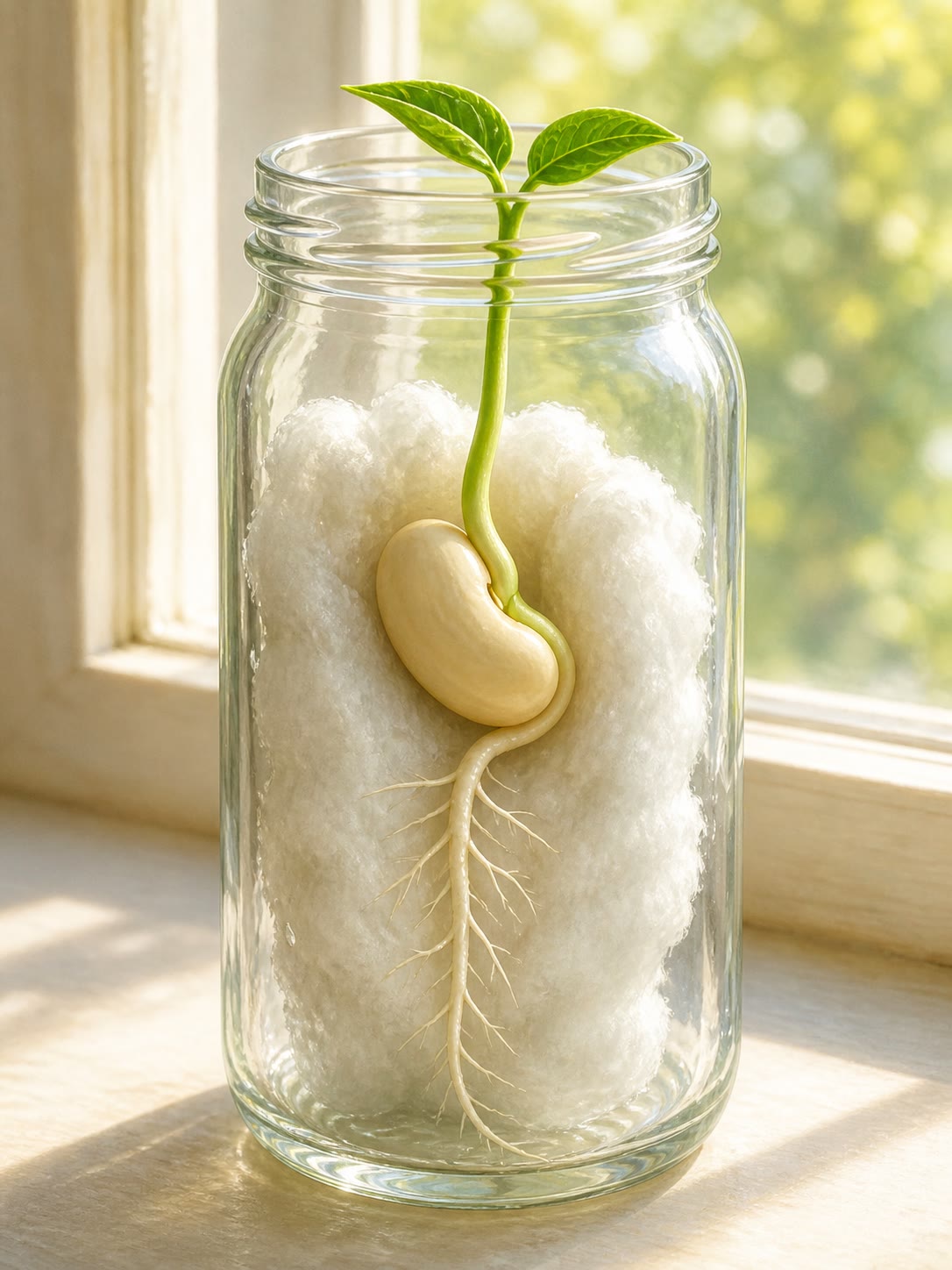
Method 9.7 (Sowing a seed and watching it germinate)
- Line a glass jar with damp cotton or paper;
- slide a bean between glass and cotton, so you can see it;
- keep the jar in a warm room and the cotton damp;
- look every day and note what you see: swelling, the coat splitting, root down, shoot up.
The glass makes visible what usually happens under the soil.
Remark 9.8 (Root down, shoot up — always)
However the bean lies in the jar — on its side, upside down — the root always turns downward and the shoot always turns upward. The seedling cannot see, yet it knows which way is up. Plants sense more than they show.
9.3 From seedling to plant with seeds
Proposition 9.9 (The plant’s life cycle)
The seedling grows into a plant with roots, stem and leaves; the plant flowers; the flowers make new seeds; and the cycle can start again. A single bean plant can make dozens of new beans in one summer.
Proof. Admitted at this level. ∎
Example 9.10 (One bean, one summer)
Sown in May, a bean germinates in a week; by June it is a leafy plant climbing its pole; in July come white flowers, then green pods; in August the pods hang heavy, each holding a row of new beans — next year’s seeds, made by this year’s plant.
9.4 Exercises
Exercise 9.1 ★
What two things lie inside a seed’s coat?
Exercise 9.2 ★
What does germinate mean? What comes out of the seed first: the root, or the shoot?
Exercise 9.3 ★
Name the two things a seed needs to germinate. Which famous need of grown plants is not on the list?
Solution
Solution of Exercise 9.3.
Water and warmth. Light is not on the list — the seed germinates happily in the dark, under the soil.
Exercise 9.4 ★
How can a buried seedling grow in the dark, before reaching the light? Where does its food come from at first?
Exercise 9.5 ★
Name four seeds you could find in a kitchen.
Solution
Solution of Exercise 9.5.
For example: beans, peas, lentils, rice, sunflower seeds, apple pips, a peach stone.
Exercise 9.6 ★
Why do gardeners sow in spring rather than in winter?
Exercise 9.7 ★
Put in order: pod with new beans — seed — flowering plant — seedling — leafy plant.
Exercise 9.8 ★
Try it: set up the glass jar of Method 9.7 with two beans — one lying sideways, one upside down. After germination, compare their roots and their shoots. What does Remark 9.8 predict?
Exercise 9.9 ★★
Nina keeps a packet of bean seeds in a dry drawer for a whole year, and they still germinate when she finally sows them. Why did they neither grow nor die in the drawer? Use Proposition 9.5.
Exercise 9.10 ★★
The chick of Chapter 8 grows inside its egg, fed by the yolk. What plays the yolk’s part inside a bean? What do an egg and a seed have in common?
Solution
Solution of Exercise 9.10.
The seed’s food store — the bean’s two thick halves — plays the yolk’s part. Egg and seed are both beginnings of a new living thing, packed with the food the young one needs before it can feed itself.