Primary & Middle School Biology · Grades 1–9
11Where Animals Live
You will not meet a trout in the schoolyard, nor a squirrel at the bottom of the pond. Each animal lives in the kind of place that suits it — where it finds its food, its shelter and its neighbors. Biologists have a name for an animal’s home ground.
11.1 Habitats
Definition 11.1 (Habitat)
The habitat of an animal is the kind of place where it naturally lives and finds everything it needs: food, water, shelter, and a safe spot for its young. The pond, the forest, the meadow, the hedge and the seashore are habitats.
Example 11.2 (Four habitats, four neighborhoods)
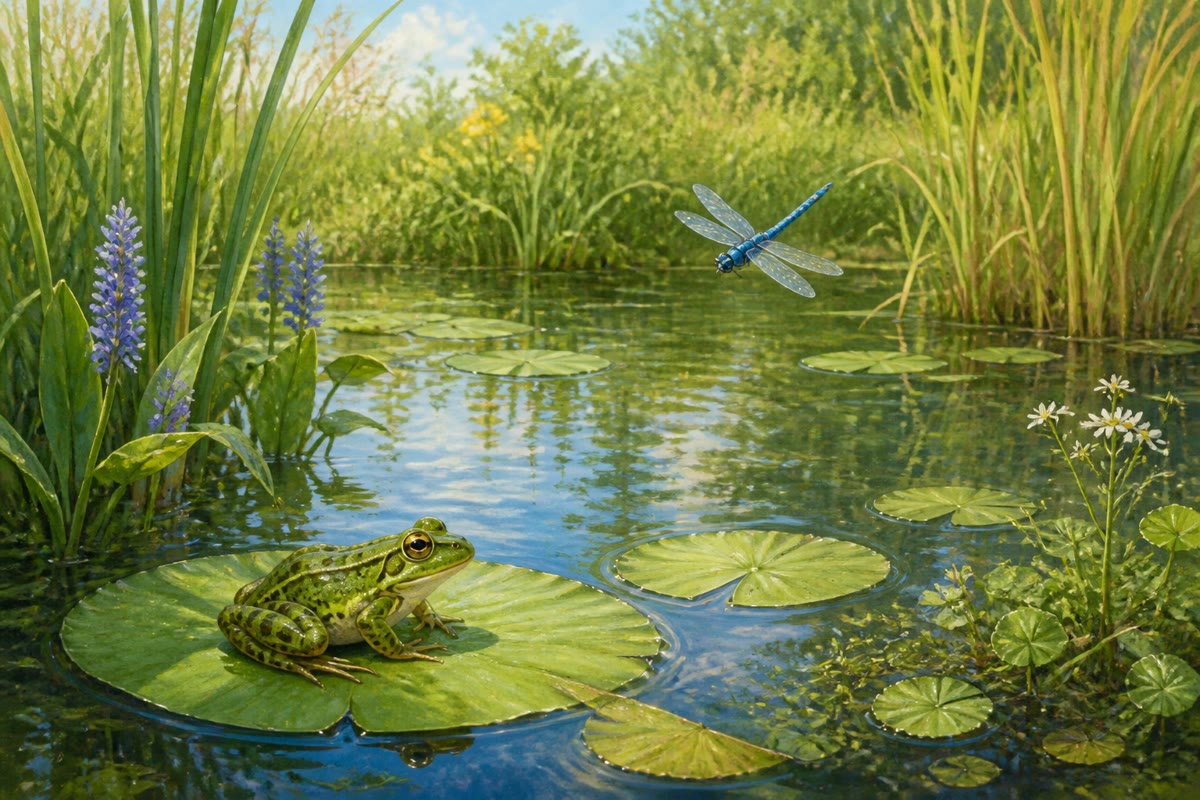
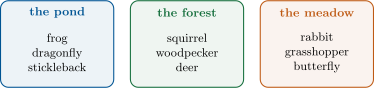
In the pond: frogs, dragonflies, sticklebacks, pond snails. In the forest: squirrels, deer, woodpeckers, wood ants. In the meadow: rabbits, grasshoppers, butterflies, field mice. Under the stones of an old wall: woodlice, spiders, sometimes a lizard sunning itself on top.
Remark 11.3 (One habitat, many homes)
A habitat has many corners. In the one forest, the woodpecker lives high on the trunks, the squirrel in the branches, the deer among the bushes, and the wood ants on the ground in their heaped nest. Same forest, different floors — so many animals can share one habitat without crowding.
11.2 Fitted to the habitat
Proposition 11.4 (Animals fit their habitat)
An animal’s body and habits fit the place it lives:
- the frog’s webbed feet push water — made for the pond;
- the squirrel’s gripping claws and big balancing tail are made for trees;
- the rabbit’s digging paws and long warning ears are made for open meadow with burrows below;
- the duck’s feathers shed water, and its webbed feet paddle.
Moved to the wrong habitat, an animal loses these advantages.
Proof. Admitted at this level. ∎
Example 11.5 (The mole’s equipment)
The mole lives underground, in tunnels it digs beneath the meadow. Its hands are wide digging shovels, its fur lies flat in both directions so soil never ruffles it, and its weak eyes hardly matter in the dark. Above ground it is clumsy; in its own habitat it is a champion.
Method 11.6 (Matching an animal to its habitat)
Given an unfamiliar animal:
- look at its equipment: webbed feet? claws? wings? digging paws?
- ask what it eats, and where that food is found;
- ask where it can shelter and raise young;
- the habitat that answers all three is its likely home.
11.3 Habitats can be lost
Proposition 11.7 (No habitat, no inhabitants)
An animal cannot live without its habitat. If a pond is filled in, its frogs and dragonflies disappear with it; if a hedge is torn out, the birds that nested there lose their shelter. Protecting animals starts with protecting the places they live.
Proof. Admitted at this level. ∎
Example 11.8 (The school pond)
A school digs a small pond in a corner of the yard. Within two years, dragonflies patrol it, pond skaters walk on it, and frogs have moved in — nobody brought them. Make the habitat, and the inhabitants find it.
Remark 11.9 (Looking without disturbing)
Visiting a habitat, we are guests. Watch quietly, turn stones back the way you found them, leave eggs and nests alone, and carry your litter home — the habitat should forget you were there. The next chapters give more ways to care for nature.
11.4 Exercises
Exercise 11.1 ★
What is a habitat? Name the four things an animal finds in it.
Solution
Solution of Exercise 11.1.
The kind of place where an animal naturally lives. It finds there its food, water, shelter, and a safe spot for its young.
Exercise 11.2 ★
Give two animals of the pond, two of the forest, and two of the meadow.
Solution
Solution of Exercise 11.2.
Pond: frog, dragonfly (or stickleback, pond snail). Forest: squirrel, woodpecker (or deer, wood ant). Meadow: rabbit, grasshopper (or butterfly, field mouse).
Exercise 11.3 ★
Which habitat fits each animal: the stickleback, the woodpecker, the grasshopper, the woodlouse?
Solution
Solution of Exercise 11.3.
Stickleback: the pond. Woodpecker: the forest. Grasshopper: the meadow. Woodlouse: under the stones of an old wall (damp hidden corners).
Exercise 11.4 ★
What is the frog’s swimming equipment? And the squirrel’s tree-climbing equipment?
Solution
Solution of Exercise 11.4.
The frog: webbed feet that push water. The squirrel: gripping claws and a big balancing tail.
Exercise 11.5 ★
List the mole’s three pieces of underground equipment from Example 11.5.
Exercise 11.6 ★
In Remark 11.3, which “floor” of the forest does each animal use: woodpecker, squirrel, deer, wood ant?
Solution
Solution of Exercise 11.6.
Woodpecker: high on the trunks. Squirrel: in the branches. Deer: among the bushes. Wood ant: on the ground, in its heaped nest.
Exercise 11.7 ★
What happens to the frogs and dragonflies when a pond is filled in? What does that teach about protecting animals?
Exercise 11.8 ★
Try it: choose one small habitat near you — under a stone, a bush, a flowerbed. Watch quietly and list every animal you see in a fixed time. Put each stone back. How many inhabitants did your little habitat have?
Solution
Solution of Exercise 11.8.
Open answer. Even a single turned stone often shelters woodlice, ants, a beetle, sometimes a centipede — small habitats are surprisingly full.
Exercise 11.9 ★★
A mystery animal has webbed feet, dense feathers that shed water, and a flat beak for sifting. Use Method 11.6 to name its habitat — and perhaps the animal.
Exercise 11.10 ★★
Tom wants to “help” a frog by taking it home to a dry terrarium with plenty of food. Using Proposition 11.4 and Proposition 11.7, explain why this would not help the frog at all.
Solution
Solution of Exercise 11.10.
The frog’s equipment — webbed feet, moist skin, a body made for water and damp banks — is useless in a dry box, and its habitat gave it more than food: water for its skin and its eggs, hiding places, other frogs. Kindness to a wild animal is leaving it in — or returning it to — its habitat.