Primary & Middle School Biology · Grades 1–9
20Animals Through the Seasons
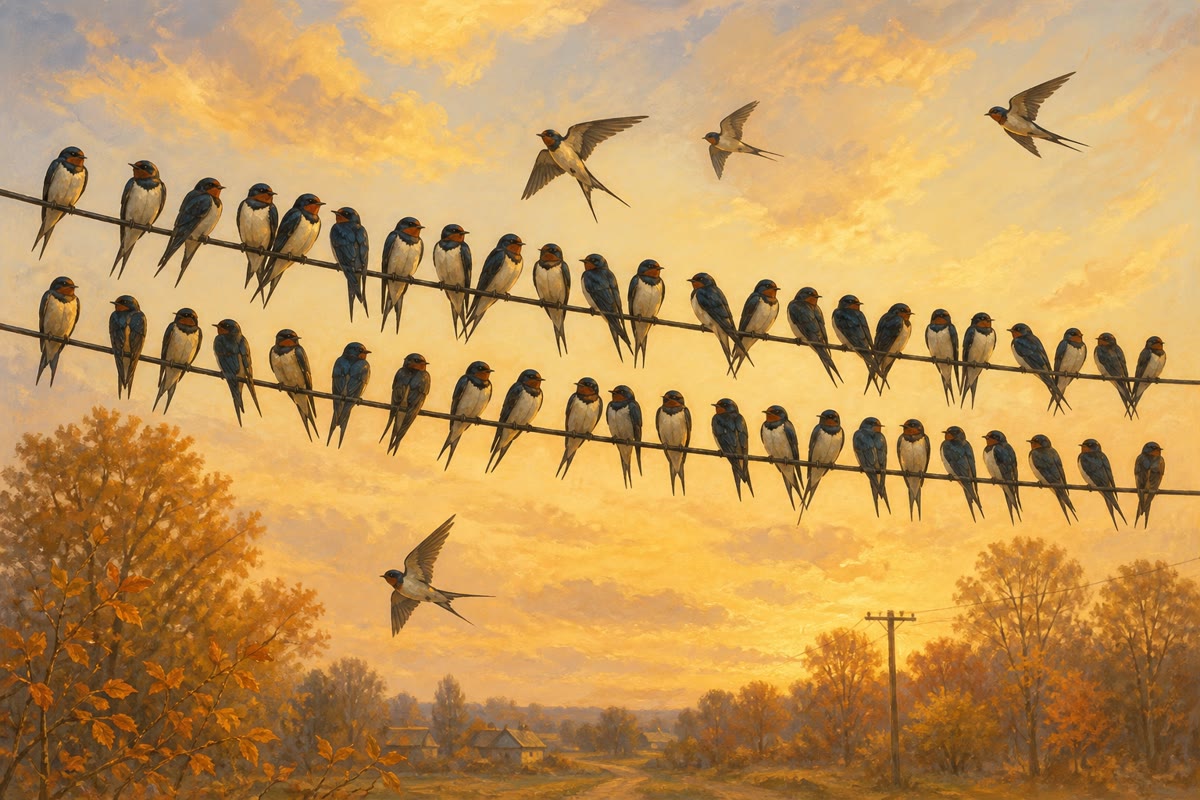
In October the swallows line up on the wires and, one morning, they are gone. The hedgehog under the hedge rolls itself into its leaf nest and will not be seen before spring. The fox, meanwhile, is out in every snow. Winter is a hard season — cold, and above all short of food — and animals have three great ways through it.
20.1 Winter, the season of scarcity
Proposition 20.1 (Winter’s double problem)
Winter brings animals two problems at once:
- cold, which drains body warmth faster — and keeping warm costs energy (Proposition 18.1);
- scarce food: plants stop growing, insects disappear, the first links of the food chains of Chapter 19 thin out — so the scarcity travels up to everyone.
More warmth needed, less food to pay for it: that is the winter problem every animal must solve.
Proof. Admitted at this level. ∎
Example 20.2 (Where did the insect-eaters’ food go?)
The swallow feeds on flying insects, caught on the wing. In November there are simply none: too cold. No change of menu can fix that for a bird built for aerial hunting — the swallow’s food supply vanishes completely.
20.2 Three answers to winter
Definition 20.3 (Migration)
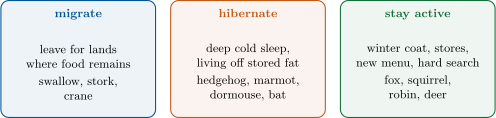
To migrate is to travel, each year, from one region to another as the seasons change — leaving before winter for warmer lands where food remains, and returning in spring. The swallow, the stork and the crane are migrators; some travel thousands of kilometres, and find their way back to the very same nest.
Definition 20.4 (Hibernation)
To hibernate is to spend the winter in a deep, cold sleep, hidden in a shelter: the body cools, heart and breathing slow to almost nothing, and the animal lives slowly off fat stored up in autumn. The hedgehog, the dormouse, the marmot and the bat hibernate.
Definition 20.5 (Staying active)
The rest stay active and change their equipment or their habits: a thicker winter coat, food stores gathered in autumn (the squirrel’s buried nuts), a switch of menu (Example 10.8’s blackbird), or simply harder searching — the fox, the deer, the robin.
Example 20.6 (Three neighbors, three strategies)
One hedgerow in January: the swallows that nested above it are in Africa, catching insects under a warm sun; the hedgehog below it sleeps cold and slow in its leaf nest, burning August’s fat; the robin on top of it, in its puffed-up winter plumage, patrols for the last berries. Come April, all three will be busy in the same hedge again.
Remark 20.7 (Sleep is not laziness, travel is not tourism)
Each strategy has its price. The migrator risks an exhausting journey; the hibernator must gather every gram of its winter fat in autumn — a hedgehog too thin in November will not wake in spring; the active animal gambles on finding food through the hungriest months. Winter is paid for in advance, or en route, or day by day.
Method 20.8 (Guessing an animal’s winter strategy)
- Ask what it eats, and whether that food exists here in winter;
- food completely gone (flying insects, nectar): expect migration or hibernation;
- food findable (seeds, berries, prey): expect an active winter, perhaps with a thicker coat or stores;
- check in autumn: fattening up and digging a nest points to hibernation; gathering in flocks points to departure.
Example 20.9 (Spring undoes it all)
In March and April the order reverses: insects return, the migrators reappear at their old nests, the hibernators wake thin and ravenous, winter coats are shed. The seasons turn, and the animals’ calendar turns with them — next autumn, the swallows will line up on the wires again.
20.3 Exercises
Exercise 20.1 ★
What double problem does winter set every animal?
Exercise 20.2 ★
Name the three winter strategies, with two animals for each.
Solution
Solution of Exercise 20.2.
Migrate: the swallow, the stork (or crane). Hibernate: the hedgehog, the marmot (or dormouse, bat). Stay active: the fox, the squirrel (or robin, deer).
Exercise 20.3 ★
What happens to a hibernating hedgehog’s body during its long sleep? What does it live on?
Solution
Solution of Exercise 20.3.
Its body cools, its heart and breathing slow to almost nothing, and it sleeps deeply in its shelter. It lives off the fat it stored up in autumn.
Exercise 20.4 ★
Why exactly must the swallow leave — what is its food, and what becomes of it here in winter?
Exercise 20.5 ★
Give three ways an active animal gets through winter, each with its animal.
Solution
Solution of Exercise 20.5.
A thicker winter coat (the fox, the deer); food stores gathered in autumn (the squirrel’s buried nuts); a changed menu (the blackbird switching from worms to berries); and harder searching (the robin patrolling for the last berries).
Exercise 20.6 ★
What is each strategy’s price, by Remark 20.7?
Solution
Solution of Exercise 20.6.
The migrator risks an exhausting journey; the hibernator must gather all its winter fat in autumn or not wake in spring; the active animal gambles on finding food through the hungriest months.
Exercise 20.7 ★
In autumn, an animal is seen eating hugely and lining a hole with dry leaves. Which strategy is it preparing? Which step of Method 20.8 told you?
Solution
Solution of Exercise 20.7.
Hibernation — eating hugely builds the winter fat, the leaf-lined hole is the winter nest. Step 4: the autumn check (fattening up and digging a nest points to hibernation).
Exercise 20.8 ★
Try it: keep a winter list of the birds you actually see outside during one cold week. Are the swallows on it? Which of your birds chose the active strategy?
Solution
Solution of Exercise 20.8.
Open answer. No swallows in winter — they are in Africa. The birds actually seen (robins, tits, blackbirds, sparrows, crows) are the active-strategy ones.
Exercise 20.9 ★★
Use Method 20.8 on: (a) the squirrel (eats nuts and seeds); (b) the crane (eats frogs and insects of wet meadows). What does each likely do in winter?
Exercise 20.10 ★★
A mild autumn keeps a young hedgehog awake and hunting late, but it stays thin. Why is this dangerous for it, by Remark 20.7? What do animal rescuers do with too-thin autumn hedgehogs?
Solution
Solution of Exercise 20.10.
A hibernator pays for winter in advance, with autumn fat; a thin hedgehog has nothing to burn through its months of cold sleep and will not wake. Rescuers take in too-thin autumn hedgehogs and feed them indoors until they weigh enough to hibernate safely — or keep them warm and fed through the winter.