Primary & Middle School Biology · Grades 1–9
16Flowers, Fruits and Seeds
In April the cherry tree is white with blossom; in June it hangs with cherries. Where did the flowers go — and where did the fruit come from? The answer is one of the prettiest transformations in the living world: the flower does not disappear, it becomes the fruit.
16.1 Looking inside a flower
Definition 16.1 (The parts of a flower)
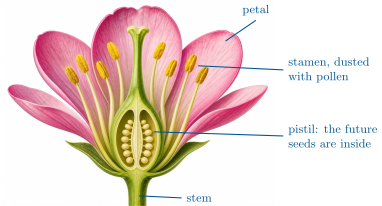
A flower is the part of the plant that will make the seeds. From the outside in:
Example 16.2 (Dissecting a tulip)
Open a wilting tulip gently, petal by petal. Inside stand the stamens — brush one on your finger and it leaves yellow pollen dust — and in the middle the fat green pistil. Slice the pistil across (a grown-up’s knife-work) and there they are: rows of tiny pale future seeds.
16.2 From flower to fruit
Proposition 16.3 (Pollination, then transformation)
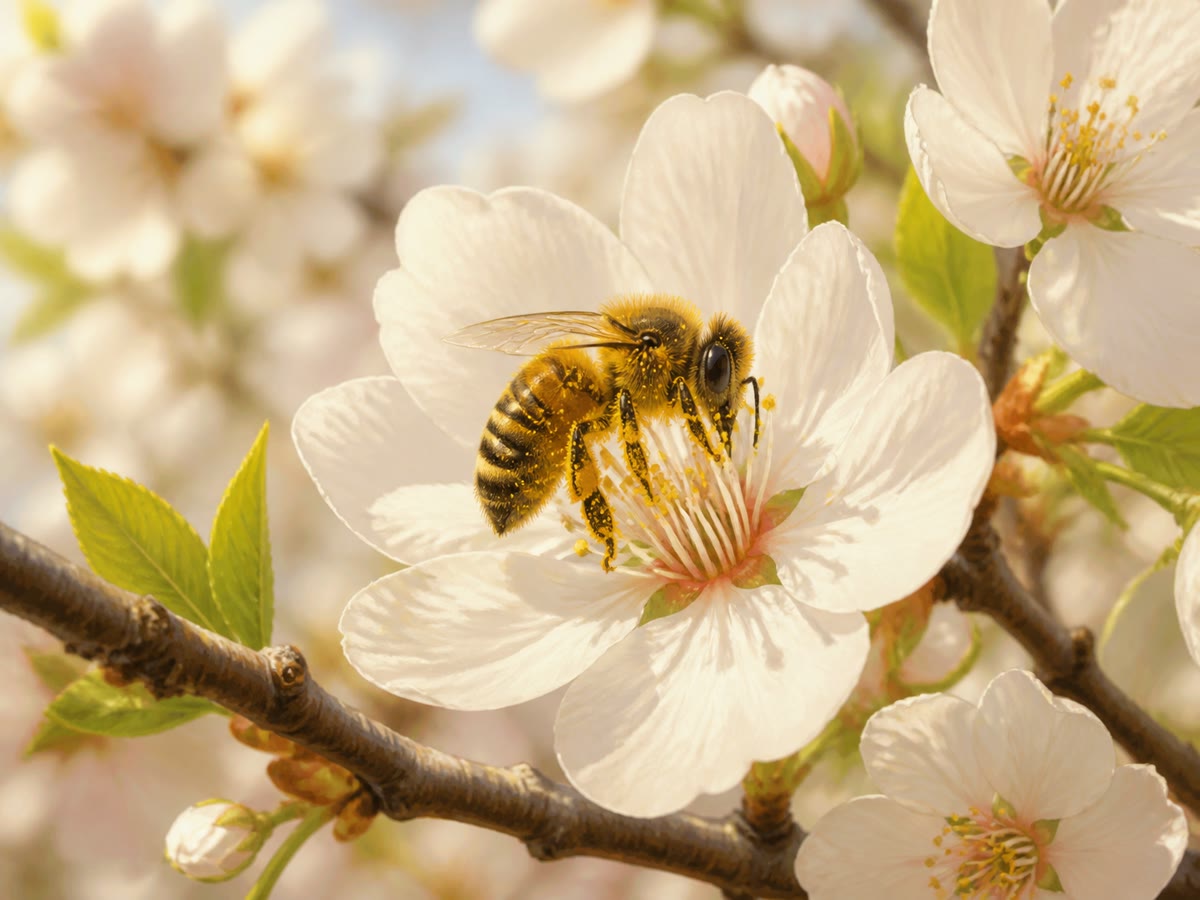
For the transformation to start, pollen must reach the pistil — that step is pollination. Bees and other insects do most of the carrying, dusted with pollen as they drink from flower after flower; the wind does some too. After pollination:
- the petals and stamens, their work done, wither and fall;
- the pistil swells and becomes the fruit;
- the future seeds inside it become the seeds.
A fruit is a transformed pistil, and every true fruit carries seeds.
Proof. Admitted at this level. ∎
Example 16.4 (Watching one cherry happen)
Follow a single cherry blossom. April: white petals, buzzing bees. May: petals snowing down; where each flower stood, a tiny green ball — the swelling pistil. June: the ball grown red and sweet — a cherry, with the stone (its seed) inside. The flower did not fall; only its petals did.
Remark 16.5 (No bees, no cherries)
Cherry growers welcome beekeepers’ hives into their orchards — without insect visits, most blossoms would stay unpollinated and fall without ever becoming fruit. The bee is not stealing from the flower; flower and bee feed each other: nectar for the bee, pollen delivery for the plant.
16.3 Fruit or not fruit?
Method 16.6 (The seed test)
To decide whether something from the greengrocer is a fruit in the biologist’s sense:
Example 16.7 (Surprises at the greengrocer’s)
The seed test springs surprises. Tomato: full of seeds — a fruit, whatever the salad bowl says. Cucumber and courgette: seeds — fruits. Green bean pod: seeds in a row — a fruit. Carrot: no seeds — a root (Exercise 3.10 guessed it). Lettuce: no seeds — leaves. Potato: no seeds — a swollen underground stem.
Remark 16.8 (Kitchen words, science words)
In the kitchen, “fruit” means sweet and “vegetable” means savory — useful for planning dessert, useless for biology. The biologist’s word follows the seed test. Both vocabularies are fine, as long as you know which one you are speaking.
16.4 Exercises
Exercise 16.1 ★
Name the parts of a flower from the outside in, with each part’s job.
Exercise 16.2 ★
What is pollen, and where is it found? What is pollination?
Exercise 16.3 ★
After pollination, what becomes of: (a) the petals? (b) the pistil? (c) the future seeds inside it?
Exercise 16.4 ★
Retell the story of one cherry, from white blossom to red fruit, in three dated steps.
Exercise 16.5 ★
Why do cherry growers welcome beehives in the orchard?
Exercise 16.6 ★
State the seed test, and apply it to the tomato and the carrot.
Exercise 16.7 ★
Fruit or not, by the seed test: the cucumber, the lettuce, the green bean pod, the potato?
Exercise 16.8 ★
Try it: at home, cut open three things from the kitchen and run the seed test on each. Which surprised you?
Exercise 16.9 ★★
A late frost kills all the blossom on the plum tree in April. What will the June harvest be, and why? Use Proposition 16.3.
Exercise 16.10 ★★
“The apple grows so that we have something nice to eat.” What is the apple really for, from the apple tree’s point of view? What lies at its core, and what could each one become? (Recall Chapter 9.)
Solution
Solution of Exercise 16.10.
For the tree, the apple is a way of making and protecting seeds. At its core lie the pips — seeds — and each pip, planted, could germinate into a new apple tree. That we find the packaging delicious is our luck (and, for the tree, a way of getting its seeds carried far from home).