Primary & Middle School Biology · Grades 1–9
45The Cell, Unit of Life
Chapter 29 ended with a promise: the little rooms are not empty. This year the school microscope comes back out — with better slides and sharper questions. What exactly is in a cell? Do plant and animal cells differ? And is a cell a part of life, or can one cell be a whole living thing? The smallest unit of biology deserves one thorough chapter.
45.1 Inside the cell
Definition 45.1 (The cell’s parts)
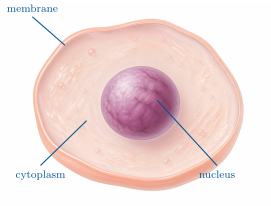
Seen properly, every cell shows the same basic equipment:
- the membrane, the cell’s thin outer envelope, which holds it together and controls what enters and leaves;
- the cytoplasm, the jelly filling where the cell’s work goes on;
- the nucleus (Remark 29.6’s dark spot), the command center that directs the cell’s life and its division.
Membrane, cytoplasm, nucleus: the three-part kit of nearly every cell in every plant, animal and fungus.
Proposition 45.2 (Plant cells carry extras)
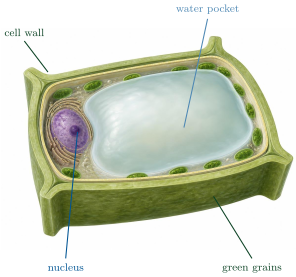
Plant cells add equipment of their own:
- a stiff cell wall outside the membrane — the walls that make onion skin’s brickwork (Example 29.5) and give plants their standing stiffness without bones;
- green grains of the light-catching substance in the cytoplasm — the producers’ workshops (Proposition 40.3), absent from every animal cell;
- often a large water-filled pocket whose pressure keeps the cell plump — wilting (Example 3.9) is these pockets going slack.
Proof. Admitted at this level. ∎
Example 45.3 (Telling the slides apart)
Back at the microscope with Example 29.5’s two slides, the differences now have names. Onion skin: straight walls meeting at corners — cell walls; a nucleus pushed to the side — the water pocket’s doing. Cheek cells: no walls, soft rounded outlines — membrane only — nucleus near the middle. One glance now reads plant or animal.
45.2 Whole lives in one cell
Definition 45.4 (Unicellular living things)
A unicellular living thing is a complete organism of exactly one cell (Remark 29.9). In one membrane it feeds, moves, senses and reproduces — by dividing in two (Proposition 29.7’s division, as a whole life story). The yeast of Example 43.5 is one; so are the swimmers of any pond drop, and most microbes of soil, yogurt and hands.
Example 45.5 (A drop of pond water, toured)
One drop from the aquarium’s green wall, under the lens: a slipper-shaped cell rowing past with beating hairs, faster than anything else in view; green single cells — swimming producers, catching light like any leaf; a blob that flows around its food and swallows it whole. Each is feeding, moving, avoiding — a complete animal-or-plant’s life, budgeted into one cell.
Remark 45.6 (One cell or many: two ways to be alive)
A unicellular organism does everything with one cell; your body does everything with tens of thousands of billions, specialized — cheek cells for lining, muscle cells that contract (Definition 17.6), nerve cells that carry Proposition 33.2’s messages. Many cells allow division of labor; one cell means every trade in one room. Both plans work: the unicellulars are the most numerous living things on Earth.
45.3 The cell theory
Proposition 45.7 (The cell theory)
Two sentences, centuries in the making, sum up this chapter and Chapter 29:
- every living thing is made of one or more cells, the smallest units of life;
- every cell comes from the division of an existing cell.
No exception has ever been found — not in the deepest sea, not in the oldest rock pool. The second sentence has a sweeping consequence: every cell alive today continues an unbroken chain of divisions reaching back to the earliest life — kinship (Proposition 44.4) written at the cell’s scale.
Proof. Admitted at this level. ∎
Method 45.8 (Reading any organism at cell scale)
Faced with any living thing:
- ask first: one cell, or many?
- if many: expect specialized kinds — lining, carrying, contracting, commanding;
- plant or animal? check for walls and green grains at the microscope;
- every growth, repair or reproduction you observe: translate it into divisions of cells — sentence 2 guarantees the translation exists.
Example 45.9 (The theory at work in this book)
Sentence 1 underwrote the unity of life (Proposition 29.2); sentence 2 underwrote growth-by-division (Example 29.8), the yeast doubling in the dough, decomposers multiplying in the warm heap, and the microbe workforces of Chapter 43. One small theory, carrying a large share of this year’s biology.
45.4 Exercises
Exercise 45.1 ★
Name the three-part kit of every cell, with each part’s job.
Exercise 45.2 ★
Exercise 45.3 ★
At the microscope, how do you tell an onion-skin cell from a cheek cell? Two visible differences.
Exercise 45.4 ★
What is a unicellular living thing? Name two from this chapter.
Exercise 45.5 ★
State the cell theory’s two sentences.
Solution
Solution of Exercise 45.5.
Every living thing is made of one or more cells, the smallest units of life; and every cell comes from the division of an existing cell.
Exercise 45.6 ★
How does a unicellular organism reproduce?
Exercise 45.7 ★★
Why do plants stand up without bones? Which two pieces of plant-cell equipment share the job — and what is wilting, at cell scale?
Solution
Solution of Exercise 45.7.
The stiff cell walls and the plump water pockets: millions of walled, pressurized cells brace one another like inflated brickwork. Wilting is the pockets going slack — pressure lost for lack of water, the whole structure sagging.
Exercise 45.8 ★★
Which cell part is the producers’ workshop of Proposition 40.3? Why must every animal cell lack it, by Proposition 41.1?
Exercise 45.9 ★★
Give three specialized cell kinds of your body and each one’s trade, from Remark 45.6.
Exercise 45.10 ★★
Translate into cell divisions, per Method 45.8: a healing scrape; dough doubling overnight; a growing tadpole.
Exercise 45.11 ★★
The pond drop’s green swimmers are single cells that catch light. Which trade of Definition 34.3 do they run, and what does that make them in the pond’s food web?
Solution
Solution of Exercise 45.11.
The producers’ trade: single-celled manufacture of organic matter from mineral supplies and light. In the pond web they are first links — the green floor the tadpoles and water fleas graze.
Exercise 45.12 ★★★
Take the cell theory’s second sentence seriously, as Remark 44.8 took the tree: what unbroken chain connects one of your cheek cells to the distant past? State the consequence in one sentence.
Solution
Solution of Exercise 45.12.
Each of your cells came from a division, whose parent cell came from a division, without one break — back through the fertilized egg cell, through your parents’ cells, and beyond into the deep past of life. Consequence in one sentence: every living cell, yours included, is the latest link of one unbroken chain of divisions as old as life itself.
45.5 Problem: The Microscopy Afternoon
Problem 45.1
Weekend problem — four slides, one theory
The class’s microscopy afternoon: four stations, four slides — onion skin (A), cheek scrape (B), a drop of pond water (C), a smear of yogurt (D). Each team tours all four and keeps drawings.
Part I — Stations A and B.
- At station A the team draws straight-walled “bricks”, each with a dark spot squeezed to one side. Name the wall, the spot, and the crowding culprit.
- At station B: rounded cells, no walls, spots central. List the equipment A’s cells have that B’s lack — and the kit both share.
- A teammate asks why the onion cells, from a bulb grown underground, show no green grains. Answer with the grains’ job and the bulb’s address.
- Whose cells are on slide B? State what that implies by cell theory sentence 2: where did each of those cells come from?
Part II — Stations C and D.
- Station C: the slipper-shaped rower, green swimmers, the flowing blob. For each, name the life activities visible in one minute’s watching — and conclude what each one is.
- The green swimmers are single cells yet producers. Which piece of equipment must the drawing show to prove it?
- Station D’s yogurt smear shows tiny paired and chained cells in vast numbers. Connect them to Example 43.6: what did these cells do to the milk, and what are they, in this chapter’s vocabulary?
- One team claims slide D shows “no living things, just specks”. What single observation — given patience or a warm slide — would settle whether the specks live, by cell theory sentence 2?
Part III — Writing up.
- The write-up must sort all four slides by: one cell or many? plant, animal or neither? Do it.
- Every drawing of the afternoon shows the same three-part kit. State the kit, and what its universality is evidence of (Proposition 29.2).
- The teacher closes: “everything you drew today was once one cell.” Defend the sentence for the onion, the cheek cells’ owner, and the yogurt chains.
- Formulate the afternoon’s finding as the cell theory — two sentences — and mark, for each slide, which sentence it illustrated best.
Solution
Solution of Problem 45.1.
1. The wall: the plant cell wall. The spot: the nucleus. The crowding culprit: the large water pocket, pressing the nucleus to the side.
2. A has the wall, the water pocket (and, in green parts, green grains) that B lacks. Both share the kit: membrane, cytoplasm, nucleus.
3. The grains are the light-catching workshops — and an underground bulb lives in the dark, where workshops would stand idle: the plant builds them in its lit leaves, not its buried storeroom.
4. The students’ own cells. By sentence 2, each came from the division of an existing cell — a chain of divisions reaching back to each student’s own fertilized egg cell.
5. The rower: moving, steering, feeding — a complete unicellular organism (an animal-like one). The green swimmers: moving and light-catching — unicellular producers. The blob: flowing, engulfing food — a unicellular hunter. Each shows a whole life’s activities in one cell.
6. The green grains — the light-catching equipment that runs the producers’ manufacture.
7. They fed on the milk’s sugar and released the acid that set it into yogurt: they are unicellular living things — the microbe workforce, seen in person at last.
8. Watch a speck divide: one becoming two, two becoming four — division is the signature sentence 2 demands of the living. (On a warm slide, yogurt microbes oblige within hours.)
9. A: many cells, plant. B: many cells (a sample of a many-celled animal), animal. C: single cells — animal-like (rower, blob) and plant-like (green swimmers) side by side. D: single cells, neither plant nor animal — microbes.
10. Membrane, cytoplasm, nucleus. Its universality across onion, cheek, pond and yogurt is evidence of the unity of life: one construction plan under all of it.
11. The onion grew from one cell of its parent plant’s making, by divisions; the student began as one fertilized egg cell; each yogurt chain began as one microbe dividing and dividing. Everything drawn traces to a single starting cell.
12. Sentence 1 — every living thing is made of cells: best shown by A and B (and the tour as a whole). Sentence 2 — every cell from a dividing cell: best shown by C and D, where division is a visible way of life.