Primary & Middle School Biology · Grades 1–9
48Oxygen in the Water
The mountain stream and the summer pond are both “water” — yet the trout that darts in one would gasp in the other, and the carp that thrives in the pond would find the stream bare of its food. The difference between the two waters is largely one invisible number: how much oxygen is dissolved in them. This chapter learns to read, measure and predict that number — and with it, the map of water life.
48.1 Dissolved oxygen, a scarce stock
Definition 48.1 (Dissolved oxygen)
Water holds oxygen the way sweet tea holds sugar — invisibly, dissolved. The quantity is tiny: a litre of well-aerated water carries about of oxygen, some thirty times less than a litre of air. Every gill and every underwater respirer of Chapter 47 draws on this one thin stock (Proposition 46.8).
Proposition 48.2 (What fills the stock)
Two suppliers replenish a water’s oxygen:
Proof. Admitted at this level. ∎
Proposition 48.3 (What drains it, and what it can hold)
The stock is drained by every respirer — animals, plants at night, and above all the decomposers when there is much dead matter to eat (Problem 46.1’s eighth jar). And the ceiling moves: cold water can hold notably more dissolved oxygen than warm — a stream at carries half as much again as a pond at . Warmth is a double squeeze: less oxygen held, while every engine note (Example 46.7) runs faster.
Proof. Admitted at this level. ∎
Example 48.4 (Stream against pond)
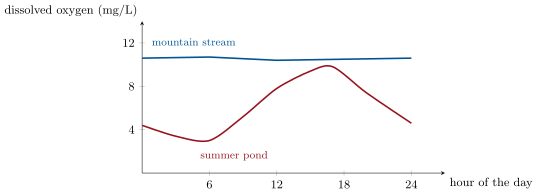
Now the two waters read like ledgers. The mountain stream: cold (high ceiling), churned white over every boulder (fast refilling) — oxygen near the ceiling all year. The summer pond: warm (low ceiling), still (slow refilling), rich in mud and dead matter (hungry decomposers) — oxygen scraping along the floor, worst in the small hours before dawn, when the plants have been respiring all night with no daylight manufacture to offset them.

Example 48.5 (Reading the pond’s curve)
The pond’s daily wave is Remark 40.5 drawn as data: sunrise starts the producers’ manufacture and the curve climbs; late afternoon peaks it; night leaves every respirer drawing on the stock with no supplier but the still surface — the curve slides to its dawn minimum. Fish kills in overgrown ponds happen at dawn, and now you know why.
48.2 The map of inhabitants
Proposition 48.6 (Oxygen draws the map)
Because species differ in their oxygen needs, the dissolved number maps the inhabitants (Proposition 37.6, under water):
- demanding species — trout, mayfly larvae with their waving gill tufts (Problem 47.1) — live only in cold, churned, oxygen-rich water;
- tolerant species — carp, many pond snails, rat-tailed larvae with snorkels to the surface — manage in warm, still, poorer water;
- so the census reads backward: find mayfly larvae under the stones and the water is good; find only snorkelers and air-gulpers, and it is poor.
River wardens census the small life for exactly this reason: the inhabitants are a record of the water’s worst recent days, which a single probe reading can miss.
Proof. Admitted at this level. ∎
Example 48.7 (The organic-waste story)
A village’s untreated waste — rich organic matter — reaches a clear stream. Downstream of the pipe, the decomposers feast and multiply (Definition 42.3), and their massed respiration drains the oxygen: the trout and mayfly larvae vanish, the tolerant snorkelers take over, and further downstream still — the waste consumed, the water re-aerated over riffles — the demanding species return. The pollution was organic matter; the killer was oxygen hunger; the map recorded it all.
Method 48.8 (Judging a water)
To judge a stream or pond:
- measure or estimate the suppliers: temperature, stirring, green growth;
- weigh the drains: mud and dead matter, crowding, any organic waste inflow;
- census the small life under stones and among weeds — demanding species present, or tolerant only?
- if sampling at one hour, remember the pond curve: a fine afternoon reading can hide a lethal dawn.
48.3 Exercises
Exercise 48.1 ★
Roughly how much oxygen does a litre of well-aerated water hold, and how does that compare with air?
Solution
Solution of Exercise 48.1.
About per litre — roughly thirty times less than a litre of air carries.
Exercise 48.2 ★
Name the two suppliers of a water’s oxygen, and the condition under which each supplies fastest.
Exercise 48.3 ★
Name three drains on the stock. Which one grows huge when dead matter is plentiful?
Solution
Solution of Exercise 48.3.
The animals’ respiration, the plants’ own respiration at night, and the decomposers’ — which grows huge when dead matter is plentiful.
Exercise 48.4 ★
State warmth’s double squeeze on water-breathers.
Solution
Solution of Exercise 48.4.
Warm water holds less dissolved oxygen (the ceiling drops) while every respirer’s engine runs faster (the demand rises): less supply, more need, at once.
Exercise 48.5 ★
Why does the pond’s oxygen curve peak in late afternoon and bottom out at dawn?
Solution
Solution of Exercise 48.5.
By day the producers’ manufacture adds oxygen faster than respiration drains it — the curve climbs to a late afternoon peak. All night every respirer draws on the stock with no manufacture at all — the curve slides to its lowest just before sunrise.
Exercise 48.6 ★
Which two census finds mark an oxygen-rich water, and which mark a poor one?
Solution
Solution of Exercise 48.6.
Rich: trout (or trout fry) and mayfly larvae under the stones. Poor: only tolerant species — carp, pond snails, and snorkel-bearing larvae that fetch air from the surface.
Exercise 48.7 ★★
Explain the fish-kill-at-dawn of Example 48.5 to a pond owner — and propose one remedy from each supplier of Proposition 48.2.
Solution
Solution of Exercise 48.7.
The night’s respiration — fish, plants and mud decomposers together — drains the pond to its minimum just before sunrise, so overloaded ponds suffocate their fish at dawn. Remedies: from supplier 1, stir the surface — run a fountain or cascade through the night; from supplier 2, thin the overgrowth and mud so night respiration shrinks (and daylight production reaches the water, not just the surface mat).
Exercise 48.8 ★★
Retell Example 48.7 as a chain: waste in, then what, then what — and why does the stream heal downstream?
Solution
Solution of Exercise 48.8.
Waste in — the decomposers feast and multiply — their massed respiration drains the oxygen — the demanding species vanish and the tolerant take over. Downstream the waste is finally consumed, the riffles re-aerate the water, and the demanding species return: the drain closed, the suppliers caught up.
Exercise 48.9 ★★
Why do river wardens trust the small-life census over a single probe reading? Use the idea of “the worst recent days”.
Solution
Solution of Exercise 48.9.
A probe records one instant; the inhabitants record history. A demanding species lives at a station only if the water has stayed good through its whole residence — including the dawns and the bad weeks no single visit catches. The census is a season’s minimum, written in animals.
Exercise 48.10 ★★
A garden pond turns pea-soup green, then suffers a still, hot week. Trace the danger with both propositions — and say when the owner should run the fountain hardest.
Solution
Solution of Exercise 48.10.
The pea-soup green is a huge population of green single cells: by day they produce, but every warm night the whole soup respires — and the hot still week lowers the ceiling and stops the surface refilling. The dawn minimum heads for zero: fish kill weather. Run the fountain hardest through the night and small hours — daylight can look after itself.
Exercise 48.11 ★★
Trout farms are built on cold rivers with weirs and splashing raceways, never on warm still lakes. Justify every clause of the sentence.
Exercise 48.12 ★★★
“In water, oxygen is the currency; temperature sets the money supply; decomposers are the biggest spenders.” Translate each clause into this chapter’s plain claims, citing one proposition or example for each.
Solution
Solution of Exercise 48.12.
Currency: every underwater respirer draws on the one dissolved stock — who thrives where is priced in oxygen (Proposition 48.6). Money supply: temperature sets how much the water can hold — cold raises the ceiling, warmth lowers it (Proposition 48.3). Biggest spenders: given dead matter, the decomposers’ massed respiration outdrains everyone — the creamery pipe’s lesson (Example 48.7).
48.4 Problem: The Warden’s Yearbook
Problem 48.1
Weekend problem — one river, four stations, a year of readings
A river warden keeps a yearbook for four stations: K1, a cold rapid below a weir; K2, a slow warm reach through pastures; K3, just below a creamery’s waste pipe; K4, two kilometres further down, past a long stony riffle. Each station gets probe readings and a small-life census.
Part I — Reading the stations.
- K1 reads at ; K2 reads at . Attribute the difference to the right suppliers and ceilings.
- K1’s census: trout fry, mayfly larvae. K2’s: carp, pond snails, rat-tailed larvae. Interpret both with Proposition 48.6.
- K3 reads though the water is no warmer than K2. Name the drain, and the workers behind it.
- K4 reads and its census again shows mayfly larvae. Explain the recovery with both suppliers and the waste’s fate.
Part II — The year’s rhythms.
- K2’s dawn readings in August dip to while its afternoon readings reach . Draw or describe its daily curve, and name the two processes trading places.
- January’s readings at K2 are steadier and higher than August’s, though the pasture reach is as still as ever. Give the two winter reasons.
- A hot, windless fortnight is forecast. Rank the four stations by fish-kill risk, with one reason each.
- The warden times her August probe visits for just before sunrise. Defend the schedule.
Part III — Verdicts and remedies.
- The creamery installs treatment that removes most organic matter from its outflow. Predict K3’s probe and census a year later, in order of recovery.
- A landowner proposes felling K2’s bankside trees “to let more light make more oxygen”. Weigh the proposal: what does the shade also do, by Proposition 48.3, and what would you answer?
- The census finds mayfly larvae at a station whose single afternoon probe reading looks mediocre. Which witness do you believe about the season as a whole, and why?
- Close the yearbook with the warden’s one-sentence rule for the whole river, using cold, stirred and unloaded (of organic waste).
Solution
Solution of Problem 48.1.
1. K1 is cold — high ceiling — and churned by the weir — surface refilling at full speed: near-ceiling readings. K2 is warm — lowered ceiling — and unstirred: a modest reading is all its suppliers can hold.
2. K1’s demanding species certify rich, steady oxygen; K2’s tolerant cast — carp, snails, snorkelers — marks a water that runs poor, at least in its bad hours.
3. The decomposers’ respiration: the creamery’s organic-rich outflow feeds a massed population of them, and their feasting drains the stock far below what temperature alone would explain.
4. Two kilometres of consumption have used up the waste — the feast is over and the spenders have thinned — while the stony riffle has stirred oxygen back in: both suppliers restored, the drain closed, and the census certifies the recovery.
5. A daily wave: dawn trough at , afternoon crest at . The traders: daylight manufacture (adding by day) and round-the-clock respiration (draining alone all night).
6. Winter cold raises the ceiling, so the water holds more; and cold slows every respirer — fish, plants, mud decomposers — so the drains shrink. Steadier, too, because the producers’ daily wave is smaller.
7. K3 first (already drained, and heat speeds its decomposers); K2 second (low ceiling, still water, dawn troughs); K4 third (recovering but downstream of trouble); K1 last (cold and churned — the weir keeps refilling whatever the weather).
8. Before sunrise is the daily minimum: readings then record the worst the river’s life must survive. An afternoon schedule would file the year under its best moments.
9. The probe recovers within weeks — the drain closes as the food for decomposers stops. The census recovers more slowly and in order: first the tolerant cast thins, then drifting and flying colonists (Chapter 39’s logic, animal version) re-seed the demanding species — mayfly larvae first from upstream, trout last.
10. The shade also keeps the reach cool — and cold is the ceiling. Felling would add daylight production but lower the ceiling and speed every drain in the warmed water; on a slow reach the loss likely outweighs the gain. Answer: keep the trees, stir the water instead.
11. The census: mayfly larvae cannot fake a good season — they lived every dawn of it. The mediocre afternoon reading is one instant, perhaps an off day; the larvae are the season’s sworn record.
12. “Keep the river cold, stirred and unloaded, and the oxygen — and everything that breathes it — looks after itself.”