Primary & Middle School Biology · Grades 1–9
8How Animals Grow Up
A kitten looks like a small cat from its very first day. But the frog in the pond began as a fish-shaped tadpole with no legs, and the butterfly on the buddleia spent weeks as a crawling caterpillar. Young animals do not all resemble their parents — some must transform completely on the way to adulthood.
8.1 From the egg or born alive
Definition 8.1 (Two ways to be born)
Young animals come into the world in two ways:
- most hatch from an egg laid by the mother: birds, fish, frogs, snails, insects;
- others are born alive, coming out of the mother’s body already formed, and drink her milk: cats, dogs, cows, rabbits — and humans.
Example 8.2 (In the henhouse and in the basket)
The hen lays eggs and sits on them to keep them warm; after three weeks, chicks break the shell and hatch. In the basket by the stove, the cat’s kittens were born alive the same night, and they found her milk within the hour.
Remark 8.3 (An egg is not a stone)
Inside a sat-on egg, a chick is quietly being built, fed by the yellow yolk. The egg is not waiting — it is working. That is why the hen keeps her eggs warm, and why an egg from the fridge, which was never going to hatch anyway, must not be blamed on the cold.
8.2 Growing without transforming
Definition 8.4 (Growing like the parents)
Many young animals are miniatures of their parents: the kitten is a small cat, the foal a small horse, the chick a small hen. Growing up, for them, means getting bigger and stronger — the body’s shape stays the same.
Example 8.5 (Kitten to cat)
The newborn kitten drinks milk with closed eyes. At one month it plays and pounces; at six months it hunts like a grown cat; at one year it is an adult, perhaps with kittens of its own. Small cat, bigger cat, cat: the same shape all along the way.
8.3 Growing by transforming
Definition 8.6 (Metamorphosis)
Some young animals look nothing like their parents, and must change their whole body shape to become adults. That great change is called metamorphosis. The tadpole becomes a frog; the caterpillar becomes a butterfly.
Example 8.7 (The frog’s road)
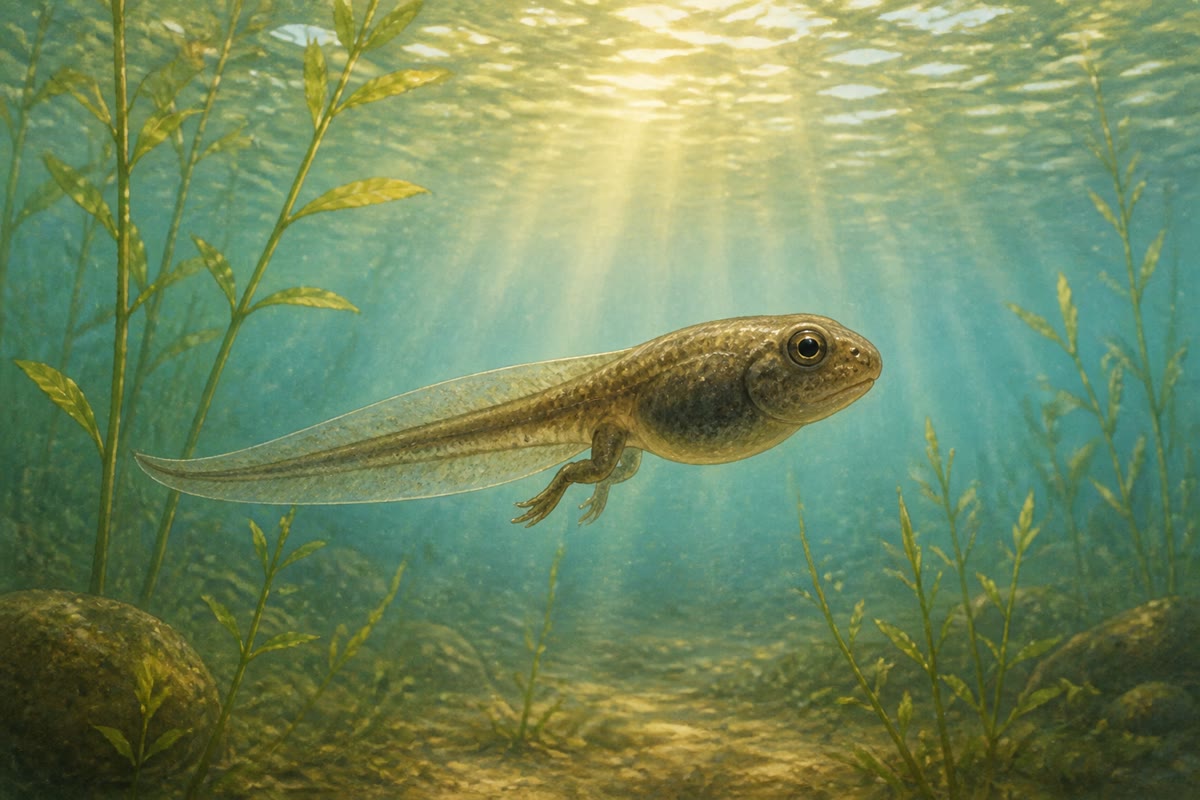
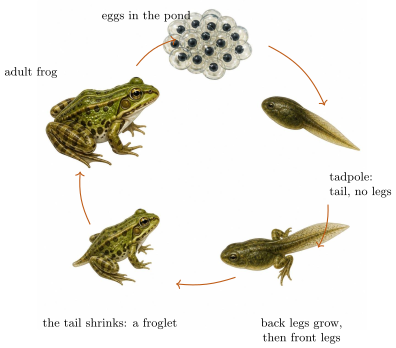
From the frog’s eggs in the pond hatch tadpoles: round-headed, long-tailed, legless, breathing in water like fish. Then, week by week: back legs appear, then front legs; the tail shrinks away; and one day a small frog climbs out onto the bank. Same animal — rebuilt.
Example 8.8 (The butterfly’s road)
From the butterfly’s egg hatches a caterpillar, which does little but eat leaves and grow. One day it wraps itself in a case, the chrysalis, and stops moving. Inside, the body is rebuilt; after some weeks the case splits, and out climbs a butterfly, unfolding wet new wings. Egg, caterpillar, chrysalis, butterfly: four stages of one and the same animal.
Method 8.9 (Reading an animal’s life cycle)
For any animal you meet:
- ask how it is born: from an egg, or born alive?
- ask what the young looks like: a miniature of its parents, or a different shape?
- if it is a different shape, it will transform: look for the stages of its metamorphosis;
- draw the cycle as a wheel, with an arrow from the adult back to the eggs.
Remark 8.10 (Milk, or straight to work)
Kittens are fed and washed by their mother for weeks; a newly hatched tadpole gets no help at all and must feed itself from the first day. Some young animals are cared for, others start life alone — both roads lead to adulthood.
8.4 Exercises
Exercise 8.1 ★
Give the two ways young animals come into the world, with one example of each.
Solution
Solution of Exercise 8.1.
From an egg laid by the mother (a chick, a frog, a snail), or born alive from the mother’s body and drinking her milk (a kitten, a calf, a human baby).
Exercise 8.2 ★
From an egg, or born alive: (a) a chick; (b) a kitten; (c) a frog; (d) a rabbit; (e) a snail?
Solution
Solution of Exercise 8.2.
(a) From an egg. (b) Born alive. (c) From an egg. (d) Born alive. (e) From an egg.
Exercise 8.3 ★
What does a kitten drink first? Which animals of this chapter drink the same at birth?
Solution
Solution of Exercise 8.3.
Its mother’s milk. All the animals born alive in this chapter — puppies, calves, baby rabbits, human babies — begin on milk too.
Exercise 8.4 ★
What is metamorphosis? Name the two famous examples of this chapter.
Solution
Solution of Exercise 8.4.
Metamorphosis is the great change of body shape some young animals go through to become adults. The tadpole becoming a frog, and the caterpillar becoming a butterfly.
Exercise 8.5 ★
Put the frog’s stages in order: frog — eggs — tadpole with legs — tadpole.
Exercise 8.6 ★
Put the butterfly’s stages in order: butterfly — caterpillar — egg — chrysalis. At which stage does the animal eat leaves and grow the most?
Solution
Solution of Exercise 8.6.
Egg, caterpillar, chrysalis, butterfly. It is the caterpillar that eats leaves and does nearly all the growing.
Exercise 8.7 ★
Which young animal is a miniature of its parents: the tadpole, or the foal? What does growing up mean for that one?
Solution
Solution of Exercise 8.7.
The foal — a small horse from its first day. For it, growing up means getting bigger and stronger while keeping the same shape.
Exercise 8.8 ★
Why does the hen sit on her eggs? What is happening inside them, by Remark 8.3?
Exercise 8.9 ★★
In the pond, Zoe finds a small animal with a round head, a long tail, two back legs and no front legs. Using the frog cycle figure, say exactly where it is on its road, what it was before, and what comes next.
Solution
Solution of Exercise 8.9.
It is a tadpole partway through metamorphosis: the back legs have grown, the front legs have not yet appeared. Before, it was a legless tadpole (and before that, an egg); next, front legs will appear, the tail will shrink, and it will become a small frog.
Exercise 8.10 ★★
“The caterpillar died in its case, and a butterfly moved in.” What really happened inside the chrysalis? Answer with Definition 8.6 and Example 8.8.
Solution
Solution of Exercise 8.10.
Nothing moved in — the caterpillar and the butterfly are the same animal. Inside the chrysalis the caterpillar’s body was rebuilt into a butterfly’s: that rebuilding is what metamorphosis means.