Primary & Middle School Biology · Grades 1–9
68How Species Change
The evidence hall established the fact; this chapter builds the engine. Its parts are all in your hands already: mutation writing new spellings (Proposition 65.6), the shuffle dealing unique decks (Proposition 66.1), the environment’s checks collecting most of every generation’s surplus (Proposition 55.6). Assembled, they run themselves — that self-running is natural selection, and it is the most consequential simple idea in biology.
68.1 The engine, assembled
Proposition 68.1 (Natural selection)
Three facts, none deniable, and their consequence:
- variety: a population’s individuals differ in inherited traits (Proposition 66.6 banked it);
- over-production and checks: far more young are produced than the environment lets survive — the checks collect the surplus (Example 55.7);
- unequal collection: the checks do not collect at random — individuals whose inherited traits suit the current conditions escape them a little more often, and so leave more offspring, who inherit those traits.
Consequence: generation after generation, the suited alleles’ share of the population grows. That drift of a population’s inherited makeup, driven by nothing but variety meeting checks, is natural selection — and enough time makes it evolution.
Proof. Admitted at this level. ∎
Example 68.2 (The moths, mechanized)
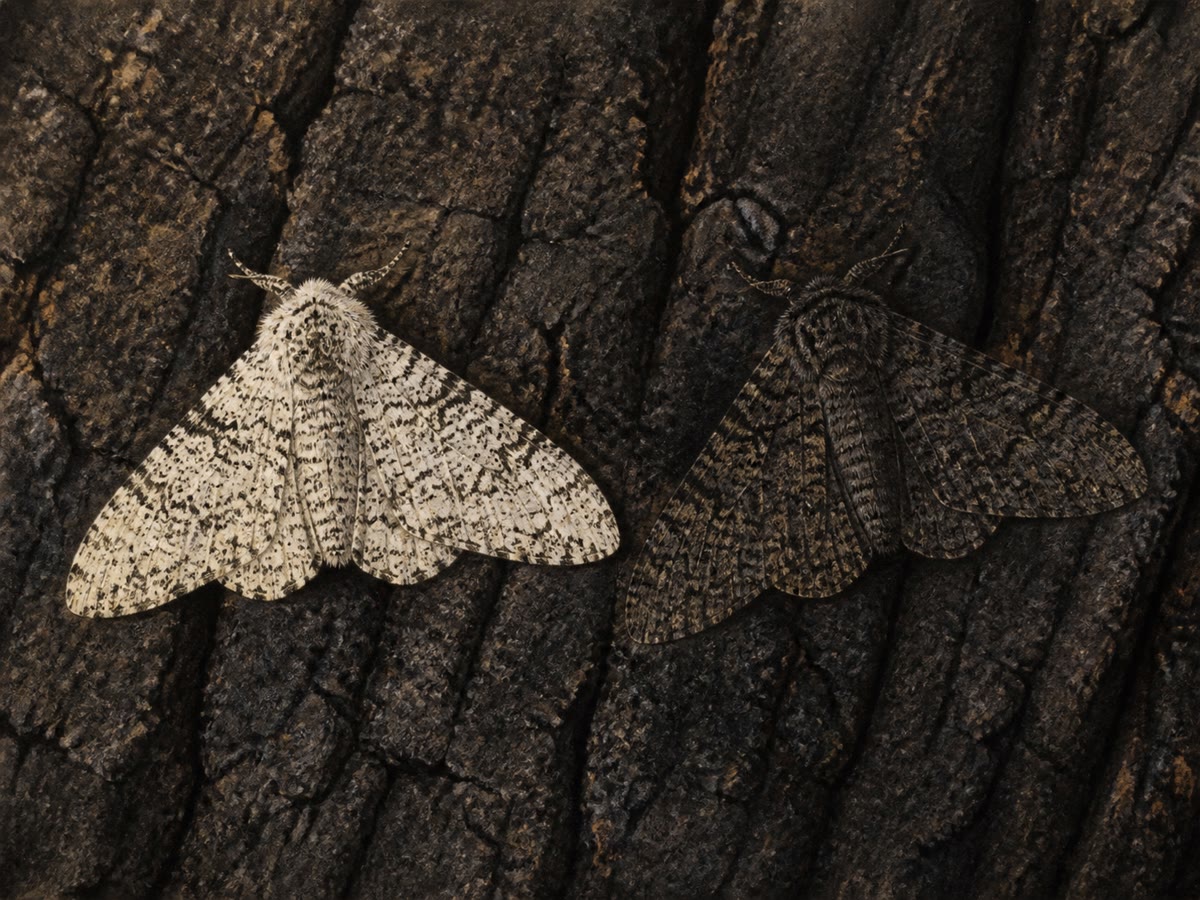
Example 67.6’s peppered moths, part by part. Variety: pale and dark inherited forms. Checks: birds hunt moths by sight against bark. Unequal collection: on soot-blackened trunks the pale form is the visible one — eaten more, so the dark allele’s share climbs toward the observed dark woods; the air clears, the bark pales, and the same engine runs in reverse. No moth changed; the population’s makeup did — selection edits the deck’s frequencies, not the individuals.
Remark 68.3 (What selection is not)
Three standing confusions, retired:
- no intention: conditions select the way dampness “selected” woodlice (Example 37.7) — by consequences, not choices; nothing plans;
- no perfection: selection only compares the variants present — it finds the better available, not the best imaginable (the shared limb plan’s awkward re-jobbing, Exercise 67.7, is its signature);
- no inheritance of effort: the blacksmith’s arm dies with the blacksmith (Proposition 63.4); selection works only on what gametes carry. Giraffes did not stretch their necks long — longer-necked variants out-fed and out-bred the shorter.
68.2 The engine observed and exploited
Example 68.4 (Selection in the hospital)
The medical case, mechanized for Chapter 69’s use: a microbe population holds rare resistant mutants (mutation’s trickle); an antibiotic is the check; it collects the susceptible and spares the resistant, who inherit the ward. Days, not millennia — generations turn in hours, and selection’s speed scales with them. Every rule about finishing antibiotic courses and not scattering antibiotics into farming is engine management: weaken the check raggedly, and you breed what you meant to kill.
Example 68.5 (Selection with a human hand on the check)
Problem 54.1’s breeder ran the same engine with herself as the check — keeping the crisp and resistant, culling the rest. Every dog breed, every crop variety, every dairy line is accumulated artificial selection: proof of the engine’s power on a human timescale, wolf to lapdog inside some thousands of generations. Darwin — the naturalist who assembled this chapter’s argument — opened his great book with exactly that comparison.
Proposition 68.6 (From change to new species)
Selection explains a population changing; one more ingredient explains populations splitting. Separate two populations of one species — a sea rises, a range divides, an island receives castaways (Exercise 39.11) — and each runs the engine under its own conditions, accumulating its own alleles. Given enough divergence, the two no longer interbreed where they meet: by Definition 30.1’s own definition, two species stand where one stood. The tree’s forks (Definition 44.6) are exactly such splits, deep time’s worth of them.
Proof. Admitted at this level. ∎
Method 68.7 (Running the engine on any case)
For any claimed example of evolution:
- name the variety and check it is inherited (Method 63.8);
- name the check, and how it collects unequally across that variety;
- follow the bookkeeping: whose alleles gain share in the next generation?
- for a split, add the separation and the diverging conditions;
- timescale check: generations, not years, are the engine’s ticks.
68.3 Exercises
Exercise 68.1 ★
State natural selection’s three facts and their consequence.
Solution
Solution of Exercise 68.1.
Variety of inherited traits; over-production met by the environment’s checks; unequal collection — the suited escape a little oftener and leave more heirs. Consequence: the suited alleles’ share grows generation by generation — natural selection, and with time, evolution.
Exercise 68.2 ★
In the moth case, name variety, check, and the unequal collection — in both directions.
Solution
Solution of Exercise 68.2.
Variety: inherited pale and dark forms. Check: sighted bird predation against bark. Unequal collection: on sooty trunks the pale are seen and eaten — dark’s share climbs; on clean pale bark the dark are seen — pale’s share recovers. One engine, either direction.
Exercise 68.3 ★
What changes under selection — the individuals, or the population? Explain.
Solution
Solution of Exercise 68.3.
The population: no individual moth darkens. Selection shifts the frequencies of inherited forms across generations — individuals are dealt and spent; the deck’s composition is what drifts.
Exercise 68.4 ★
Correct, mechanism in hand: “giraffes stretched their necks and passed the stretch on.”
Solution
Solution of Exercise 68.4.
Effort is not inherited — a stretched neck is the blacksmith’s arm. The mechanism: necks varied heritably; longer-necked variants fed higher, survived the lean checks oftener and left more heirs carrying the longer-neck alleles — the population’s necks lengthened, no giraffe’s did.
Exercise 68.5 ★
Why does antibiotic resistance evolve in days where moths took decades?
Solution
Solution of Exercise 68.5.
The engine ticks in generations, and microbe generations turn in hours: days hold thousands of ticks. Add a savage check (the antibiotic) and rare resistant mutants inherit the ward within the week.
Exercise 68.6 ★
What did the apple breeder and the moth’s birds have in common, and what differed?
Solution
Solution of Exercise 68.6.
Both were the unequal check on an inherited variety — deciding who breeds. The difference: the breeder chose on purpose toward a goal; the birds chose nothing — their hunting’s consequences did the selecting.
Exercise 68.7 ★★
Why can selection not produce “the best imaginable” organism? Which of its three facts limits it?
Solution
Solution of Exercise 68.7.
Fact 1: it can only compare the variants present. Selection is a sieve over the current deck — it cannot summon the unmutated, unshuffled better design, only promote the best on hand; hence re-jobbed limb plans, not fresh engineering.
Exercise 68.8 ★★
Run Method 68.7 on the finches’ drought (Example 67.6): seeds harden, big beaks crack what small ones cannot.
Solution
Solution of Exercise 68.8.
Variety: beak depth, heritable (ringers’ pedigrees show it). Check: the drought’s hard seeds — small beaks cannot crack the remaining food. Bookkeeping: deep-beaked birds feed, survive, breed; next season’s hatchlings average deeper — the deep alleles gained share. No split: one population, one tick, measured.
Exercise 68.9 ★★
Assemble speciation for the island castaways of Exercise 39.11: separation, divergence, and the test that would declare two species.
Solution
Solution of Exercise 68.9.
Separation: the sea — castaways breed alone. Divergence: each island’s conditions run the engine its own way, accumulating its own alleles, generation on generation. The test: reunited birds failing to interbreed — by the species definition, the fork is complete.
Exercise 68.10 ★★
Explain, engine in hand, why unfinished antibiotic courses and farm-scattered antibiotics both breed resistance.
Solution
Solution of Exercise 68.10.
Both apply the check raggedly. The unfinished course kills the susceptible and releases the survivors — enriched for resistance — mid-selection; farm-scattered doses run the same partial sieve across vast microbe populations daily. A check that culls without finishing is a breeding program for what it spares.
Exercise 68.11 ★★
“Selection is the checks of Chapter 55, falling on the variety of Chapter 66.” Justify the sentence as the book’s own summary.
Solution
Solution of Exercise 68.11.
The checks chapter established that most of every generation’s surplus is collected — predation, hunger, conditions; the uniqueness chapter established that the collected differ heritably, deck by deck. Selection is nothing added: it is the observation that those checks, falling on that variety, cannot fall equally — the two chapters multiplied together.
Exercise 68.12 ★★★
Why does the engine need sexual reproduction’s shuffle and mutation’s trickle — what happens to selection in a population of perfect clones (Exercise 66.8) once conditions turn?
Solution
Solution of Exercise 68.12.
Selection spends variety; the shuffle and mutation restock it. A clone population offers the sieve one deck: when conditions turn, selection has nothing to promote — the vineyard stands or falls as one plant. Without the trickle of new spellings and the deal of new combinations, the engine seizes: variation is not a by-product of the mechanism, it is the fuel.
68.4 Problem: The Island Notebooks
Problem 68.1
Weekend problem — two centuries on a volcanic archipelago
A (composite, historically inspired) archipelago: volcanic islands, never joined to the mainland, hosting finch-like birds whose beak forms differ island to island — and differ from their one evident mainland kin. Naturalists’ notebooks span two centuries.
Part I — The pattern.
- The islands hold only species that could cross the sea — birds, drift-seeds, one bat, no native land mammals or frogs. Which chapter predicted the passenger list (Exercise 39.11)?
- All the archipelago’s finches resemble the one mainland species more than any other bird on Earth. What does kinship reasoning (Proposition 44.4) conclude about their origin?
- Beaks differ by island’s diet: seed-crackers on seed islands, probers on cactus islands. Read the match with Proposition 28.4 — then say what this chapter adds that the adaptation chapter could not.
- Why are volcanic, never-joined islands the engine’s showcase? Name the speciation ingredient they supply wholesale.
Part II — The engine’s notebook years.
- A drought year: soft seeds fail, hard seeds remain; the ringers’ calipers show next year’s hatchlings averaging deeper beaks. Run the engine’s bookkeeping through that sentence.
- Wet years follow, soft seeds return, and the average drifts back. What does the reversal prove about selection’s “direction”?
- One island’s finches, transplanted by storm to another, breed poorly with the residents. Which proposition is being watched mid-run?
- A creationist-era notebook objects: “no one has seen one species become another.” Answer with timescale and the convergent-witness method (Method 67.7).
Part III — The synthesis lecture.
- Deliver the archipelago’s story in the engine’s five steps (Method 68.7), castaway arrival to island species.
- Explain why every island’s finch is “the better available, not the best imaginable” — what could each island’s deck offer selection?
- Connect the archipelago to the hospital ward of Example 68.4: same engine, different tick rate — state what sets the rate.
- Close the lecture with Darwin’s comparison made explicit: what the pigeon-fancier’s hand and the drought’s hard seeds have in common.
Solution
Solution of Problem 68.1.
1. The dispersal chapter: only the long-range services — wings, drift, the storm-blown — reach an oceanic island; the passenger list is the services’ manifest.
2. That the archipelago’s finches descend from mainland castaways — shared attributes in detail mean shared ancestry, and their nearest kin names the source population.
3. The adaptation chapter reads the fit — each beak answers its island’s food problem. This chapter adds the coming-about: castaway variety, island checks, unequal collection, generations of bookkeeping — the fit’s manufacture, where before we could only see the fit (Remark 28.9’s promised answer).
4. Separation: sea-bound populations breed alone from the start, each island a sealed engine room — speciation’s first ingredient supplied by geography wholesale.
5. Check arrives (hard seeds only); the inherited variety in beak depth is collected unequally (small beaks starve); the survivors’ breeding writes the shift into the next generation’s average — one tick of the engine, caliper-documented.
6. That its “direction” is only ever the current conditions: selection tracks the check, and a reversed check reverses the drift — no destination, just consequences, season by season.
7. Proposition 68.6 mid-run: divergence far enough advanced that interbreeding falters — a fork closing before the notebooks’ eyes.
8. Speciation’s ticks are generations by the thousands — watched fully only in fast-turning life (the ward’s microbes). For finches, the method stands witness instead: pattern, kinship, live ticks and half-closed forks converge on the process no single lifetime spans.
9. (1) Variety: castaway founders, shuffled and mutating. (2) Checks: each island’s own foods and dangers. (3) Bookkeeping: each island’s suited alleles gain, island by island. (4) Separation: the sea between, holding each ledger apart. (5) Timescale: thousands of generations — and the forks stand complete.
10. Only what its founders carried plus its own mutations since: each island’s deck is a castaway’s sample, and selection could promote only the best available beak from it — islands with richer decks or luckier mutations got nearer answers.
11. The generation time: hours in the ward, years on the islands — same three facts, same bookkeeping, ticks apart by a factor of thousands.
12. Both are checks deciding who breeds: the fancier’s deliberate hand and the drought’s mindless hard seeds do identical bookkeeping on inherited variety — which is why the changes wrought in pigeon lofts in centuries certify what nature’s checks can write in millions of years.