Primary & Middle School Biology · Grades 1–9
3Plants Around Us
A daisy in the lawn, moss on the wall, the big chestnut tree in the schoolyard: none of them will ever run away, yet they are all alive. Plants are the quiet living things — they are born, they feed, they grow, sometimes for hundreds of years, all without moving from their spot.
3.1 Plants are living things
Definition 3.1 (Plant)
A plant is a living thing that stays fixed in the ground and makes its own food, using light. Grass, daisies, tomato plants and trees are all plants. Most plants are green.
Example 3.2 (The daisy is alive)
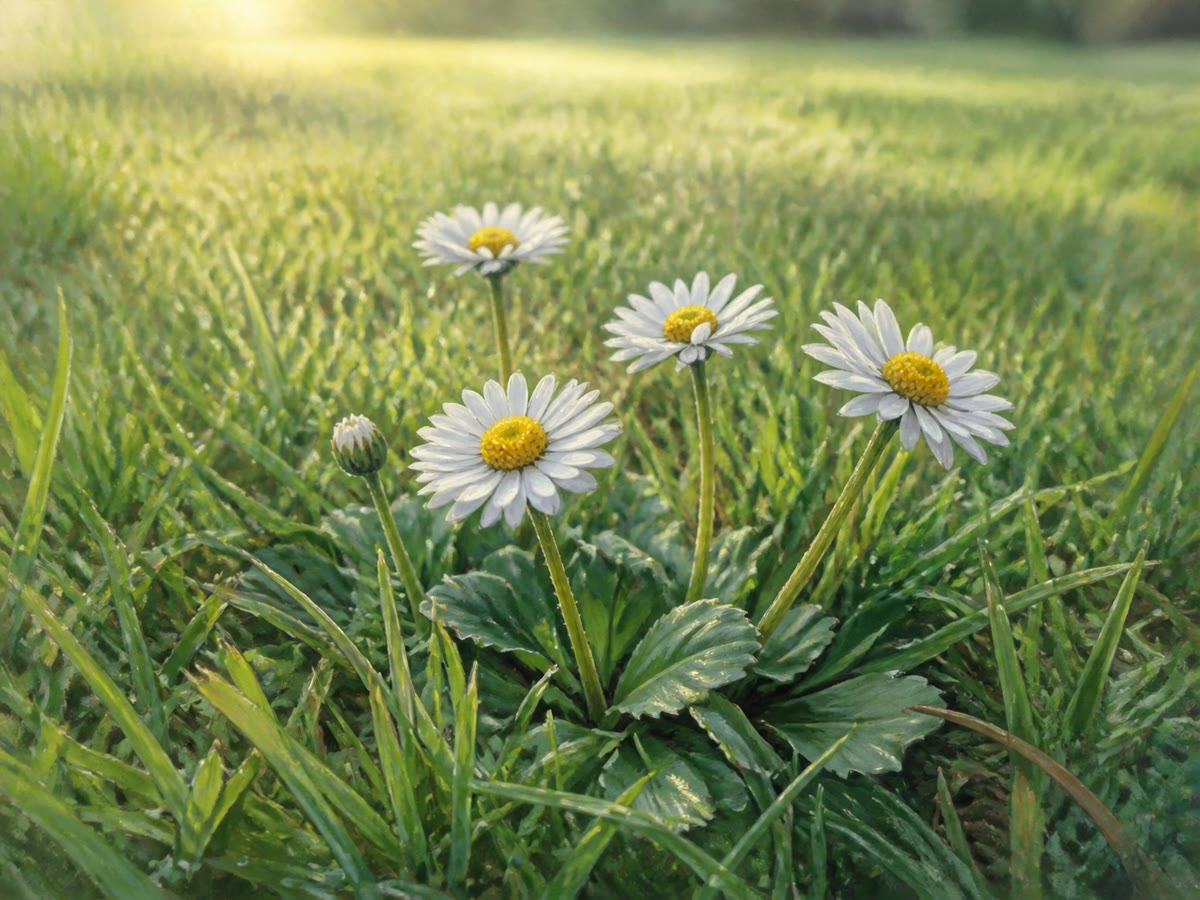
Check the signs of life on a daisy: it was born from a seed; it feeds — with water from the soil and light from the sky; it grows; it makes seeds that become new daisies; it dies in the frost. All the signs are there. The daisy is as alive as the cat — it is just much quieter about it.
Remark 3.3 (Alive without running)
Plants do not walk, but they are not completely still. A sunflower turns to follow the light during the day, and a plant on a windowsill slowly leans toward the window. Plants move by growing — too slowly for our eyes, fast enough for a week’s watching.
3.2 The parts of a plant
Definition 3.4 (Parts of a plant)
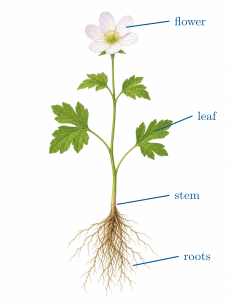
A flowering plant has four main parts:
Example 3.5 (Pulling up a weed)
Pull a weed gently out of loose, wet earth and you bring up the hidden part: a tuft of pale roots, sometimes longer than the whole green plant above. Now the plant can be read from bottom to top: roots, stem, leaves — and, if you are lucky, a flower.
Definition 3.6 (Tree)
A tree is a big plant whose stem is made of wood. The tree’s woody stem is called the trunk; it divides into branches, which carry the leaves.
Example 3.7 (The chestnut tree)
The chestnut tree in the yard has the same plan as the daisy, but bigger and harder: roots under the ground, a trunk instead of a soft stem, branches with thousands of leaves, and in spring, flowers. The daisy lives one year; the chestnut can live longer than a hundred.
3.3 What a plant needs
Proposition 3.8 (The needs of a plant)
To live and grow, a plant needs water, light, and a place for its roots, usually soil. A plant kept in the dark, or never watered, wilts and dies.
Proof. Admitted at this level. ∎
Example 3.9 (The forgotten plant)
Forget to water the classroom plant before the holidays: its leaves hang down, soft and sad — it wilts. Water it, and a few hours later the leaves stand up again. Water was the missing need.
Method 3.10 (Looking after a plant)
Remark 3.11 (Plants feed everyone)
Plants matter to every animal. The snail eats the salad, the blackbird eats berries, we eat bread made from wheat — a plant. Even the cat, who eats no salad, eats animals that ate plants. Without plants, no one else would have anything to eat; a later chapter follows these food chains.
3.4 Exercises
Exercise 3.1 ★
Name the four parts of a flowering plant, from under the soil to the top.
Exercise 3.2 ★
Which part of the plant: (a) drinks water from the soil? (b) catches the light? (c) will make the seeds? (d) holds the plant upright?
Exercise 3.3 ★
The daisy never walks. Go through the signs of life and say why it is a living thing anyway.
Solution
Solution of Exercise 3.3.
It was born from a seed, it feeds (water from the soil, light from the sky), it grows, it makes seeds that become new daisies, and it dies one day. All the signs of life are there; walking is not one of them.
Exercise 3.4 ★
What are the special names of the tree’s stem and of the parts that carry its leaves?
Exercise 3.5 ★
Give the three things a plant needs to live, from Proposition 3.8.
Exercise 3.6 ★
The classroom plant has soft, hanging leaves. What has probably been forgotten? What will happen after it is given?
Exercise 3.7 ★
In what ways are the daisy and the chestnut tree the same? In what two ways are they different?
Exercise 3.8 ★
Try it: put one bean plant (or cress pot) near the window and one in a dark cupboard, and water both. Look after one week. What difference do you expect, and which need explains it?
Exercise 3.9 ★★
Leo says: “Plants are not really alive — they never do anything.” Give him two things a plant does, slowly but surely, from Remark 3.3 and Example 3.2.
Solution
Solution of Exercise 3.9.
For example: the plant grows — taller week after week — and it turns or leans toward the light, like the sunflower following the day. Slow is not the same as doing nothing.
Exercise 3.10 ★★
A carrot is orange and grows under the ground. Looking at the figure of the plant’s parts, which part of the carrot plant do you think we eat? What clue does “under the ground” give?