Primary & Middle School Biology · Grades 1–9
12Teeth and Eating Well
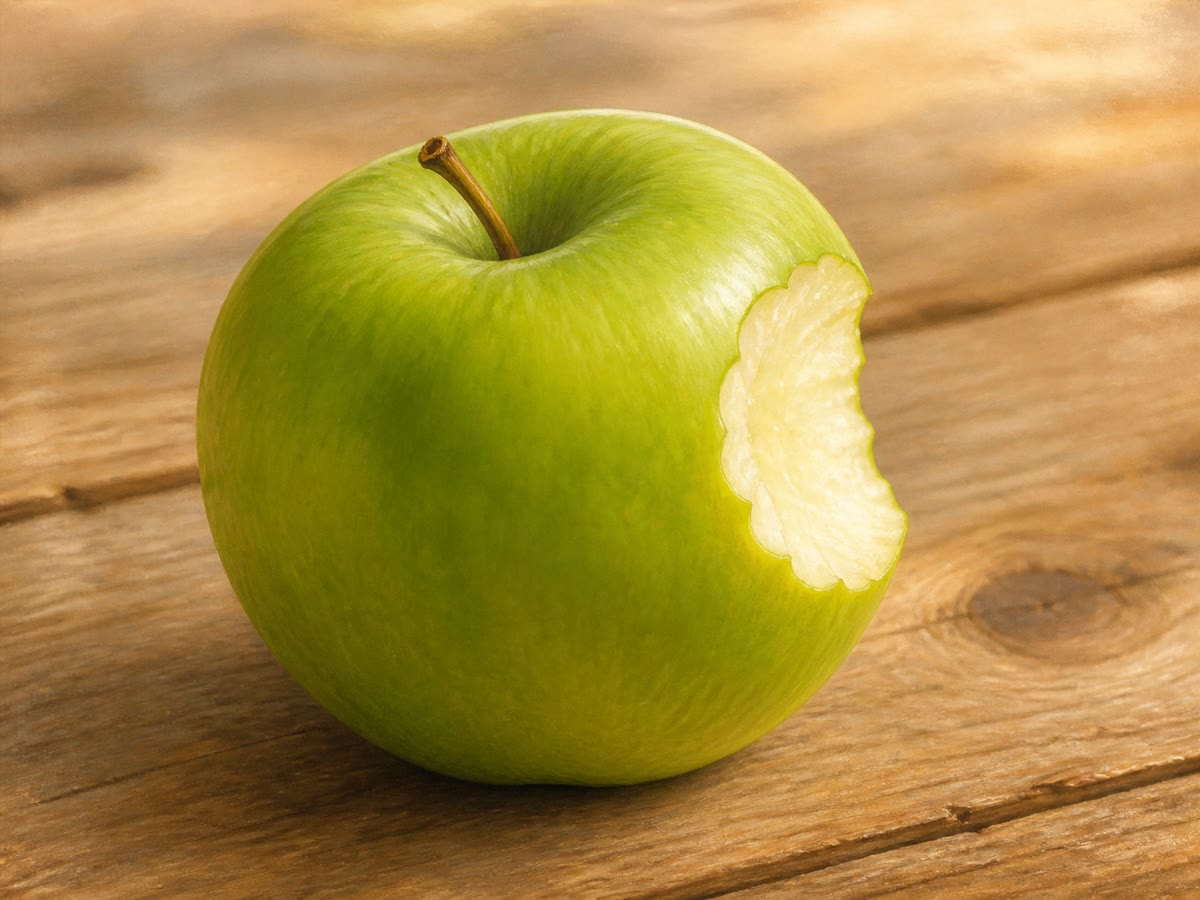
Bite into an apple and look at the mark: a neat curved row of little prints. Your teeth made that — a full toolbox that cuts, tears and grinds every meal before you swallow it. And like every good toolbox, it deserves care, and good things to work on.
12.1 The teeth: a toolbox in the mouth
Definition 12.1 (The three kinds of teeth)
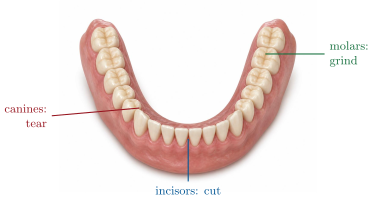
Human teeth come in three kinds, each with its job:
- the incisors, flat and sharp at the front, cut — they slice into the apple;
- the canines, pointed, at the corners, tear — they grip and pull tougher food;
- the molars, broad and bumpy at the back, grind — they crush food into a paste ready to swallow.
Example 12.2 (One bite of apple, three tools)
Eating a piece of apple uses the whole toolbox in order: the incisors slice off the bite, the canines help pull it free, and the tongue passes it back to the molars, which grind it up. Only then do you swallow.
Remark 12.3 (Remember the animals)
Your mixed toolbox tells a story: flat cutters and grinders like a herbivore, pointed canines like a carnivore. It is an omnivore’s mouth — humans are equipped for plants and meat, just as Chapter 10 sorted us.
12.2 Baby teeth, adult teeth
Proposition 12.4 (Two sets in one life)
Humans grow two sets of teeth. The baby teeth arrive in the first years of life. From about age six they loosen and fall out one by one, pushed from below by the adult teeth — the final set, up to of them, which must last the rest of your life.
Proof. Admitted at this level. ∎
Example 12.5 (The wobbly incisor)
A front tooth starts to wobble at the very age children start school. Under it, an adult incisor has been quietly growing and dissolving the baby tooth’s root, until the little tooth lets go. The gap is not an accident — it is a changeover.
Remark 12.6 (No third set)
After the adult set, no new teeth will ever come. A lost baby tooth is replaced; a lost adult tooth is lost. That is the real reason grown-ups insist on brushing: the second toolbox must last seventy years or more.
12.3 Eating well
Proposition 12.7 (A balanced plate)
To grow and stay healthy, the body needs food from each family, every day:
- fruit and vegetables — for vitamins, at every meal;
- bread, cereals, potatoes — for lasting energy;
- milk, yogurt, cheese — for building bones and teeth;
- meat, fish or eggs — for building the body, once or twice a day is enough;
- water — the only drink the body truly needs;
- sugary and fatty treats — for pleasure, in small amounts, not at every meal.
Proof. Admitted at this level. ∎
Example 12.8 (Two snack bags)
Snack A: an apple, a piece of bread, water. Snack B: sweets, a soda. Snack B tastes of sugar and little else — and sugar is just what the germs of Chapter 6 feast on. Snack A feeds the body and gives the teeth honest work. Guess which one the dentist packs for her own children.
Method 12.9 (Checking a day’s menu)
Take a day’s meals and check:
- fruit or vegetables at each meal?
- something from the building families — dairy, and meat, fish or eggs?
- water as the everyday drink?
- treats kept small and occasional?
If a family is missing, the next meal is the chance to invite it back.
12.4 Exercises
Exercise 12.1 ★
Name the three kinds of teeth and the job of each.
Exercise 12.2 ★
Which teeth are at the front of the mouth, and which at the back?
Exercise 12.3 ★
Follow a bite of carrot through the mouth: which tooth does what, in order?
Exercise 12.4 ★
How many baby teeth are there? What happens to them from about age six?
Solution
Solution of Exercise 12.4.
There are baby teeth. From about age six they loosen and fall out one by one, pushed from below by the growing adult teeth.
Exercise 12.5 ★
Why must adult teeth be cared for even more than baby teeth?
Solution
Solution of Exercise 12.5.
Because they are the last set: a lost baby tooth is replaced by an adult one, but a lost adult tooth is never replaced. The adult set must last the whole of life.
Exercise 12.6 ★
Name the food families a healthy day should include. Which drink does the body truly need?
Exercise 12.7 ★
Compare the two snacks of Example 12.8: what does snack A give the body that snack B does not?
Solution
Solution of Exercise 12.7.
Vitamins from the apple, lasting energy from the bread, and water — real nourishment, and honest chewing work for the teeth. Snack B gives mostly sugar, which feeds the tooth-attacking germs instead.
Exercise 12.8 ★
Try it: look at your own teeth in a mirror. Find an incisor, a canine and a molar, and check their shapes against the figure.
Exercise 12.9 ★★
Using Remark 12.3, explain what the shapes of human teeth say about the human menu — and which animals of Chapter 10 we resemble.
Exercise 12.10 ★★
Lila’s day: breakfast — cereal and milk; lunch — pasta and sweets; snack — soda and biscuits; supper — pizza. Run Method 12.9 on it: what is missing, and what appears too often?
Solution
Solution of Exercise 12.10.
Missing: fruit and vegetables (none all day!) and water as the everyday drink; meat, fish or eggs are absent too. Too often: sugary things — sweets, soda, biscuits. One fix: fruit at breakfast and snack, vegetables and some fish or egg at lunch or supper, water instead of soda, treats kept to one.