Primary & Middle School Biology · Grades 1–9
6Healthy Habits
Why does everyone keep saying “wash your hands”, “brush your teeth”, “off to bed”? Not to spoil the fun. Your body is the living thing you will keep the longest — your whole life — and a few small habits, done every day, keep it strong. Here is what they are, and why they work.
6.1 Keeping clean
Definition 6.1 (Germs)
Germs are living things far too small to see, which are everywhere — on hands, on door handles, in dirt. Most are harmless, but some can make us ill when they get inside the body. Because they are invisible, hands that look clean can still carry them.
Definition 6.2 (Hygiene)
Hygiene means the habits that keep the body clean and keep germs out: washing hands, washing the body, brushing teeth, keeping food clean.
Method 6.3 (Washing hands well)
- Wet the hands and take soap;
- rub everywhere — palms, backs, between the fingers, around the thumbs — while you slowly count to or sing a short song;
- rinse under running water;
- dry with a clean towel.
Wash before eating, after the toilet, and after playing outside or touching animals.
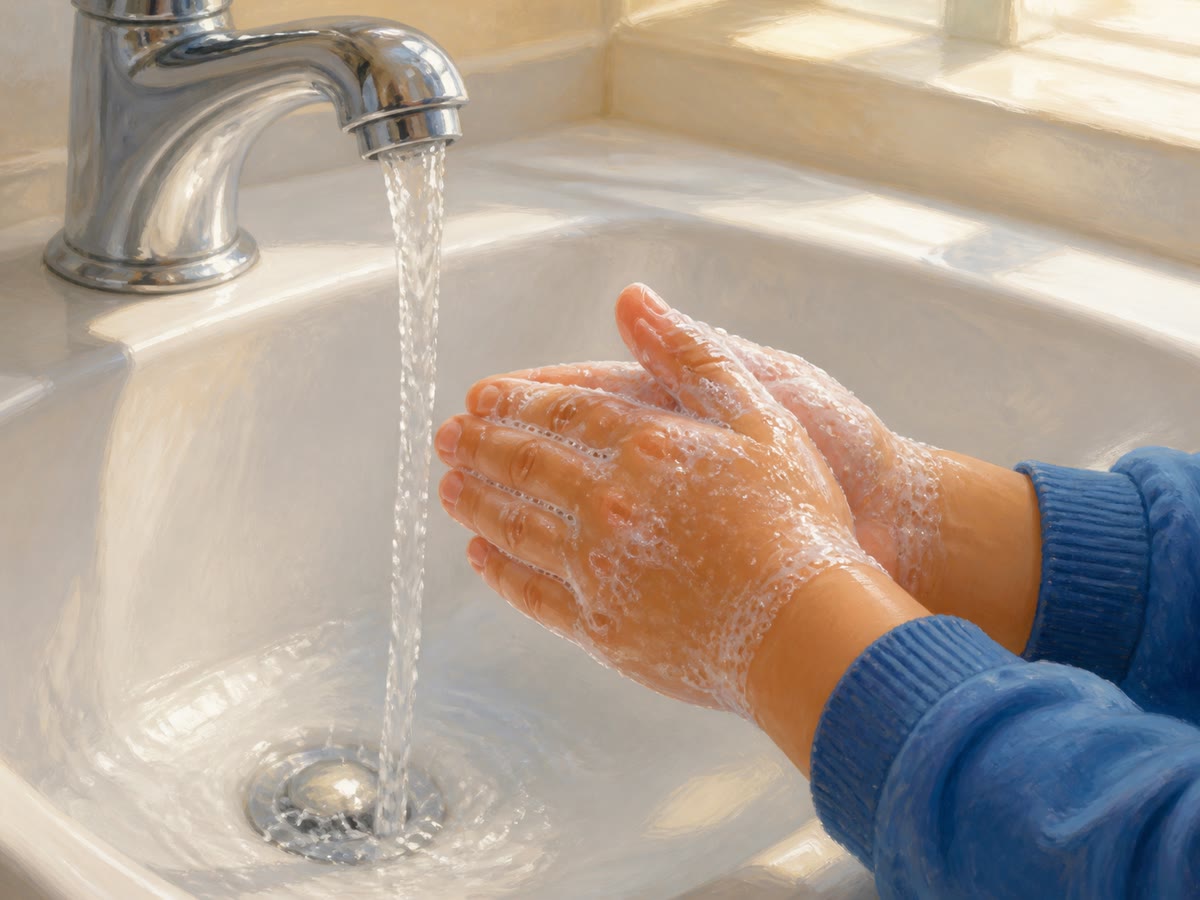
Example 6.4 (The glitter experiment)
Rub a pinch of glitter on your palms, then shake hands with a friend, open a door, pick up a pencil: glitter everywhere. Germs travel exactly like that, only invisibly. Now wash with soap, counting to — the glitter goes, and so do the germs.
6.2 Teeth to keep
Proposition 6.5 (Why teeth must be brushed)
After eating, bits of food stay on the teeth. Germs in the mouth feed on these leftovers — especially the sugary ones — and slowly make holes in the teeth, which hurt. Brushing sweeps the leftovers away before the germs can feast.
Proof. Admitted at this level. ∎
Method 6.6 (Brushing my teeth)
- Brush after breakfast and before bed — every day;
- brush every side of every tooth: the front, the back, and the top where you chew;
- take your time — about as long as a song;
- change to a new toothbrush when the bristles splay out.
Remark 6.7 (Baby teeth matter too)
“These teeth will fall out anyway — why brush them?” Because they must chew for you for years yet, because holes in them hurt just as much, and because the grown-up teeth are already waiting underneath and deserve a clean, healthy mouth to arrive in.
6.3 Eating, moving, sleeping
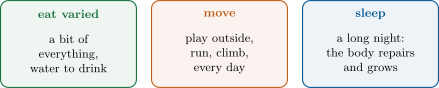
Proposition 6.8 (The three daily needs)
A growing body needs, every day:
- varied food — a bit of everything: vegetables and fruit, bread and cereals, milk and cheese, meat or fish or eggs, and water to drink; sweets only now and then;
- movement — running, climbing, cycling, playing outside: moving makes muscles, bones and heart stronger;
- sleep — at night the body rests, repairs itself and grows; a child needs a long night, far longer than a grown-up’s.
Proof. Admitted at this level. ∎
Example 6.9 (A good day for the body)
Breakfast with fruit; hands washed before lunch; an afternoon of running in the park; teeth brushed after supper; lights out early with a story. Nothing extraordinary — and that is the point: health is made of ordinary days like this one.
Remark 6.10 (Tired is a message)
Yawning, stinging eyes, grumpiness for no reason: that is the body saying “I need sleep”. Listening to it is a healthy habit too. A well-slept morning brain learns better, plays better and laughs more easily.
6.4 Exercises
Exercise 6.1 ★
What are germs? Why can hands that look clean still need washing?
Solution
Solution of Exercise 6.1.
Germs are living things far too small to see, found everywhere; some can make us ill when they get inside the body. Because they are invisible, hands can look perfectly clean and still carry them.
Exercise 6.2 ★
Give three moments of the day when hands must be washed.
Solution
Solution of Exercise 6.2.
Before eating, after the toilet, and after playing outside or touching animals.
Exercise 6.3 ★
In Method 6.3, how long should the rubbing with soap last? Name two spots that are easy to forget.
Solution
Solution of Exercise 6.3.
While slowly counting to (about a short song). Easy to forget: between the fingers, around the thumbs, and the backs of the hands.
Exercise 6.4 ★
Why do teeth get holes when they are not brushed? Tell the story with the germs and the leftovers.
Solution
Solution of Exercise 6.4.
Bits of food stay on the teeth after eating. Germs in the mouth feed on these leftovers, especially sugary ones, and little by little they make holes in the teeth, which hurt. Brushing sweeps the leftovers away before the feast.
Exercise 6.5 ★
When should teeth be brushed, and how long should it take?
Solution
Solution of Exercise 6.5.
After breakfast and before bed, every day — and it should take about as long as a song, on every side of every tooth.
Exercise 6.6 ★
Name the three daily needs of Proposition 6.8, and one example of each from your own day.
Solution
Solution of Exercise 6.6.
Varied food (fruit at breakfast, water to drink), movement (playing outside, cycling), and sleep (a long night with an early bedtime). Examples open.
Exercise 6.7 ★
What does the body do during sleep? Who needs the longer night, a child or a grown-up?
Solution
Solution of Exercise 6.7.
It rests, repairs itself and grows. A child needs the longer night — far longer than a grown-up’s.
Exercise 6.8 ★
Give two signs that a body is asking for sleep.
Solution
Solution of Exercise 6.8.
For example: yawning, stinging or heavy eyes, grumpiness for no reason.
Exercise 6.9 ★★
Sam says: “My baby teeth will fall out anyway, so brushing them is useless.” Answer him with Remark 6.7 — two reasons at least.
Solution
Solution of Exercise 6.9.
Baby teeth must chew for years before they fall out; holes in them hurt just as much as in grown-up teeth; and the grown-up teeth waiting underneath deserve a clean, healthy mouth to arrive in. Two of these reasons suffice.
Exercise 6.10 ★★
In the glitter experiment of Example 6.4, what does the glitter stand for? What does the experiment show about shaking hands — and about soap?