Primary & Middle School Biology · Grades 1–9
63Heredity and Traits
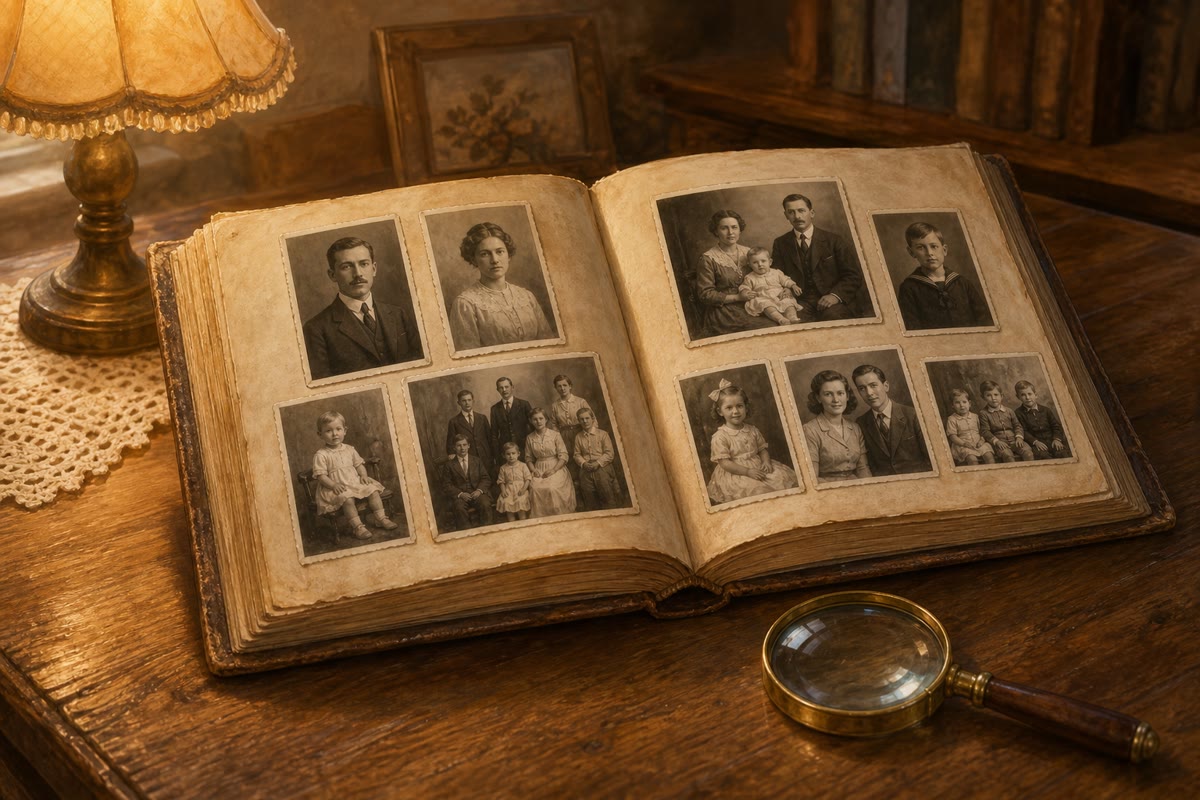
Family photographs are biology data. Grandmother’s chin on the toddler, the mother’s curls on neither child, one brother tall and one not — resemblance runs in families, and so does difference. This book has leaned on the fact for years (Remark 23.3’s foal, Proposition 54.5’s siblings); this year’s opening chapter finally studies it: what exactly is inherited, what is not, and what the patterns of family resemblance let us conclude.
63.1 Traits, and where they come from
Definition 63.1 (Traits)
A trait is any describable characteristic of an individual: eye color, blood group, earlobe shape, height, a singing voice, a scar. The individual’s whole collection of traits is built by two workings: what was inherited, and what the environment and life added (Definition 28.1’s world, acting on one body).
Definition 63.2 (Heredity)
Heredity is the transmission of traits from parents to offspring through reproduction — through, as Chapter 54 showed, two single cells. Traits that pass this way are hereditary: eye color and blood group are; scars and pierced ears are not, however long worn. The sorting test is the gametes: what two cells cannot carry, families cannot transmit.
Example 63.3 (Sorting a family album)
Grandfather’s photographs: his distinctive nose — hereditary, there it is again on the aunt and the cousin; his weathered farmer’s tan — acquired, his office-working grandson lacks it; his height — partly both, for the grandson overtops him on the same frame, fed by richer years (Proposition 18.1); his violin skill — not hereditary as skill (Example 60.6: synapses are trained, not transmitted), though the musical family tells us something subtler is at work in what is passed on: perhaps aptitude, never the trained wiring itself.
Proposition 63.4 (Inherited and acquired)
The two workings separate on three tests:
- family pattern: hereditary traits recur through the tree along reproduction’s lines; acquired ones follow lives (all the sailors weathered, whoever their parents);
- presence from the start: blood group is fixed at fertilization; the tan and the skill are built after;
- transmission: children of amputees have their limbs; children of bodybuilders start untrained. Acquired traits die with their acquirer — the gametes do not carry them.
Most visible traits — height, build, even temperament — are woven of both workings, inherited range and lived filling-in.
Proof. Admitted at this level. ∎
63.2 Reading family patterns
Example 63.5 (Traits that skip)
Some patterns puzzle at first sight: two brown-eyed parents with a blue-eyed child; grandmother’s trait absent in every child yet returning in a grandchild. Skipping is common, and it carries a heavy conclusion: a parent can transmit what they do not show. The trait’s instructions traveled hidden through a generation — so what is inherited is not the trait itself but something that determines it, carriable unseen.
Proposition 63.6 (What the patterns force us to conclude)
Three conclusions, each forced by an observation:
- since acquired traits do not pass, what passes must be determinants — instructions for building traits, not the traits themselves;
- since traits skip generations, the determinants can be carried without showing: each individual carries more than it displays;
- since every child receives from both parents by two gametes (Proposition 54.2), each parent contributes a selection of its determinants — and the selections differ from child to child, or siblings would match (Proposition 54.5’s shuffle, now located: it is a shuffle of determinants).
Proof. Admitted at this level. ∎
Remark 63.7 (The question this sets)
The family album has cornered us into a marvelous question. Somewhere in a sperm cell’s almost-nothing (Example 57.2 — a packed nucleus and a tail) travel instructions for a nose, a blood group, an eye color — carriable unshown, selectable by halves, readable by the growing body. Where are they, and what are they made of? The sperm’s anatomy already points the answer: everything the father sends fits in a nucleus (Remark 29.6 promised that spot mattered). The next two chapters open it.
Method 63.8 (Auditing a trait)
For any trait, run the three tests:
- map it on the family tree: does it follow reproduction’s lines, or lives and habits?
- date it: fixed from the start, or built along the way?
- apply the gamete test: could two cells carry it? (a scar cannot; a blood group can);
- verdict: inherited, acquired, or — commonest — an inherited range, lived into.
63.3 Exercises
Exercise 63.1 ★
Define trait and heredity, and give the sorting test in one phrase.
Exercise 63.2 ★
Classify: blood group; a pierced ear; freckles; fluent French; earlobe shape.
Solution
Solution of Exercise 63.2.
Blood group: hereditary. Pierced ear: acquired. Freckles: hereditary tendency, sun-lived (both workings). Fluent French: acquired. Earlobe shape: hereditary.
Exercise 63.3 ★
State the three tests of Proposition 63.4.
Solution
Solution of Exercise 63.3.
Family pattern (recurs along reproduction’s lines, or follows lives); presence from the start (fixed at fertilization, or built after); transmission (passes to children, or dies with its acquirer).
Exercise 63.4 ★
Why do children of bodybuilders start untrained? What does that show?
Exercise 63.5 ★
What does a skipping trait prove a parent can do?
Solution
Solution of Exercise 63.5.
Transmit what they do not show: the trait’s determinant traveled through them hidden, and surfaced a generation on.
Exercise 63.6 ★
Why must what is inherited be determinants rather than traits? One sentence.
Exercise 63.7 ★★
Height ran taller in the grandson on the same frame. Untangle the two workings in that sentence.
Solution
Solution of Exercise 63.7.
Inherited: the height range the frame suggests — the grandson received the family’s determinants. Lived: richer feeding filled the range further — the environment’s addition on top of the inheritance.
Exercise 63.8 ★★
Explain why siblings differ, in determinant language — and why identical twins (Exercise 58.10) do not.
Solution
Solution of Exercise 63.8.
Each child receives a different selection of each parent’s determinants — the shuffle deals fresh combinations per fertilization. Identical twins split after one fertilization: one deal, two builds — so their determinant sets match.
Exercise 63.9 ★★
Run Method 63.8 on: (a) a family’s recurring early gray hair; (b) a football player’s stamina.
Solution
Solution of Exercise 63.9.
(a) Follows the tree, appears at its family age regardless of trade or town, conceivably gamete-carried: hereditary. (b) Built by training, follows the sport not the parents, no gamete carries stamina: acquired — on an inherited range of build and heart (Proposition 49.7 builds what heredity only sketches).
Exercise 63.10 ★★
The violin case: what could the musical family be transmitting, if never the trained skill? Distinguish carefully.
Solution
Solution of Exercise 63.10.
Never the skill — synapses train in each life anew. What may pass: aptitude’s raw materials — ear, dexterity, temperament — an inherited range that musical households then fill with practice, tuition and example (the second, living-together channel of transmission).
Exercise 63.11 ★★
Two brown-eyed parents, a blue-eyed child — and the neighbor doubts the family. Defend the family with Example 63.5’s logic.
Exercise 63.12 ★★★
From the sperm cell’s anatomy alone (Example 57.2), argue where the father’s determinants must sit — and what size that implies for the instructions of a whole human.
Solution
Solution of Exercise 63.12.
Everything the father transmits rides in the sperm cell, and the sperm cell is a tail and a packed nucleus — so the determinants must sit in the nucleus. And since a whole human’s paternal instructions fit in a package thousandths of a millimetre across, the instructions must be written at molecular smallness — a script finer than any cell structure the school microscope shows.
63.4 Problem: The Village Genealogist
Problem 63.1
Weekend problem — three generations, one trait ledger
A village genealogist annotates the parish’s family trees with traits: the “chapel chin” (a distinctive chin recurring for a century), left-handedness, the bakers’ floury lung cough, blood groups from the donation register, and the shepherds’ weathered faces.
Part I — Sorting the ledger.
- Sort the five traits by Method 63.8, with the deciding test for each.
- The cough follows the bakery, not the family: marrying in brings it, moving away loses it. Which test is this, in action?
- The chapel chin skips the middle generation in two branches. Draw the conclusion it forces.
- Blood groups sometimes surprise the register: a group-O child of group-A and group-B parents. What must each parent have carried?
Part II — The determinant reading.
- Rewrite the chin’s century in determinant language: what actually traveled down four generations, in what vehicles (Definition 63.2)?
- Why do the chin-carrying cousins differ in everything else? Locate the shuffle.
- The genealogist finds no case — in a century — of a scar, a trade or a language passing to a newborn. State the generalization, and its mechanism-level reason.
- One family’s twins match to the chin and beyond. What does the ledger conclude about their beginning (Remark 32.7)?
Part III — The lecture.
- The genealogist lectures: “the parish transmits two inheritances — one by gametes, one by living together.” Assign the ledger’s five traits to the two channels.
- “Each of us displays less than we carry.” Defend from the ledger, twice.
- A listener asks what the gamete channel’s instructions are physically. Give the honest answer of Remark 63.7 — location known, contents next chapter.
- Close the lecture with the audit’s one-line verdict on the commonest case: most traits are what, lived how?
Solution
Solution of Problem 63.1.
1. Chapel chin: hereditary (family pattern, present from the start). Left-handedness: hereditary tendency (follows families loosely, fixed early). Bakers’ cough: acquired (follows the trade). Blood groups: hereditary (fixed at fertilization, gamete-carriable). Weathered faces: acquired (follow the shepherding life).
2. The family-pattern test: the trait maps onto an occupation’s lines, not reproduction’s — marrying in acquires it, moving away loses it, no gamete involved.
3. That a determinant can be carried without being shown: the middle generation transmitted the chin’s instructions while displaying other chins.
4. Each parent carried, alongside its shown group’s determinant, a hidden group-O determinant — and the child received the two hidden ones. Carriage unshown, in the register’s own ink.
5. Not the chin but its determinants — instructions for building it — traveling in the only vehicles reproduction has: one egg cell and one sperm cell per generation, four handovers in the century.
6. In the selections: each fertilization dealt the shared chin determinant alongside a fresh half-and-half selection of everything else — common card, different hands.
7. Acquired traits are never transmitted. Reason: they are built in the body’s tissues by living, and the gametes — two cells, carrying determinants only — have no way to record them.
8. One fertilization, later split: a single determinant deal built twice — Remark 32.7’s identical twins, certified by the ledger’s matching.
9. Gamete channel: chin, blood groups, left-handedness’s tendency. Living-together channel: the cough (the bakery’s air), the weathering (the hills’ weather) — and, from the album chapter, languages, trades and skills.
10. From the skips: the middle generation carried the chin unshown. From the blood register: A- and B-showing parents carried O unshown. Twice over, carriage exceeds display.
11. Physically: they sit in the gametes’ nuclei — that much the sperm’s anatomy already proves. What they are made of, and how so small a package writes so large a book, is precisely the next chapters’ question.
12. Most traits are inherited ranges, lived into: the gametes deal the sketch, the life draws it in.