Primary & Middle School Biology · Grades 1–9
15The Stages of Life
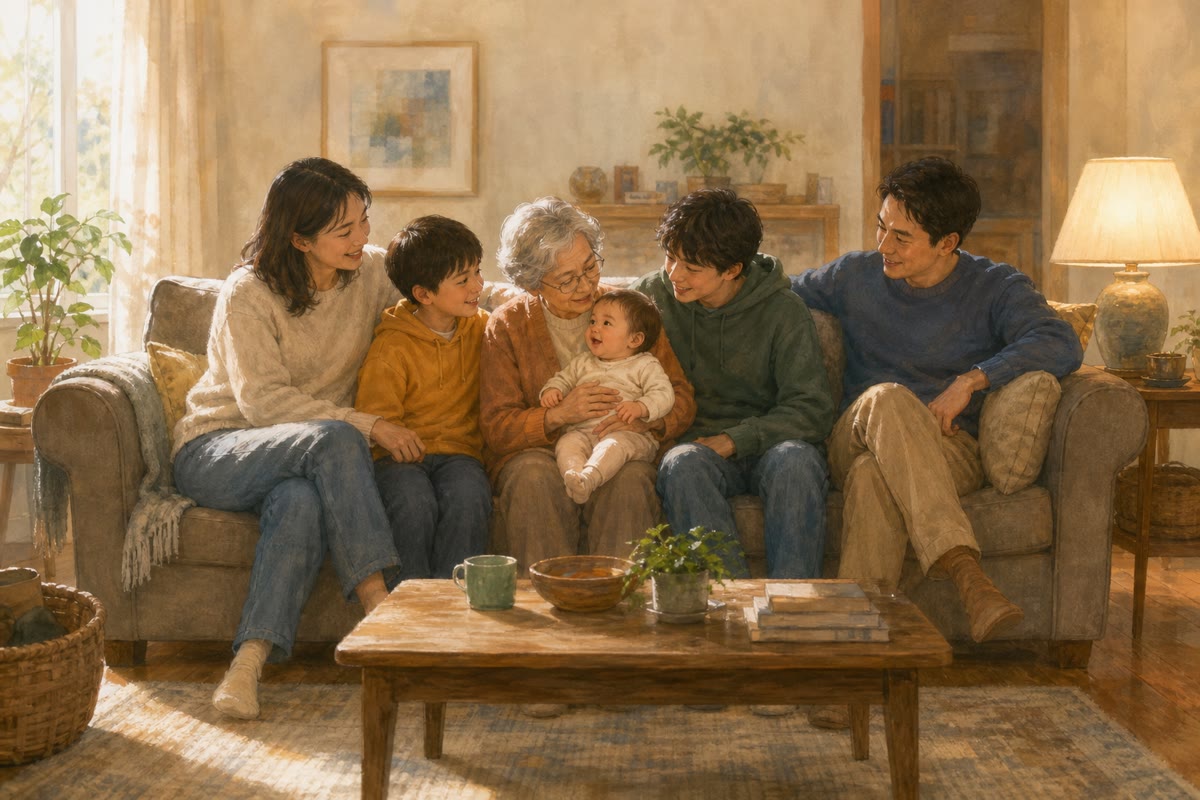
Line up a family photograph: the baby on Grandma’s knee, the schoolchild missing two front teeth, the teenage cousin suddenly taller than his mother, the parents, Grandma herself. One family, one afternoon — and the whole human life cycle sitting on one sofa. This year we look closely at those stages, and at how growth itself can be measured.
15.1 The stages of a human life
Definition 15.1 (The stages of human life)
A human life passes through stages:
- the baby (roughly the first two years): fastest growth of all, first teeth, first steps, first words;
- the child: steady growth, baby teeth traded for adult teeth, learning of every kind;
- the adolescent: a new burst of fast growth, and the body changing from a child’s into an adult’s;
- the adult: growth in height over; adults can become parents;
- old age: hair whitens, skin wrinkles, strength slowly declines — the natural last stage of the cycle.
Example 15.2 (Reading the sofa)
On the family sofa: the baby (stage 1), the gap-toothed schoolchild (stage 2 — the changeover of Chapter 12 in full swing), the sixteen-year-old cousin (stage 3, mid-burst), the parents (stage 4), Grandma (stage 5). Five stages, one family.
Remark 15.3 (Growing is not steady)
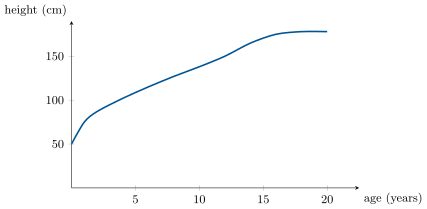
Growth has a rhythm: very fast for the baby — height roughly half as much again in the first year — slower and steady through childhood, fast again for the adolescent, then over. Two bursts with a calm stretch between: that is the normal shape of growing up.
15.2 Measuring growth
Definition 15.4 (Growth chart)
A growth chart is a record of height (or weight) measured again and again over time — the door-frame marks of Chapter 4, made regular and dated. Doctors keep one for every child.
Example 15.5 (Reading the chart)
On the chart, the line climbs about in the very first year — and only about a year through childhood. The two steep parts are the two bursts of Remark 15.3; the flat end says the adult has stopped growing taller.
Method 15.6 (Keeping your own growth chart)
- Measure height carefully (the wall-and-book way of the earlier years), always without shoes;
- write the date and the height in a notebook, or mark the door frame and date the mark;
- measure again every few months — regularity matters more than frequency;
- to see the story, plot the points: age along the bottom, height up the side, like the figure.
15.3 Animals and plants have stages too
Proposition 15.7 (Stages across the living world)
Every living thing passes through stages of its own version of the cycle — young, adult, old age. The young stage may look like the adult (the kitten, the foal) or nothing like it (the tadpole, the caterpillar of Chapter 8); a plant’s stages run seed, seedling, young plant, flowering adult. What none of them can do is skip a stage or run them backward.
Proof. Admitted at this level. ∎
Example 15.8 (How fast, how slow)
The speeds differ enormously. A fly is adult in weeks; a cat in about a year; a human in nearly twenty years; an oak takes several tens of years before its first acorns. Slow or fast, the order of the stages never changes.
Remark 15.9 (Old age is a stage, not a defect)
White hair and wrinkles are not an illness: they are the body’s last stage, as natural as the baby’s first teeth. In many species, and in human families, the old ones carry what the young most need — experience.
15.4 Exercises
Exercise 15.1 ★
Name the five stages of a human life, in order.
Exercise 15.2 ★
At which stage: (a) do the baby teeth fall out? (b) can a person become a parent? (c) is growth the fastest of the whole life?
Solution
Solution of Exercise 15.2.
(a) In childhood, from about age six. (b) At the adult stage. (c) At the baby stage — the first year is the fastest of all.
Exercise 15.3 ★
What are the two bursts of growth, and what lies between them?
Solution
Solution of Exercise 15.3.
The baby’s burst and the adolescent’s burst, with the calm, steady growth of childhood between them.
Exercise 15.4 ★
On the growth chart, how can you tell from the line alone that an adult has stopped growing?
Solution
Solution of Exercise 15.4.
The line goes flat: age keeps advancing along the bottom, but the height no longer climbs.
Exercise 15.5 ★
Using the chart, about how many centimetres does the line climb between ages and ? And in the single first year?
Solution
Solution of Exercise 15.5.
Between and : from about to about — roughly over the two years. In the first year alone: from about to about — roughly , twice as much as those two childhood years together.
Exercise 15.6 ★
Why must height always be measured without shoes, the same way each time? What could go wrong otherwise?
Solution
Solution of Exercise 15.6.
Because a comparison is only fair if the measurements are made the same way. Shoes one day and socks the next, or a sloppy slanted book, would create “growth” (or hide it) that never happened.
Exercise 15.7 ★
Give the stages of an oak tree’s life, from acorn to old tree.
Exercise 15.8 ★
Try it: start the growth chart of Method 15.6 for yourself, with today’s first point. Which stage of Definition 15.1 are you in — and which burst is still ahead of you?
Solution
Solution of Exercise 15.8.
Open answer. A nine-year-old is in the child stage; the adolescent burst is still ahead.
Exercise 15.9 ★★
A fly, a cat, a human and an oak run the same stages at very different speeds. Order them from fastest to slowest to reach adulthood — and say what all four orders of stages have in common.
Exercise 15.10 ★★
Tom, aged , measures himself twice in one month and finds “no growth at all”. Should he worry? Answer with Remark 15.3 and the shape of the chart at his age.
Solution
Solution of Exercise 15.10.
No. At nine he is in childhood’s calm stretch — about a year, which is half a centimetre a month: far too little to see between two measurements a month apart. The chart climbs surely, but slowly; he need only wait a few months between points.