Primary & Middle School Biology · Grades 1–9
51The Lungs and Gas Exchange
Every minute of your life, about eight litres of air pass through two organs you have never seen. Chapter 26 sketched the path and the swap; Chapter 47 placed the human machine among the kingdom’s four. This chapter completes the picture: the ventilation machinery, the air pockets by their proper name, the numbers of the exchange — and what smoke does to the whole works.
51.1 The ventilation machinery
Proposition 51.1 (How air is moved)
The lungs have no muscles of their own; the chest pumps them like a bellows:
- breathing in is work: the rib muscles lift and widen the cage, and the diaphragm — the broad muscle floor under the lungs — flattens downward; the widened chest stretches the lungs, and air flows in to fill them;
- breathing out, at rest, is mostly release: muscles relax, the stretched chest springs back, air flows out. (Blowing out candles adds muscle to the spring.)
About times a minute at rest (Definition 26.1), unasked (Remark 33.4) — and deepened and quickened on demand (Proposition 49.4).
Proof. Admitted at this level. ∎
Example 51.2 (Feeling the bellows)
Hands on ribs, breathe in deep: the cage rises and widens under your palms (Example 26.2). Now pant like a dog: the quick shallow puffs are almost all diaphragm. Hiccups, for completeness, are the diaphragm’s twitchy false starts — the bellows misfiring on its own schedule.
51.2 The alveoli and the exchange
Definition 51.3 (Alveoli)
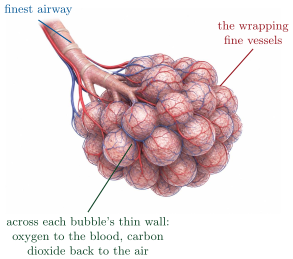
The tiny air pockets of Definition 26.3 are the alveoli: hundreds of millions of thin-walled bubbles clustered at the airways’ finest tips, each wrapped in fine blood vessels. Their summed surface is the half tennis court of Remark 26.4 — the human copy of Proposition 47.1’s large-thin-moist specification.
Proposition 51.4 (The exchange, in numbers)
Compare the air that enters with the air that leaves: inhaled air is about percent oxygen and almost free of carbon dioxide; exhaled air is down to about percent oxygen and up to about percent carbon dioxide (warm and moist besides — Example 26.7). The differences are the exchange: across the alveolar walls, oxygen crosses to the blood and carbon dioxide crosses back (Proposition 26.5), every minute of every day.
Proof. Admitted at this level. ∎
Example 51.5 (The accounting checks)
Eight litres a minute, a twentieth of each breath’s oxygen kept: the arithmetic supplies roughly the resting body’s oxygen bill — and in effort, with breathing tripled and deepened and the heart’s rounds accelerated (Proposition 49.4), the delivery multiplies to match the muscles’ bill. The machine’s numbers and the body’s ledger balance; they are the same books kept at two counters.
51.3 The machinery abused: smoke
Proposition 51.6 (What smoke does to the works)
Tobacco smoke attacks every floor of this chapter (Proposition 36.5 gave the warning; here is the engineering):
- its tars coat and irritate the airways: the cleaning surfaces falter and the “smoker’s cough” is the airways’ overloaded broom;
- alveolar walls, chronically irritated, break down: pockets merge into fewer, bigger, baggier spaces — surface is lost, and with it exchange (the specification, dismantled);
- one of smoke’s gases rides the blood’s oxygen seats, crowding oxygen off its own transport;
- and the airways narrow — every breath through a smoker’s chest is a breath through a part-blocked bellows.
The damage is slow, cumulative and only partly reversible: the never-started lung keeps its half tennis court whole (Remark 36.6).
Proof. Admitted at this level. ∎
Example 51.7 (Two stair tests)
The three flights of Chapter 49, taken by two adults of equal age and training habits, one a long-term smoker: the smoker arrives gasping at a pulse the other reaches only sprinting. Less surface, seats taken, narrowed airways — the supply chain pays Proposition 49.1’s bill through a throttled intake. Fitness tests read the lungs’ history as surely as any scan.
Method 51.8 (Keeping the machinery)
Method 26.8, upgraded with this chapter’s reasons:
- no smoke — yours or others’: surface lost is barely regained;
- air the rooms (Exercise 26.10) and prefer clean outdoor air for sport;
- exercise the bellows: deep-breathing effort builds the breathing muscles and keeps the full surface ventilated;
- nose-breathing in cold and dust (Exercise 26.7) — the filter protects the broom.
51.4 Exercises
Exercise 51.1 ★
Describe breathing in and breathing out as work and release: which muscles, which movements?
Solution
Solution of Exercise 51.1.
Breathing in: the rib muscles lift and widen the cage while the diaphragm flattens downward; the stretched chest pulls the lungs wide and air flows in — muscular work. Breathing out at rest: the muscles relax and the stretched chest springs back, pushing air out — release, nearly free.
Exercise 51.2 ★
What is the diaphragm, and where does it sit?
Exercise 51.3 ★
What are the alveoli — how many, how walled, wrapped in what?
Solution
Solution of Exercise 51.3.
The lungs’ air pockets: hundreds of millions of thin-walled bubbles at the airways’ finest tips, each wrapped in fine blood vessels.
Exercise 51.4 ★
Give the round numbers: oxygen in inhaled air, in exhaled air; carbon dioxide in exhaled air. What are the differences?
Solution
Solution of Exercise 51.4.
Inhaled: about percent oxygen, almost no carbon dioxide. Exhaled: about percent oxygen and about percent carbon dioxide. The differences — five points of oxygen taken, four of carbon dioxide added — are the exchange itself.
Exercise 51.5 ★
Which specification do the alveoli meet, and with which two other organs of this year do they share it?
Solution
Solution of Exercise 51.5.
The large-thin-moist, blood-lined crossing surface. Shared with the gills’ feathers (Proposition 47.1) and the intestine’s villi (Example 50.7).
Exercise 51.6 ★
Name three of smoke’s four attacks on the machinery.
Exercise 51.7 ★★
Why is breathing in work while resting breathing out is free? Where does the outward push come from?
Exercise 51.8 ★★
Explain why lost alveolar surface cannot be compensated by breathing faster — which factor of the exchange is missing?
Solution
Solution of Exercise 51.8.
The exchange needs surface as much as fresh air: crossing happens only where air meets blood-lined wall. Faster bellows through fewer, baggier pockets ventilates surface that no longer exists — the missing factor is the crossing area itself.
Exercise 51.9 ★★
Interpret the two stair tests of Example 51.7 attack by attack.
Solution
Solution of Exercise 51.9.
The smoker climbs with narrowed airways (throttled intake), a reduced alveolar surface (less loading per breath), and oxygen seats occupied by smoke’s gas (less carried per round). To pay the same muscular bill, the heart must run more rounds — hence the gasping arrival at a sprint-level pulse.
Exercise 51.10 ★★
A diver breathes out slowly while surfacing; a trumpet player holds long steady notes. Which halves of Proposition 51.1 are they each training or using?
Solution
Solution of Exercise 51.10.
Both are trained control of the outward phase: adding measured muscle to what is normally a passive spring — the diver to vent expanding air steadily, the player to meter one long controlled outflow. (Their deep intakes train the inward work too.)
Exercise 51.11 ★★
Reconcile Example 51.5 with Proposition 49.4: which three adjustments multiply delivery in effort, and at which counters?
Solution
Solution of Exercise 51.11.
Deeper-and-faster breathing multiplies loading at the alveolar counter; the faster, harder heart multiplies rounds at the transport counter; rerouting widens the muscles’ local vessels at the delivery counter. Three adjustments, one multiplied delivery (Example 51.5’s balanced books).
Exercise 51.12 ★★★
“The lung is a border of half a tennis court folded into a shoebox, and smoke is a slow fire at the border.” Justify both images with this chapter’s numbers and mechanisms.
Solution
Solution of Exercise 51.12.
The border: hundreds of millions of alveoli sum to about half a tennis court of exchange surface, folded into a chest — across which five percentage points of every breath’s oxygen cross inward and four of carbon dioxide cross out. The slow fire: smoke’s tars and irritation consume that border year by year — coating its approaches, collapsing its pockets, seizing its transport seats — cumulative, quiet, and only partly reversible, like a border burned faster than it can be rebuilt.
51.5 Problem: The Breathing Machine Dossier
Problem 51.1
Weekend problem — an engineer’s inspection of the human bellows
An engineering class “inspects” the human breathing machine on paper: intake, pump, exchange surface, transport connection, and maintenance record.
Part I — The pump.
- Draw up the pump’s cycle: the two phases, the movers of each, and which phase costs energy at rest.
- The pump has no contact with the pumped organ’s own muscle — the lungs have none. How does the chest’s widening move air at all?
- Give the pump’s resting rate and its two effort adjustments (Proposition 49.4).
- Panting, sighing, blowing out candles: assign each to its place in the cycle’s mechanics.
Part II — The exchange surface.
- Specify the surface: name, number, wall, wrapping, summed size.
- Verify the specification against Proposition 47.1, item by item.
- The intake air and exhaust air differ by the chapter’s percentages. Compute the oxygen difference as a fraction of the intake’s percent — roughly what share of inhaled oxygen is kept?
- Why must the exhaust stay warm and moist — which property of the surface is that the price of?
Part III — The maintenance record.
- File smoke’s four attacks under: intake, pump, surface, transport. One line each.
- The dossier notes: “surface losses are capital losses.” Explain, against the coughs and colds that are running repairs.
- Write the maintenance schedule — Method 51.8 — as four engineer’s directives with reasons.
- Conclude the inspection: one sentence on why this machine, alone of the body’s pumps and borders, is half under the owner’s voluntary control — and what that control is for (speech, song, the diver’s slow exhale).
Solution
Solution of Problem 51.1.
1. Phase in: rib muscles lift and widen the cage, diaphragm flattens — costs energy. Phase out (rest): muscles release, chest and lungs spring back — nearly free. Cycle about times a minute.
2. The lungs cling to the chest’s inner wall: widen the chest and the lungs are stretched wide with it, and the outside air flows in to fill the stretched space. The pump works by reshaping the room, not squeezing the organ.
3. About cycles a minute at rest; in effort the cycles quicken and deepen — more breaths, and more air per breath.
4. Panting: quick shallow cycles, nearly all diaphragm. Sighing: one extra-deep stretch and long release — a reset of the spring. Candles: the outward phase with muscle added to the spring.
5. The alveoli: hundreds of millions of thin-walled bubbles, each wrapped in fine vessels, summing to about half a tennis court.
6. Large: the summed court. Thin: bubble walls a cell’s breadth. Moist: their lining. Blood-lined: the wrapping vessels. Specification met on all four counts.
7. Five points kept out of — roughly a quarter of the inhaled oxygen is taken per breath.
8. Of the surface’s moisture: air leaving has swept across wet walls (and warm ones), so exhaust carries away water and warmth — the misted mirror is the surface’s upkeep cost, paid with every breath.
9. Intake: tars coat and irritate the airways. Pump: narrowed airways throttle every cycle. Surface: alveolar walls break down and merge — area lost. Transport: smoke’s gas occupies the blood’s oxygen seats.
10. Coughs and colds inflame and clear — the machinery repairs and returns to service. Broken alveolar walls do not rebuild: each merged pocket is exchange area struck permanently off the books — capital, not running costs.
11. (1) Admit no smoke: capital losses are forever. (2) Run on clean air: filters and brooms have finite capacity. (3) Exercise the pump under load: deep effort maintains muscles and ventilates the whole surface. (4) Intake through the nose in cold and dust: pre-conditioning protects the works.
12. Alone among the body’s pumps, the bellows answers both the automatic services and the will — because the same outflow that vents carbon dioxide is the wind of speech and song, and a machine lent to language must accept the speaker’s hand on the controls.