Primary & Middle School Biology · Grades 1–9
64Chromosomes
Remark 63.7 cornered the determinants in the nucleus. Catch a cell at the right moment and the nucleus shows its hand: its contents wind up into countable, photographable bodies — the chromosomes. Counting them, in body cells and in gametes, turns out to explain almost everything the family album demanded: the halves, the pairs, the shuffle, and the flip that decides whether a baby is a boy or a girl.
64.1 The nucleus, caught in the act
Definition 64.1 (Chromosomes)
A chromosome is a threadlike body in the nucleus, visible (well stained, at division time) as the nucleus’s contents coil up for transport. Between divisions the same threads run loose and invisible — working state; at division they condense — moving state. Photographed and sorted, a cell’s chromosomes make its karyotype: the full deck, laid out.
Proposition 64.2 (The human counts)
The karyotypes deliver three numbers that carry the whole chapter:
- every human body cell holds 46 chromosomes — skin, liver, neuron alike (Proposition 29.7’s divisions copy the deck faithfully to every cell);
- laid out, the 46 sort into 23 pairs, the two partners of a pair matching in size and banding;
- the gametes break the rule: egg cell and sperm cell carry 23 — one chromosome from each pair, no pair complete.
Proof. Admitted at this level. ∎
Example 64.3 (The arithmetic of fertilization)
The counts snap together like a proof. Gametes at 23 each; fertilization (Proposition 54.2) adds them: the zygote holds — the pairs restored, one partner of each pair from the mother, one from the father. Every body cell of the child then carries both parents’ contribution — which is exactly what Remark 23.3 observed from outside, foal and blaze, a chapter-generation ago.
Remark 64.4 (Why gametes must halve)
Suppose they did not: 46-chromosome gametes would make 92-chromosome children, 184-chromosome grandchildren — the deck doubling every generation. The gametes’ special halving division — each receiving one partner from each pair — is what keeps the species’ count steady at 46, generation after generation. And note the bonus: which partner of each pair a gamete receives is settled independently, pair by pair — possible decks from one parent, the shuffle of Proposition 54.5 counted at last.
64.2 The chromosomes carry the determinants
Proposition 64.5 (Evidence that the deck matters)
That the chromosomes are the determinants’ vehicles is not assumption but evidence:
- they behave exactly as Proposition 63.6 requires: present in every cell, halved into gametes, restored at fertilization, selectable partner-by-partner;
- karyotype accidents prove the cargo: a deck with one chromosome extra or missing changes the whole body’s development — an extra copy of the small pair 21, for instance, produces the recognizable set of traits called Down syndrome. One thread miscounted, many traits shifted: the threads carry trait-instructions;
- and one pair announces its cargo in every karyotype: the sex chromosomes.
Proof. Admitted at this level. ∎
Definition 64.6 (X, Y, and the coin flip)
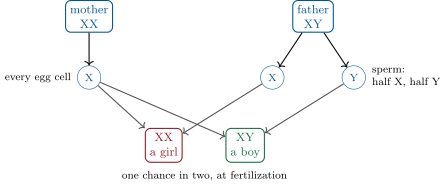
Pair 23 comes in two versions: two matching X chromosomes — the karyotype of a girl; or one X and a small Y — a boy. The halving then runs the flip: every egg cell carries an X; a sperm cell carries X or Y, half and half. Fertilization by an X-sperm makes XX, by a Y-sperm XY — one chance in two (Chapter 63’s language of chance, finally with its mechanism), decided by which swimmer arrives, at the instant of fertilization.
Example 64.7 (Old questions, short answers)
The deck settles historic scores. Whether a child is a boy or a girl owes nothing to either parent’s wishes, diets or seasons — it is the flip, run in Definition 64.6’s mechanism (and, for the record of old injustices: the deciding difference rides in the sperm). Equal halves also answer the family album: mother and father contribute one full half-deck each — 23 and 23 — and heredity’s arithmetic honors both lines alike.
Method 64.8 (Reading a karyotype)
Handed a karyotype photograph:
- count: 46 expected in a body cell, 23 in a gamete;
- pair: partners matched by size and banding, 22 ordinary pairs plus the 23rd;
- read the 23rd: XX or XY;
- check the counts: any pair with one or three members explains, by Proposition 64.5, a shifted development.
64.3 Exercises
Exercise 64.1 ★
What is a chromosome, and when is it visible?
Exercise 64.2 ★
Give the three human counts, and where each holds.
Exercise 64.3 ★
Run the fertilization arithmetic, and say what it restores.
Solution
Solution of Exercise 64.3.
: fertilization restores the pairs, one partner of each from the mother, one from the father — both parents in every body cell of the child.
Exercise 64.4 ★
Why must gametes halve the deck? Show the runaway otherwise.
Exercise 64.5 ★
What are the two versions of pair 23, and which parent’s gamete decides between them?
Exercise 64.6 ★
What does an extra copy of chromosome 21 produce, and what does that prove about the threads?
Solution
Solution of Exercise 64.6.
The recognizable trait-set called Down syndrome. It proves the threads carry trait-instructions: one thread’s count changed, many traits shift.
Exercise 64.7 ★★
Where exactly does Proposition 54.5’s shuffle happen, in this chapter’s terms — and how large is one parent’s shuffle space?
Solution
Solution of Exercise 64.7.
In the halving division: which partner of each pair a gamete receives is settled independently, pair by pair — possible half-decks per parent, before fertilization multiplies two such spaces together.
Exercise 64.8 ★★
Match each requirement of Proposition 63.6 to the chromosome behavior that satisfies it.
Exercise 64.9 ★★
“The chance of a boy is one in two at every birth, whatever came before.” Defend with the mechanism — why does a run of three girls change nothing?
Solution
Solution of Exercise 64.9.
Each fertilization is a fresh flip: the sperm population is half X, half Y at every attempt, and no past birth reaches into the race. Three girls are three fair flips — the fourth is as fair.
Exercise 64.10 ★★
Run Method 64.8 on: (a) a 46,XX body cell; (b) a 23,Y gamete; (c) a body cell with 47, the extra in pair 21.
Solution
Solution of Exercise 64.10.
(a) A body cell of a girl or woman: full deck, XX. (b) A sperm cell carrying the Y: a gamete, half-deck — its fertilization would make a boy. (c) A body cell with the pair-21 extra: 47 threads — the karyotype of Down syndrome, XX: a girl’s.
Exercise 64.11 ★★
History blamed queens for kingdoms’ daughters. Correct the record with Example 64.7, gamete by gamete.
Solution
Solution of Exercise 64.11.
Every egg the queens supplied carried an X — their contribution to pair 23 admits no alternative. The X-or-Y variety rides in the kings’ gametes alone: if the record must assign the flip’s coin, it sat in the royal sperm — and in any case the flip is chance, blamable on no one.
Exercise 64.12 ★★★
The body’s every cell carries the full 46 — yet a neuron and a skin cell differ utterly (Remark 45.6). Formulate the puzzle this sets, and the direction of its resolution (the next chapter’s business: what, on a chromosome, is read).
Solution
Solution of Exercise 64.12.
The puzzle: one deck, many cell kinds — if every cell holds the same 46 threads of instructions, why is a neuron not a skin cell? Direction of resolution: cells must differ in which instructions they read, not which they hold — the deck is a library, and specialization is a borrowing policy. What the readable units on a chromosome are is the next chapter’s question.
64.4 Problem: The Cytogenetics Bench
Problem 64.1
Weekend problem — four karyotypes on one light table
A hospital cytogenetics lab’s teaching table: karyotype A — 46 chromosomes, 23rd pair XY; B — 46, 23rd pair XX; C — 23 chromosomes, one X among them; D — 47, with three copies at pair 21, 23rd pair XX.
Part I — The readings.
- Read A, B and C by Method 64.8: whose cells could each be?
- C’s count is not an error. What kind of cell is it, and what history of division does its 23 record?
- Read D: count, pair, and the development it announces.
- Which parent’s gamete decided A’s 23rd pair, and what were the odds at that fertilization?
Part II — The arithmetic questions.
- A trainee asks why body cells of one person all agree with karyotype A. Answer with the copying divisions of Proposition 29.7.
- Another asks how two 46-cell parents made C’s 23. Name the special division and its rule.
- Combine C with an X-bearing egg cell, and with its own lab’s Y-bearing neighbor — wait: C is Y-free. State what C’s X guarantees about any child it helps make.
- Compute the possible decks one parent can deal: state the pair-by-pair independence and the conclusion — then add fertilization’s pairing of two such deals.
Part III — The counseling room.
- Parents of a child with karyotype D ask “what did we do wrong?” Give the mechanism’s honest answer about halving accidents — and what the child’s 47 threads do and do not change about the love in the room. (Answer as the counselor, with the biology straight.)
- A couple with three daughters asks the odds of a son next. Answer with the flip, and correct the run-of-luck instinct.
- A visitor claims a diet can choose a baby’s sex. Audit the claim against Definition 64.6: where is the decision made, and what could a diet reach?
- Close the bench with one sentence: what the four photographs together prove about where heredity rides.
Solution
Solution of Problem 64.1.
1. A: a body cell of a boy or man — 46, XY. B: a body cell of a girl or woman — 46, XX. C: a gamete — 23, one partner per pair; its X makes it either an egg cell or an X-sperm.
2. A gamete. Its 23 records the special halving division: from a 46-cell, one partner of each pair taken, no pair complete.
3. 47 threads, the extra at pair 21, 23rd pair XX: the karyotype of a girl with Down syndrome — one miscounted thread, a shifted development.
4. The father’s — his sperm’s X-or-Y. Odds at the meeting: one in two, each way.
5. Because the body grew from one zygote by copying divisions: each division duplicates the deck and deals a full copy to each daughter cell — 46 faithful copies from skin to neuron.
6. The gametes’ halving division, with its rule: one partner from each of the 23 pairs — a complete half-deck, no pair doubled, none dropped.
7. That the child receives an X from it: whatever partner arrives from the other side, C’s contribution to pair 23 is fixed — an X-gamete writes X into the child’s 23rd pair unconditionally.
8. Each of the 23 pairs contributes either partner, independently: , 23 times — half-decks, several million, from one parent. Fertilization pairs one such deal from each parent: the two spaces multiply, and the shuffle’s arithmetic explains why siblings never repeat.
9. Nothing was done wrong: the extra 21 arises in a halving accident — a pair’s partners failing to separate — a mischance of the mechanism, not of the parents’ acts or worth. The 47th thread shifts the child’s development; it changes nothing about the child being wholly their child — the counseling truth and the cytogenetic truth agree.
10. One in two, exactly as at every birth: the sperm population is half X, half Y at each fertilization, and past flips leave no trace in it. The run feels meaningful; the mechanism keeps no memory.
11. The decision is made at fertilization, by which sperm arrives — inside the father’s contribution, in the race’s last millimetres. A diet reaches neither the sperm population’s half-and-half manufacture nor the race’s outcome: the claim has no link to block or bias — Method 59.8’s question 1, failed again.
12. Heredity rides on countable threads in the nucleus: halved into gametes, restored at fertilization, trait-shifting when miscounted, sex-deciding at pair 23 — four photographs, one vehicle.