Primary & Middle School Biology · Grades 1–9
35People and Nature
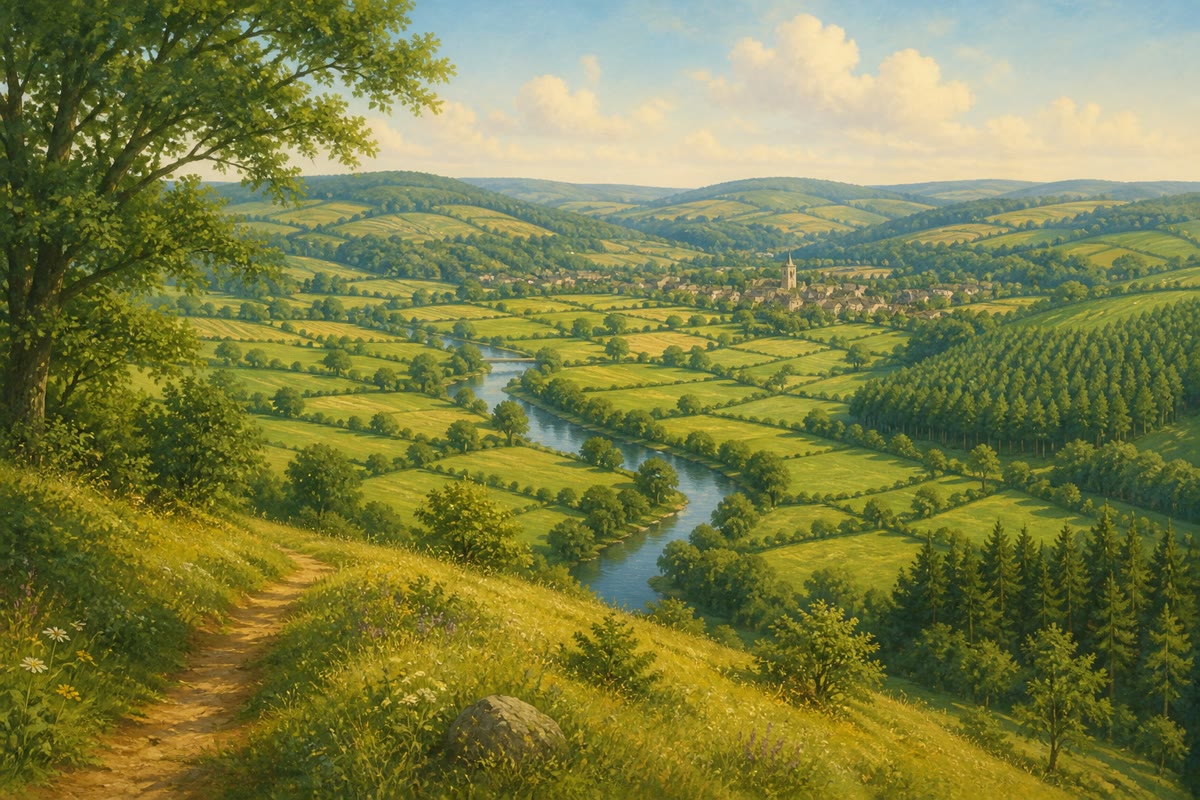
From a hilltop, look down at the valley: fields in neat squares, a managed forest, straightened riverbanks, roads, roofs. Almost nothing in sight grew that way by itself. Humans are the one species that reshapes whole landscapes to its needs — and this chapter looks honestly at that power: what it gives us, what it costs, and how it can be used well.
35.1 Landscapes made by people
Proposition 35.1 (Most landscapes are managed)
Nearly every landscape around us is shaped by people:
- fields are managed ground where one chosen plant — wheat, maize, potatoes — is grown in place of the wild mixture;
- most forests are planted, thinned and harvested like slow crops;
- meadows exist because they are mowed or grazed — abandoned, they grow back to scrub and then woodland;
- towns, roads and dams redraw the land itself.
“Untouched” corners are the exception, and most are protected on purpose.
Proof. Admitted at this level. ∎
Example 35.2 (Reading the valley)
That hilltop view, item by item: the wheat field feeds the bakery; the spruce rows are a timber crop older than their forester; the flowery meadow is mowed each July — skip two summers and brambles take it; the river was straightened long ago to protect the fields from floods. The valley is a workshop — one that has been running for centuries.
Remark 35.3 (Neither villain nor garden gnome)
It would be false to tell this story as pure destruction — farming feeds humanity, and hedged farmland can be rich in species (Example 30.6) — and just as false to pretend reshaping costs nothing (Proposition 30.8 listed the bills). The honest question is never “touch nature or not?” but “how to manage what we touch so it keeps working — for us and for the rest of the web?”
35.2 Managing well and managing badly
Example 35.4 (Two ways to farm a hillside)
Hillside A: one giant field, hedges grubbed out, soil bare all winter. Rain washes the loosened soil downhill; the helpers of Example 30.6 have no home; one pest can sweep the single crop unopposed. Hillside B: smaller fields with hedges kept, soil covered through winter, crops rotated year by year. The hedges hold the soil and house the pest-eaters; the rotation rests the ground. Both hillsides feed people — one still will in a hundred years.
Proposition 35.5 (The rules of lasting use)
Use of nature lasts when it respects three rules:
- take no faster than it renews: harvest wood at the forest’s growing pace, fish at the shoal’s breeding pace — the overfishing of Proposition 30.8 is this rule broken;
- keep the workers: soil life, pollinators, pest eaters — the free services of Exercise 30.11 — need their homes kept;
- return what you borrow: the compost loop of Remark 22.5, at every scale.
Proof. Admitted at this level. ∎
Example 35.6 (The forester’s arithmetic)
A well-run forest is the oldest proof that rule 1 works: foresters count what the forest grows each year, and cut no more than that. The forest then yields timber every year, forever — while remaining a forest, with its owls, deer and beetles. Some managed forests in the world have been harvested this way for many hundreds of years without shrinking.
35.3 Cities, and making room again
Example 35.7 (Nature in town)
A city looks like nature’s opposite, yet it is a habitat too — a strange rocky one. Swifts nest on “cliffs” of concrete, foxes patrol the bins, wild plants split the asphalt seams. And town-dwellers can widen the welcome: parks, green roofs, balcony flowers for the bees, the school pond of Example 11.8. The methods of Method 30.9 work between buildings too.
Example 35.8 (Giving a river its bends back)
The straightened river of the valley ran fast and flooded badly downstream; its fish and dragonflies had gone with the bends. Engineers now sometimes re-bend such rivers: restored curves and wet meadows slow the water, store the floods, and the storks of Example 30.10 find their meadows again. Management can run in reverse — repairing is managing too.
Method 35.9 (Judging a use of nature)
Given any use of land or water — a farm, a fishery, a planned road, a garden:
- ask what is taken, and whether faster than it renews (rule 1);
- ask what homes and workers are kept or lost (rule 2);
- ask what is returned — and what wastes are left (rule 3);
- then judge: could this go on for a hundred years? What one change would most improve the answer?
35.4 Exercises
Exercise 35.1 ★
Give four kinds of human-shaped landscape from Proposition 35.1, each with what it is managed for.
Solution
Solution of Exercise 35.1.
Fields, managed for one chosen crop; forests, managed for timber; meadows, kept open for hay or grazing; towns, roads and dams, built for living and moving. (Any four with their purposes.)
Exercise 35.2 ★
What happens to a meadow that stops being mowed or grazed?
Solution
Solution of Exercise 35.2.
Left unmowed and ungrazed, it grows back to scrub within a few years, and then to woodland — the open, flowery meadow habitat disappears.
Exercise 35.3 ★
State the three rules of lasting use.
Solution
Solution of Exercise 35.3.
Take no faster than it renews; keep the workers (the species whose free services the use depends on); return what you borrow (close the loops, leave no piling wastes).
Exercise 35.4 ★
In Example 35.4, list three differences between the two hillsides, and what each difference changes.
Solution
Solution of Exercise 35.4.
Hedges grubbed out versus kept: A loses the soil-holders and the homes of pest-eaters. Bare winter soil versus covered: A’s soil washes downhill in the rains. One giant single crop versus rotation: A invites any pest of that crop to sweep the whole hillside, and never rests the ground.
Exercise 35.5 ★
Explain the forester’s arithmetic. Which rule is it, and what does the forest yield in return — for how long?
Solution
Solution of Exercise 35.5.
Count what the forest grows in a year; cut no more than that. It is rule 1 — take no faster than it renews — and the forest yields timber every year, indefinitely, while remaining a living forest.
Exercise 35.6 ★
Name three wild inhabitants of cities, and what feature of the city each uses as habitat.
Exercise 35.7 ★
What did re-bending the river restore — for people, and for the web?
Exercise 35.8 ★
Try it: pick one view near home — street, field, park — and list everything in it that people manage, as in Example 35.2. Anything left unmanaged?
Solution
Solution of Exercise 35.8.
Open answer. Typical finds: mowed verges, pruned trees, planted beds, weeded pavements — with perhaps one unmanaged wall-top or ditch, which is often the wildest spot in view.
Exercise 35.9 ★★
“Protecting nature means never touching it.” Discuss using the mowed meadow of Proposition 35.1 — a habitat that disappears without human touch — and Remark 35.3.
Solution
Solution of Exercise 35.9.
Never-touching would actually destroy some habitats: the flowery meadow exists because of mowing, and grows shut without it. Protecting nature is not zero touch but good management — the honest question is how to touch: which rules the use respects, not whether hands were laid on at all.
Exercise 35.10 ★★
Run Method 35.9 on hillside A of Example 35.4: which rules does it break, and what one change would most improve it?
Solution
Solution of Exercise 35.10.
Rule 2 broken outright (workers evicted with the hedges), rule 3 partly (soil washed away is never returned), and rule 1 endangered (soil lost faster than soil forms). Most improving single change: replant the hedges — they hold the soil and rehouse the pest-eaters at one stroke.
Exercise 35.11 ★★★
A fishing fleet doubles its catch for five splendid years; in the sixth, the shoals are gone and the fleet is idle. Explain the six years with rule 1 — why did breaking it look like success at first? Compare with the forester’s opposite arithmetic.
Solution
Solution of Exercise 35.11.
The doubled catch took fish far faster than the shoals bred — spending the breeding stock itself. Spending capital always looks splendid while it lasts: the holds were full precisely because next year’s fish were being landed this year. The forester harvests only the year’s growth and keeps the growing stock whole — same arithmetic, opposite sign, which is why the forest yields forever and the fleet stopped in year six.