Primary & Middle School Biology · Grades 1–9
53Removing the Wastes
Deliveries have dominated this year: oxygen in, nutrients in, fuel to every working cell. But every workshop makes waste, and a delivery service that never collects the rubbish soon poisons its own city. The carbon dioxide account is already settled — breathed out at the alveoli. This closing chapter follows the other wastes, to the body’s discreetest organs: the kidneys.
53.1 The wastes beyond carbon dioxide
Proposition 53.1 (The cells’ other rubbish)
The cells’ burning and building (Proposition 46.5, Proposition 41.1) yield more than carbon dioxide. Using building-matter nutrients, in particular, leaves a nitrogen-bearing waste — urea — which the blood collects from every tissue exactly as it collects carbon dioxide. Urea is harmless in passing traffic and poisonous piled up: it must leave, continuously.
Proof. Admitted at this level. ∎
Example 53.2 (Two collection rounds, one blood)
The same drop of Example 52.5 runs both collections at once: at the thigh’s capillaries it takes on carbon dioxide and urea. The first it drops at the lungs, next circuit. The second rides on — past the lungs, which cannot touch it — until the body circuit carries it through the organs built for exactly this cargo.
53.2 The kidneys, the blood’s filters
Definition 53.3 (Kidneys and the urinary system)
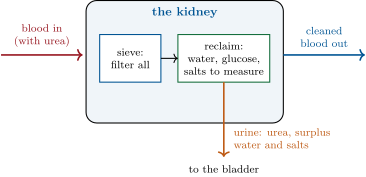
The two kidneys — fist-sized, bean-shaped, low in the back — are blood-cleaning filters. Each receives a generous artery straight from the body circuit’s main line. Inside, the blood is filtered through about a million microscopic filter units; the cleaned blood returns by the kidney’s vein, and the removed load — urea, surplus water, surplus salts — leaves as urine, trickling down two tubes to the bladder, the holding tank emptied at will.
Proposition 53.4 (Filter, then reclaim)
The kidney’s trick is generosity followed by thrift. The filter units first push a huge volume of the blood’s watery part — many tens of litres a day — through their fine sieves, urea, sugars, salts and all. Then, along each unit’s winding tube, the body reclaims what it wants back: nearly all the water, all the glucose, salts to measure — leaving the urea and the surpluses behind. Of the tens of litres sieved, about a litre and a half leaves as urine: filter everything, take back the good, and the waste has nowhere to hide.
Proof. Admitted at this level. ∎
Example 53.5 (Reading the thrift)
The reclaiming stage explains the everyday observations. Drink much, and the kidneys reclaim less water: urine plentiful and pale. Sweat a hot match dry, and they reclaim nearly all: urine scant and dark — the body guarding its water (Proposition 22.3 taught water’s value for plants; the kidney is the animal side of the same economy). And glucose in the urine, which the sieve lets through but reclaiming should recover completely, is a classic medical signal that something — reclaiming or blood sugar — is out of order.
Remark 53.6 (The skin lends a hand)
Sweat is a sideline of the same business: water and salts (with traces of urea) released at the skin — though its first job is Example 49.5’s cooling. The lungs, kidneys and skin divide the body’s whole waste removal: carbon dioxide to the first, urea and the surpluses to the second, heat and a salty trickle to the third. Nothing poisonous is left to pile up — in a healthy body, the rubbish never wins.
53.3 The year’s machine, complete
Proposition 53.7 (The full supply-and-removal loop)
With the kidneys in place, this year’s tour closes into one machine. The blood, pumped round the double circuit (Definition 52.3), loads oxygen at the alveoli and nutrients at the villi; delivers both to every working cell for burning and building; and collects the wastes — carbon dioxide to the lungs, urea and surpluses to the kidneys. Every organ of grades four and seven is a station of this single loop; every exchange crosses a capillary wall; and the whole runs on Proposition 46.5’s slow fire, cell by cell.
Proof. Admitted at this level. ∎
Method 53.8 (The whole-body audit)
For any substance, audit its passage:
- entry: mouth and villi, or nose and alveoli;
- transport: which circuit legs, which special stops (liver);
- use: fuel burned, material built in, or neither;
- exit: alveoli (gas), kidneys (urea, surpluses), skin (sweat’s share) — or, never absorbed at all, the leftovers’ route (Proposition 25.5).
Run it on water, on glucose, on a salty crisp: the machine has a station for every step, which is the year’s finding in one exercise.
53.4 Exercises
Exercise 53.1 ★
What is urea — from what use does it arise, and why must it leave?
Exercise 53.2 ★
Which wastes leave at the lungs, which at the kidneys, and which at the skin?
Exercise 53.3 ★
Describe the kidneys: number, size, place, and their plumbing to the bladder.
Exercise 53.4 ★
State the filter-then-reclaim trick, with the two volumes that frame it.
Exercise 53.5 ★
What is reclaimed completely, what to measure, and what not at all?
Exercise 53.6 ★
Why is urine plentiful and pale one day, scant and dark another?
Exercise 53.7 ★★
Why can the lungs not remove urea, and the kidneys not remove carbon dioxide fast enough? What does the divided labor say about the two wastes’ forms?
Solution
Solution of Exercise 53.7.
Carbon dioxide is a gas, and gases cross at an air border — the alveoli; urea is not a gas and cannot leave with the breath, but it rides dissolved and filters beautifully at a liquid border — the sieves. Each waste exits by the border its form suits: the division of labor is chemistry matched to architecture.
Exercise 53.8 ★★
Explain why glucose in the urine alarms a doctor, through the sieve-and-reclaim stages.
Solution
Solution of Exercise 53.8.
The sieve passes glucose freely — that is normal; the reclaiming stage should then recover every unit of it. Glucose arriving in the urine means reclaiming was overwhelmed or broken: either blood sugar so high the recovery cannot keep pace, or the recovery itself failing — both worth a doctor’s attention.
Exercise 53.9 ★★
Follow one urea unit from a thigh muscle’s capillary to the bladder, station by station.
Exercise 53.10 ★★
Run Method 53.8 on a glass of water drunk after sport.
Solution
Solution of Exercise 53.10.
Entry: no dismantling, crossing at the villi into the blood. Transport: liver first, then both circuits. Use: the medium of every cell’s wet chemistry, and the cooling system’s supply. Exit: shared among urine (tuned by reclaiming), sweat (the sporty share), breath’s moisture, and a little in the leftovers.
Exercise 53.11 ★★
Kidney patients whose filters fail visit a machine that cleans their blood through an artificial membrane. Which stage of Proposition 53.4 does the machine copy, and why must sessions recur every few days?
Solution
Solution of Exercise 53.11.
The sieve — filtering wastes from blood across a fine membrane; the machine is an external filter unit. Sessions recur because the cells never stop making urea (Proposition 53.1): a filter that runs twice a week must catch up on days of accumulation, where the kidneys’ sieves run every minute.
Exercise 53.12 ★★★
Write the year’s summary paragraph promised by Proposition 53.7: one blood, two circuits, four borders (alveoli, villi, muscle capillaries, kidney filters) — and the slow fire that the whole machine serves.
Solution
Solution of Exercise 53.12.
For example: one blood, driven round the lung and body circuits by the four-roomed heart, loads oxygen at the alveoli and nutrients at the villi, and delivers both to every cell’s capillaries, where the slow fire of respiration burns fuel with oxygen to power all work. The same blood collects the fire’s ashes — carbon dioxide to the alveoli, urea and surpluses to the kidney’s sieve-and-reclaim filters — so the four borders serve one economy. Every organ of the year is a station of this loop, and the loop exists so that the fire in the cells never lacks fuel, oxygen, or rubbish collection.
53.5 Problem: The Day of a Water Molecule
Problem 53.1
Weekend problem — one glass of water, audited through the whole machine
Follow a glass of water drunk at breakfast on a sports day, as the year’s grand audit.
Part I — Entry and transport.
- Water needs no dismantling (Definition 50.4). Name its entry crossing and the vessel network that receives it.
- Its blood makes the standard first stop. Which organ, and why is the routing sensible for nutrients even if water itself needs no sorting?
- By mid-morning the water is everywhere the blood goes. Name the two circuits it now rides in alternation.
- Some of it is soon inside working cells. List two jobs water does there (recall that the cells’ chemistry — juices, burning — runs wet).
Part II — The afternoon match.
- During the match, part of the water leaves by a border that is not an excretory organ first. Name it, its cargo besides water, and its real job that day.
- The match over, the player is thirsty and her urine that evening is scant and dark. Explain both with the reclaiming stage.
- Meanwhile the match’s hard-worked muscles made extra carbon dioxide and urea. Assign each its exit border, and the circuit legs that took it there.
- Why did the kidneys keep working right through the match, though urine production fell? What were they still removing?
Part III — The audit closed.
- Next morning, some of the glass has left in breath. Explain how water exits at the alveoli (Example 26.7 showed it years ago).
- Draw up the glass’s full ledger: entry, stores and uses, and its four exits — urine, sweat, breath, and the small share in the leftovers.
- The audit shows one blood serving lungs, villi, muscles, kidneys and skin in turn. State, in two sentences, why this single-network design makes every organ’s health every other organ’s business.
- Close the year: which single idea — name it — did every station of this audit turn out to serve? (Proposition 46.5 holds the answer.)
Solution
Solution of Problem 53.1.
1. Crossing at the villi of the small intestine, into the capillaries — the blood network receives it.
2. The liver. The routing serves the nutrients sharing the same blood — sorting and banking — and water simply rides the standard line through it.
3. The lung circuit and the body circuit, in strict alternation through the four-roomed heart.
4. It is the medium of the cells’ chemistry — juices and burning run dissolved — and the carrier of everything the blood transports; it also feeds the cooling reserve the afternoon will spend as sweat.
5. The skin: sweat — water and salts — whose real job that day is cooling the furnace-hot working muscles (Remark 49.3).
6. Sweating spent the water account; the kidneys’ reclaiming stage answered by taking nearly all sieved water back — scant, concentrated, dark urine — while thirst demanded the account be refilled.
7. Carbon dioxide: muscle capillary, vein, right heart, alveoli — breathed out. Urea: the same return, then past the lungs, left heart, kidney artery, sieved and sent bladder-ward.
8. Urea and the salts of sweat-changed blood: waste production never pauses, so the sieves never may. Urine volume fell — reclaiming kept the water — but the cleaning ran on.
9. The alveolar surface is moist, and each breath sweeps warmed, moistened air out — the misted mirror’s water. Part of any glass leaves as breath’s humidity.
10. Entry: villi. Stores and uses: blood volume, cell chemistry, cooling reserve. Exits: urine (reclaim-tuned), sweat (the match’s share), breath’s moisture, and a small share never absorbed, out with the leftovers.
11. Because every organ draws supplies from, and unloads wastes into, the one shared blood: a failing lung starves every muscle, a failing kidney poisons every cell, a furred artery throttles whichever station lies beyond it. One network means one fate, station by station.
12. Respiration — the slow fire in every cell: entry, transport, burning, building and every waste border exist to feed it, supply it, and carry away its ashes.