Primary & Middle School Biology · Grades 1–9
7Born, Growing, Dying
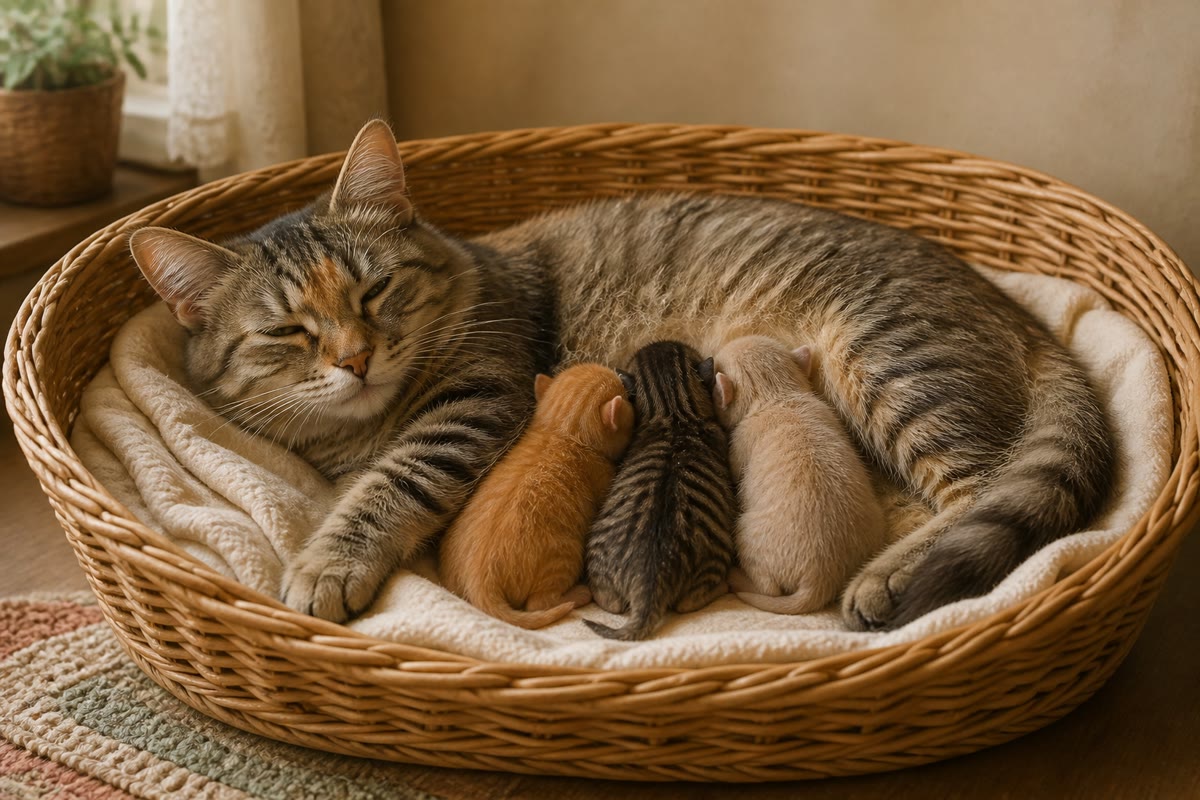
In the spring, the cherry tree by the gate is covered in blossom; under it, a cat nurses her newborn kittens; and Grandpa shows a photograph of himself when he was your age — small, gap-toothed, and already fond of cherries. Every living thing travels the same road: it begins, it grows, and one day it ends. That road is called the life cycle.
7.1 The stages of a life
Definition 7.1 (Life cycle)
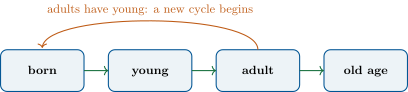
The life cycle of a living thing is the row of stages its life goes through:
- it is born — the beginning;
- it is young — it grows and changes fast;
- it is an adult — fully grown; adults can have young of their own;
- it grows old, and at the end it dies.
Example 7.2 (Three lives, same road)
A kitten is born, plays and grows into a cat, who may have kittens herself, and grows old. A cherry seed sprouts, the young tree grows taller for years, the adult tree makes blossom and cherries, and after many tens of years it dies. And you: baby, child, then one day a grown-up. Kitten, cherry tree, child — the same four stages.
Remark 7.3 (Why it is called a cycle)
Each single life runs from birth to death, like a road with two ends. But before the end, adults have young, and those young start the road again. Seen over many generations, life turns like a wheel — that is why we say life cycle.
7.2 Growing and changing
Proposition 7.4 (Growing up is more than getting bigger)
While it grows, a young living thing also changes: a baby gets teeth, loses them, and gets stronger ones; a chick’s yellow fluff becomes real feathers; a young tree’s soft green stem turns to hard wood. Growing is getting bigger and becoming different.
Proof. Admitted at this level. ∎
Example 7.5 (The photograph test)
On Grandpa’s old photographs you can follow one person through every stage: baby, schoolchild, young man, father, grandfather. Same person, changing body. Photographs are little time machines for watching a life cycle.
Method 7.6 (Putting life stages in order)
Given pictures of a living thing’s life, mixed up:
7.3 Every life ends — and life goes on
Proposition 7.7 (Lifespans)
Different living things live different lengths of time — a lifespan. A butterfly may live a few weeks; a cat, and a dog, ten to twenty years; a person often more than eighty years; some trees, hundreds of years. Long or short, every life has an end.
Proof. Admitted at this level. ∎
Example 7.8 (The old apple tree)
The bent old apple tree at the end of the garden gives fewer apples each year — it is in its old age. But its apples have pips, and one pip, planted, is already a young apple tree beginning the road. When the old tree dies, apple trees will not be gone: its young carry on.
Remark 7.9 (Talking about death)
Dying belongs to every life cycle, and it is all right to feel sad about it — people do, especially about pets and about people we love. Biology adds one comfort: because adults have young before they die, life itself continues, cycle after cycle.
7.4 Exercises
Exercise 7.1 ★
Name the four stages of a life cycle, in order.
Exercise 7.2 ★
At which stage can a living thing have young of its own?
Exercise 7.3 ★
Put in order, oldest to youngest: a schoolchild, a baby, a grandmother, a mother.
Solution
Solution of Exercise 7.3.
Oldest to youngest: the grandmother, the mother, the schoolchild, the baby.
Exercise 7.4 ★
Give the life cycle of the cherry tree of Example 7.2, stage by stage.
Exercise 7.5 ★
Give two examples from Proposition 7.4 of a young living thing changing while it grows, not just getting bigger.
Exercise 7.6 ★
Who usually lives longer: a butterfly, a cat, or an oak tree? Put the three in order of lifespan.
Solution
Solution of Exercise 7.6.
Shortest to longest: the butterfly (a few weeks), the cat (ten to twenty years), the oak tree (hundreds of years).
Exercise 7.7 ★
Why is the word cycle used, when each single life runs from birth to death like a road? Use the figure’s purple arrow.
Solution
Solution of Exercise 7.7.
Because before the road ends, adults have young, and the young begin the road again — that is the purple arrow looping back. One life is a road; life over the generations turns like a wheel.
Exercise 7.8 ★
Try it: ask your family for photographs of one grown-up at different ages, and put them in life-cycle order with Method 7.6. Which stages do the photographs show? Which stage is still to come?
Exercise 7.9 ★★
The old apple tree of Example 7.8 will die one day, yet the garden need not lose its apple trees. Explain why, with the word generation or the purple arrow of the figure.
Solution
Solution of Exercise 7.9.
The old tree’s apples carry pips — seeds — and each planted pip is a young apple tree: the next generation. When the old tree dies, its young continue the cycle, so the garden keeps its apple trees.
Exercise 7.10 ★★
A pebble never dies. Is that because it is very strong? Use Chapter 1’s idea of living and non-living to explain.
Solution
Solution of Exercise 7.10.
No — it is because the pebble was never alive. Only living things are born, grow and die; a pebble has no life cycle at all, so “never dying” is not strength, it is not living.