Primary & Middle School Biology · Grades 1–9
26Breathing
Hold your breath and start counting. Long before one minute, your chest demands, more and more urgently, to move again. You can skip a meal, sleep can wait until tonight — but air is needed now, around the clock, about fifteen times a minute. What is so urgent in a breath of air?
26.1 The breathing movements
Definition 26.1 (Breathing in and out)
Breathing is the endless alternation of two movements:
- breathing in (inhaling): the chest expands and air flows in through nose or mouth;
- breathing out (exhaling): the chest relaxes and air flows back out.
At rest, the pair repeats about times a minute — faster in babies, faster in effort — without your ever needing to think about it.
Example 26.2 (Watching the movements)
Hands flat on your ribs: breathing in, the rib cage rises and widens under your palms; breathing out, it sinks back. A sleeping cat’s flank shows the same rise and fall. The movements never stop — awake, asleep, from first cry to last day.
26.2 Where the air goes
Definition 26.3 (The breathing organs)
Inhaled air travels through the nose (or mouth), down the windpipe — the firm ringed tube you can feel at the front of your neck — which divides into two branches, one to each lung. The lungs, two spongy organs filling the rib cage (behind the ribs of Definition 17.1), end in millions of tiny air pockets, each wrapped in fine blood vessels.
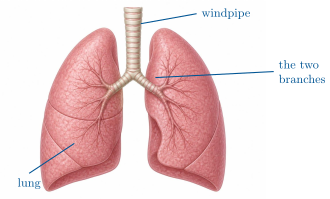
Remark 26.4 (Spongy on purpose)
Millions of pockets instead of two simple bags: it is the small intestine’s trick again (Remark 25.6). All those pocket walls add up to an enormous meeting surface between air and blood — the size of half a tennis court, folded into your chest.
26.3 What breathing is for
Proposition 26.5 (Taking oxygen, returning carbon dioxide)
Air is a mixture of gases, and the body wants one of them: oxygen. In the lungs’ pockets, oxygen from fresh air passes into the blood, which delivers it to every part of the body; there it is used, together with nutrients, to release the energy of Proposition 18.1. The body’s waste gas, carbon dioxide, makes the return trip and is breathed out. Exhaled air has less oxygen and more carbon dioxide than inhaled air — the difference is what breathing is for.
Proof. Admitted at this level. ∎
Example 26.6 (Why running takes your breath)
Sprinting, your legs burn energy fast — so they need oxygen fast. Breathing obliges: from about calm breaths a minute to or more, deep ones, while the heart (Chapter 27 tells its side) races to speed the deliveries. The panting after the race is the body settling its oxygen accounts.
Example 26.7 (The misted mirror)
Breathe on a cold mirror: mist. Exhaled air comes back changed — warmed, moistened, and, invisibly, poorer in oxygen and richer in carbon dioxide. The mirror shows the moisture; the gas swap it cannot show is the important part.

Method 26.8 (Caring for the breath)
- Air rooms daily — many breathers in a closed room means stale, carbon-dioxide-rich air;
- breathe through the nose in cold or dusty air: it warms, moistens and filters;
- run, swim, play — exercised lungs and breathing muscles grow stronger and deeper;
- keep smoke away from your lungs: it dirties the delicate pockets, and they clean themselves only slowly.
26.4 Exercises
Exercise 26.1 ★
Name the two breathing movements and what the chest does in each.
Exercise 26.2 ★
Trace a breath’s path from the nose to the tiny air pockets.
Exercise 26.3 ★
About how many times a minute does a calm resting child breathe? What happens to that number during a sprint, and why?
Exercise 26.4 ★
Which gas does the body take from the air, and which does it return? Where exactly does the swap happen?
Exercise 26.5 ★
How does exhaled air differ from inhaled air? Name three differences.
Solution
Solution of Exercise 26.5.
Exhaled air is warmer, moister (the misted mirror), poorer in oxygen and richer in carbon dioxide.
Exercise 26.6 ★
Why are the lungs built as millions of tiny pockets rather than two simple bags? Which other organ of this year uses the same trick?
Solution
Solution of Exercise 26.6.
Because the air-blood swap needs surface: millions of pocket walls add up to half a tennis court of meeting surface folded into the chest. The small intestine plays the same trick with its folds for absorbing nutrients.
Exercise 26.7 ★
Why is it better to breathe through the nose on a freezing or dusty day?
Solution
Solution of Exercise 26.7.
The nose warms, moistens and filters the air on its way in — cold, dry, dusty air reaches the delicate lungs already prepared.
Exercise 26.8 ★
Try it: sitting calmly, count your breaths for one minute. Then do twenty jumping jacks and count again. Report both numbers and explain the change.
Exercise 26.9 ★★
Meals can wait hours; breathing cannot wait a minute. What does this say about how much oxygen the body keeps in store, compared with its stores of food?
Solution
Solution of Exercise 26.9.
That the body stores food generously (hours’ or days’ worth) but keeps almost no store of oxygen at all — barely a minute’s. Oxygen must therefore be delivered continuously, breath by breath, which is why breathing can never pause long.
Exercise 26.10 ★★
A classroom feels “stuffy” by late morning. What has changed in its air, by Proposition 26.5, and what does Method 26.8 prescribe?
Solution
Solution of Exercise 26.10.
Twenty-five breathers have been taking oxygen from the room’s air and returning carbon dioxide all morning: its air has grown poorer in one and richer in the other. The prescription is rule 1: open the windows and air the room.
Exercise 26.11 ★★★
The trout has no lungs: water flows over its feathery gills, and the oxygen dissolved in the water passes into its blood there. What job do gills and lungs share? And why does a trout suffocate in air, where oxygen is plentiful? (Hint: out of water, the feathery gill surfaces collapse and stick together.)
Solution
Solution of Exercise 26.11.
Both are the meeting place of blood and oxygen: huge, thin, blood-lined surfaces where oxygen crosses in and carbon dioxide crosses out — gills taking oxygen dissolved in water, lungs taking it from air. In air the trout’s feathery gill surfaces collapse and stick together: the great crossing surface shrinks to almost nothing, and no crossing surface means no oxygen, however rich the air around it.