Primary & Middle School Biology · Grades 1–9
42Decomposers and the Soil
Every autumn, the wood drops a thick carpet of leaves — tonnes of them per hectare. Yet walk the same wood each spring and you wade through no rising sea of leaf litter: the carpet is thin again, year after year. Somebody is eating the forest’s dead. This chapter goes down into the soil to meet the eaters — and to close, at last, the circle of matter.
42.1 The soil is alive
Definition 42.1 (Soil)
Soil is the earth’s living skin: a mixture of mineral grains (ground rock, from sand to clay), organic remains in every stage of decay, water, air — and an enormous population of living things. Its dark upper layer, richest in decayed matter, is the humus layer that gardeners prize.
Example 42.2 (A handful, censused)
One handful of woodland soil, sorted on a white tray: mineral grains; root threads; half-leaves, leaf skeletons and black crumbs — organic matter on its way down; and the census — an earthworm, two woodlice, a millipede, tiny white springtails, thread-fine fungus felts. And the tray shows only the visible: a single gram of soil holds more living things too small to see than there are people in a great city.
Definition 42.3 (Decomposers)
The decomposers are the living things that feed on dead organic matter — fallen leaves, dead wood, droppings, corpses:
- the visible crew: earthworms, woodlice, millipedes, springtails, fly larvae, dung beetles;
- the fungi: molds and mushrooms, whose feeding body is a felt of white threads spread through soil and dead wood — the mushroom of Exercise 1.10 is only its fruit;
- and, finishing every job, soil life too small to see — the final dismantlers.
They are Definition 34.3’s shadow-workers, promised their own chapter: this is it.
42.2 Decomposition: organic back to mineral
Proposition 42.4 (What decomposition does)
Decomposition is the feeding of the decomposers, and its result is the reverse of the producers’ trade: dead organic matter is dismantled, stage by stage and eater by eater, until its substance is returned to the mineral world — crumbly humus, then dissolved mineral salts in the soil’s water, and gas returned to the air. The autumn carpet becomes, by spring, exactly what roots drink (Proposition 22.3).
Proof. Admitted at this level. ∎
Example 42.5 (The leaf’s last year)
Follow one oak leaf down. November: fallen, whole. Winter: softened, mined by fungi’s threads, nibbled to a lace skeleton by springtails and woodlice. Spring: dragged underground by an earthworm, eaten, and cast out as worm-worked crumbs. Summer: its last fragments are black humus, and its minerals ride the soil’s water — into a root, perhaps the oak’s own. Eaten four times, the leaf has become food for its own tree.
Remark 42.6 (The circle closes)
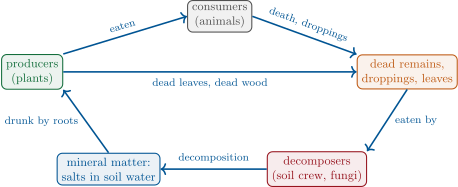
With the decomposers in place, the matter story of this year closes into a wheel: producers build organic from mineral (Chapter 40); consumers pass it along (Chapter 41); decomposers return it to mineral, ready for the producers again. Matter is not used up — it goes round. The atoms of this page’s paper have been leaf, humus, root and leaf again more times than can be counted.
42.3 Working with the decomposers
Example 42.7 (Compost, explained at last)
The compost bin of Example 13.9 now reads as an appliance: a decomposer workshop stocked with peelings. Worms, woodlice and the unseen crews dismantle the kitchen’s organic waste to dark humus; the gardener spreads it, and its minerals feed the beds (Remark 22.5). The heap even runs warm — the decomposers’ own burning (Proposition 41.6) heats their workshop.
Proposition 42.8 (What speeds and slows the work)
Decomposers are living things with conditions (Proposition 37.6): they work fastest warm, damp and aired, and almost stop when cold, dry, or drowned airless. Hence autumn’s slow winter carpet and spring’s quick clearing; hence too the gardener’s compost recipe — moist, turned for air, never a sodden sealed mass.
Proof. Admitted at this level. ∎
Method 42.9 (Reading soil health)
To judge a soil the naturalist’s way:
- dig a hand’s depth and look: dark crumbly humus, or pale lifeless dust?
- census a handful on a white tray — worms, woodlice, springtails: a rich crew means the cycle is turning;
- check the surface: does dead matter disappear over the seasons, or pile up unrotted?
- treat the crew as livestock: feed it (dug-in remains, compost, mulch), keep it damp, spare it poisons.
Example 42.10 (The earthworm, gardener of gardeners)
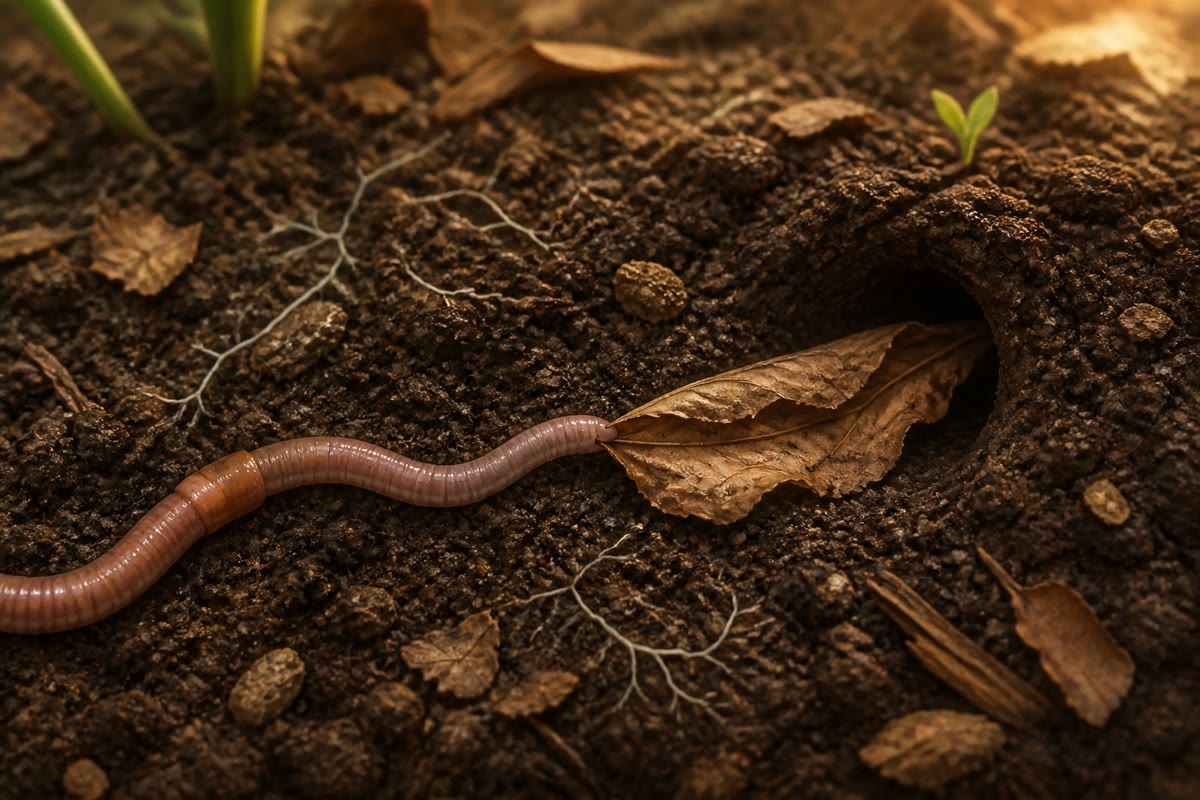
The earthworm does double duty: decomposer — dragging leaves down, eating decayed matter — and plougher, its burrows airing the soil and its casts kneading mineral and organic together. A single meadow can carry more worm weight below the grass than cow weight above it; old naturalists called the worm the true maker of farmland, and they were right.
42.4 Exercises
Exercise 42.1 ★
What is soil made of? Name its four non-living ingredients and its prized dark layer.
Solution
Solution of Exercise 42.1.
Mineral grains (ground rock), organic remains in every stage of decay, water, and air — plus its living population. The dark layer is the humus.
Exercise 42.2 ★
What do decomposers feed on? Name four visible ones and one whose feeding body is a felt of threads.
Solution
Solution of Exercise 42.2.
On dead organic matter — fallen leaves, dead wood, droppings, corpses. Visible: earthworms, woodlice, millipedes, springtails (or dung beetles, fly larvae). The felt-of-threads feeder: a fungus.
Exercise 42.3 ★
State what decomposition turns organic matter into — and whose trade it thereby reverses.
Solution
Solution of Exercise 42.3.
Back into mineral matter — humus, then dissolved mineral salts, and gas to the air. It reverses the producers’ trade, which built organic from mineral.
Exercise 42.4 ★
Retell the oak leaf’s last year in four seasons.
Solution
Solution of Exercise 42.4.
November: fallen whole. Winter: softened and mined by fungi, laced to a skeleton by springtails and woodlice. Spring: dragged down and eaten by an earthworm, cast out as crumbs. Summer: black humus; its minerals in the soil water, drunk by roots — perhaps the oak’s own.
Exercise 42.5 ★
Why does the forest’s autumn carpet not pile up year after year?
Solution
Solution of Exercise 42.5.
Because the decomposers eat it as fast as the years drop it: each carpet is dismantled to humus and minerals before the next has fully fallen.
Exercise 42.6 ★
Under which three conditions do decomposers work fastest? Where in the year does the work slow, and why?
Solution
Solution of Exercise 42.6.
Warm, damp and aired. The work nearly stops in winter — cold — which is why the carpet lies thick until the warm damp spring clears it.
Exercise 42.7 ★★
Draw or describe the cycle of matter with its three trades — producers, consumers, decomposers — and one arrow between each.
Solution
Solution of Exercise 42.7.
Producers consumers (plants eaten); producers and consumers dead remains, droppings, fallen leaves decomposers (the dead eaten); decomposers mineral salts in the soil water drunk by the producers: a closed wheel.
Exercise 42.8 ★★
Explain the compost bin as a decomposer workshop: who works there, on what, producing what for the garden — and why does the heap run warm?
Solution
Solution of Exercise 42.8.
Workers: worms, woodlice, springtails, fungi and the unseen crews. Raw material: the kitchen’s organic waste. Product: dark humus whose minerals feed the beds. It runs warm because the workers, like all consumers, burn part of what they eat — the heap is heated by its staff’s own living.
Exercise 42.9 ★★
Give the earthworm’s two jobs, and why old naturalists called it the maker of farmland.
Solution
Solution of Exercise 42.9.
Decomposer — dragging leaves underground and eating decayed matter — and plougher: its burrows air the soil, its casts knead mineral and organic together. Whole fields’ soil passes through worm guts, which is why the old naturalists crowned it farmland’s maker.
Exercise 42.10 ★★
Run Method 42.9 on two soils: a mulched garden bed and a bare trampled path. Predict each step’s findings.
Solution
Solution of Exercise 42.10.
Mulched bed: dark crumbly humus; a rich census — worms, woodlice, springtails; surface litter visibly vanishing season by season; verdict, a turning cycle worth feeding. Trampled path: pale compacted dust; a near-empty tray; whatever falls lies unrotted; verdict, a starved, airless soil whose crew has gone.
Exercise 42.11 ★★
A sealed plastic bag of grass clippings turns to stinking sludge instead of compost. Which working condition was denied, by Proposition 42.8, and what would the gardener change?
Solution
Solution of Exercise 42.11.
Air. Sealed and sodden, the airless bag stops the aired workers and lets only sour, airless rotting run. The fix: out of the bag, into a loose, moist, turned heap — moisture kept, air admitted.
Exercise 42.12 ★★★
“Without decomposers, the producers would starve amid mountains of the dead.” Justify both halves of the sentence with the cycle of matter — what piles up, and what runs out?
Solution
Solution of Exercise 42.12.
What piles up: the dead — every autumn’s carpets, every generation’s remains, mountains of undismantled organic matter. What runs out: the soil’s mineral salts, never restocked once the return arrow is cut; the producers drink the last dissolved minerals and then can build no more, whatever the light. Both halves are the same cut arrow — decomposition — seen from its two ends.
42.5 Problem: The Leaf-Bag Experiments
Problem 42.1
Weekend problem — mesh bags, buried leaves, and a winter of soil science
The class buries leaf bags in the school hedge bank in November: equal weights of fresh oak leaves in mesh bags, to be dug up and reweighed through the year. Three bag types: coarse mesh (lets in worms, woodlice, everything), fine mesh (excludes the visible crew, admits only the unseen), and sealed plastic (excludes everything and the air besides).
Part I — Setting up.
- Why must all bags hold the same weight of the same leaves, buried the same day in the same bank? Name the method.
- What question does the fine-mesh bag ask, that the coarse one cannot ask alone?
- One team wants a fourth bag: coarse mesh, but buried in the dry gravel of the schoolyard. What question would it ask, by Proposition 42.8?
- Predict, before digging: rank the three hedge-bank bags by how much leaf weight they will lose by June.
Part II — The results.
- June’s weighings: coarse mesh — most weight gone, leaves reduced to skeletons and crumbs; fine mesh — clearly lightened, leaves softened and blackened but slower; sealed plastic — weight almost unchanged, contents sour sludge. Interpret each bag.
- In the coarse bag the class finds woodlice, a worm, springtails and white fungus threads. Assign each its role in the leaf’s dismantling (Example 42.5 is the model).
- The fine bag lost real weight although every visible animal was excluded. What does that prove about the unseen soil life?
- The gravel-yard bag (question 3’s) lost far less than its hedge-bank twin. Which working conditions does the gravel deny?
Part III — The larger lesson.
- Where did the coarse bag’s lost weight go? Answer with Proposition 42.4 — two destinations at least.
- The hedge’s spring nettles grow greenest exactly along the bank where the class buried its bags. A coincidence? Argue from the cycle of matter.
- Use the sealed bag to explain why landfilled organic waste, wrapped airtight in plastic, persists for decades while the same waste composts in months.
- Conclude in two sentences: what did the winter prove about who clears the forest’s carpet, and what does the clearing feed?
Solution
Solution of Problem 42.1.
1. So the bags differ in one thing only — the mesh — and any weight difference can be pinned on it: the fair test, buried.
2. Whether the unseen soil life alone can dismantle leaves — the coarse bag mixes visible and unseen workers; the fine bag isolates the unseen.
3. Whether conditions rule the work: same leaves, same mesh, but dry gravel against damp bank — it tests Proposition 42.8’s damp condition in the field.
4. Coarse loses most, fine less, sealed almost nothing — predicted straight from who and what each bag admits.
5. Coarse: the full crew worked — fastest dismantling. Fine: only the unseen worked — real but slower loss. Sealed: no workers and no air — almost no true decomposition, only sour airless spoilage.
6. The fungi’s threads mine and soften the leaf; springtails and woodlice nibble it to lace; the worm drags fragments down, eats them and casts out worked crumbs; the unseen crews finish every fragment to humus and minerals.
7. That it is a true decomposing workforce in its own right: weight left the bag with every visible animal barred, so the dismantling continued at the scale below sight.
8. Dampness above all — gravel drains and dries — and with it the working population a moist bank holds; dry conditions idle whatever crew arrives.
9. Into the soil and the air: part became humus and dissolved mineral salts in the bank’s soil water, and part was burned by the working decomposers and left as gas — the lost grams are all accounted for, none vanished.
10. No coincidence: the buried leaves’ minerals were released exactly there, and nettles are famous gluttons for rich ground. The green stripe is the cycle’s last arrow made visible — decomposition feeding producers.
11. The landfill wrap is the sealed bag at city scale: airless and crewless, it denies decomposition its workers and conditions, so the waste persists as the bag’s sludge did — while the same peelings in an aired, damp, worker-filled heap return to soil in months.
12. The winter proved the carpet is cleared by the soil’s decomposers — visible crew and unseen crews together, fastest where warm, damp and aired. Their clearing feeds the soil’s mineral stores, and through them the producers: the wheel of matter, turning in a hedge bank.