Primary & Middle School Biology · Grades 1–9
40Plants Are Producers
Weigh a watered pot, plant an acorn in it, and come back after years to weigh the young oak: kilograms of wood, bark, leaf and root — while the pot’s soil has scarcely lost a gram (Example 22.7 first sprang this surprise). Kilograms of tree, made from what? This chapter pins the answer down — and names the plants’ unique trade.
40.1 Organic and mineral matter
Definition 40.1 (Mineral and organic matter)
Matter, for a biologist, comes in two kinds:
- mineral matter: matter of the non-living world — water, air’s gases, rock, the dissolved mineral salts of Proposition 22.3;
- organic matter: matter made by living things and composing their bodies — wood, leaf, muscle, fat, sugar, wool. Burnable, rottable, and always traceable to a living maker.
Example 40.2 (Sorting a pocketful)
From a coat pocket after a walk: a pebble — mineral; a hazelnut — organic (a hazel made it); a plastic button — organic by origin, oddly enough (plastics are made from oil, the transformed remains of ancient living things); a drop of rain — mineral; a woolly glove — organic (a sheep made the wool).
40.2 The producers’ trade
Proposition 40.3 (Plants produce organic matter from mineral matter)
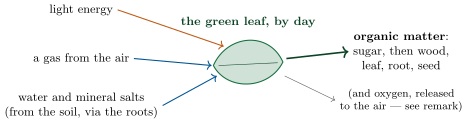
A green plant, given only mineral ingredients — water and dissolved salts from the soil, a gas taken from the air — and the energy of light, makes organic matter: its own sugar, and from it wood, leaf and root. This making is the trade Proposition 22.6 promised to explain: plants are producers — the only makers of new organic matter from purely mineral supplies. The green substance of the leaves is the light-catching machinery; the manufacture happens in the leaf, by day.
Proof. Admitted at this level. ∎
Example 40.4 (The evidence, assembled)
Three earlier observations now click together. The weighed pot: the oak’s kilograms did not come from the soil — they came mostly from air and water. The pale prisoner of Example 22.4: no light, no manufacture — the plant starves in the dark with a full larder of minerals. The mineral-starved mint of Exercise 22.11: salts are needed — but as small supplies, not as the bulk. Bulk from air and water, energy from light, seasoning from the soil.
Remark 40.5 (The gas swap, both ways)
The air gas the leaf takes in is carbon dioxide — the very gas every breather exhales (Proposition 26.5); and manufacturing releases oxygen to the air — the very gas every breather needs. Plants also breathe, day and night, like all living things; but by day a working leaf’s manufacture far outruns its breathing. The world’s breathable air is the producers’ by-product — one more debt every animal owes the green.
40.3 Producers feed everyone — and store for themselves
Proposition 40.6 (The first link, explained)
Proposition 19.3 decreed every food chain starts with a plant; now the decree has its reason. Only producers make organic matter from mineral matter; every consumer (Definition 34.3) can only transform organic matter it eats. So all the organic matter in every living body — rabbit, fox, buzzard, you — was first manufactured in a leaf, and the food pyramid of Proposition 34.5 stands on the green floor because that is where matter enters the living world.
Proof. Admitted at this level. ∎
Example 40.7 (The plant’s own pantry)
What a plant makes beyond the day’s needs, it stores as organic reserves: the potato tuber and tulip bulb (Example 24.7), the bean’s thick halves (Definition 9.1), the carrot’s fat root (Exercise 3.10), the sweetness of the beet. Every one is summer light, banked as matter — and every one is exactly what farmers, and eaters, harvest.
Method 40.8 (Tracing any food to its leaf)
Take any food on the table:
- if it is plant matter — bread’s wheat, the potato, the apple — it is producer’s manufacture directly: name the plant and its stored organ;
- if it is animal matter — cheese, egg, ham — step down the chain: what did the animal eat? and that food’s maker? continue to the plant;
- write the chain with arrows (Definition 19.1);
- conclusion, always the same: the trail ends in a leaf, in the light.
40.4 Exercises
Exercise 40.1 ★
Define mineral matter and organic matter, with two examples each.
Solution
Solution of Exercise 40.1.
Mineral matter: matter of the non-living world — water, rock (also air’s gases, mineral salts). Organic matter: matter made by living things and composing their bodies — wood, muscle (also sugar, wool, fat).
Exercise 40.2 ★
State the producers’ trade: inputs, energy source, output, and the workshop where it happens.
Solution
Solution of Exercise 40.2.
Inputs: water and mineral salts from the soil, a gas (carbon dioxide) from the air. Energy: light, caught by the green substance. Output: organic matter — sugar, then wood, leaf, root, seed. Workshop: the green leaf, by day.
Exercise 40.3 ★
Sort as mineral or organic: dew, a snail shell, beeswax, granite, cooking oil, sea salt.
Solution
Solution of Exercise 40.3.
Mineral: dew, granite, sea salt. Organic: beeswax, cooking oil — and the snail shell is the snail’s making, built of mineral substance the animal laid down: made by a living thing, from mineral supplies. (Credit for either answer with that reasoning.)
Exercise 40.4 ★
Where did the oak’s kilograms mostly come from, if hardly from the soil?
Solution
Solution of Exercise 40.4.
Mostly from air and water — the gas taken from the air and the water drunk by the roots — assembled in the leaves with light’s energy; the soil gave only small amounts of mineral salts.
Exercise 40.5 ★
Which gas does the working leaf take from the air, and which does it release? Who exhales the first and needs the second?
Solution
Solution of Exercise 40.5.
It takes carbon dioxide and releases oxygen. Every breathing living thing exhales the first and needs the second — ourselves included.
Exercise 40.6 ★
Name four plant storage organs and what each stores, from Example 40.7.
Solution
Solution of Exercise 40.6.
The potato tuber and the tulip bulb (underground stores), the bean’s thick halves (the seed’s food store), the carrot’s fat root, the sugar-filled beet — all organic reserves banked from summer’s manufacture.
Exercise 40.7 ★★
Why does the dark-cupboard plant starve with a full larder of mineral salts? Which input has no substitute?
Solution
Solution of Exercise 40.7.
Because the manufacture runs on light: with no light there is no energy to build organic matter, whatever minerals wait in the soil. Light is the one input with no substitute — the salts are seasoning, not fuel.
Exercise 40.8 ★★
Why can no animal be the first link of a food chain? Answer with the producer/consumer distinction.
Solution
Solution of Exercise 40.8.
Because a chain’s first link must put new organic matter into the living world, and animals are consumers: they can only transform organic matter already made by someone else. Only producers manufacture it from mineral supplies — so the first link is always green.
Exercise 40.9 ★★
Run Method 40.8 on a cheese sandwich: bread, butter, cheese — three trails to three leaves.
Exercise 40.10 ★★
“Compost feeds the plant the way hay feeds a cow.” Correct the sentence precisely, using Remark 22.5 and this chapter’s definitions — what does compost actually supply, and what does the plant make for itself?
Solution
Solution of Exercise 40.10.
Hay is the cow’s food — organic matter she transforms into her body. Compost is not the plant’s food: it restocks the soil’s mineral salts as it rots. The plant then makes its own organic matter from those minerals, air, water and light. The cow eats meals; the plant manufactures them.
Exercise 40.11 ★★
A sealed, lit aquarium of water plants and fish can run for months; a sealed dark one fails in days. Use Remark 40.5 to explain both outcomes.
Solution
Solution of Exercise 40.11.
Lit, the plants’ daytime manufacture releases oxygen and takes up carbon dioxide, balancing the fish’s breathing — the gas swap runs both ways and the jar cycles. Dark, the manufacture stops while every inhabitant (plants included) keeps breathing: oxygen runs out, carbon dioxide piles up, and the sealed world suffocates.
Exercise 40.12 ★★★
An old experiment: a willow sapling grown five years in a tub gained many kilograms; the tub’s dried soil lost only grams. The experimenter concluded “the tree was made of water alone.” Which part of his conclusion was right, which incomplete — and what second mineral input, unknown to him, would a modern biologist add?
Solution
Solution of Exercise 40.12.
Right: the tree’s matter did not come from the soil — his weighing proved that forever. Incomplete: water was only one bulk ingredient; he could not know about the gas taken from the air, which supplies much of the wood’s substance. The modern addition: carbon dioxide from the air (plus the soil’s small mineral salts) — water and air together, assembled by light.
40.5 Problem: The Market Gardener’s Year
Problem 40.1
Weekend problem — light, leaves and the ledger of a vegetable garden
A market gardener grows potatoes, carrots, beans and lettuces, and keeps a sharp ledger of what goes in and what comes out.
Part I — The ledger’s riddle.
- The garden yields two tonnes of vegetables a year; the gardener spreads only sacks of compost. Weigh the riddle: where do the tonnes come from, if not from the sacks? (Answer with the producers’ trade.)
- Classify the yield: the potato, the carrot, the bean seed, the lettuce leaf — name each one’s role for the plant (storage organ, working organ, seed store).
- The gardener says: “my real supplier delivers by daylight.” Translate into Proposition 40.3’s terms.
- Why does the gardener still need the compost at all, if not for the tonnes? (Recall the mint in sand.)
Part II — Reading the seasons.
- June’s lettuces, shaded under a trial cloth for a week, come out pale and stretched. Name the experiment this repeats, and the input it removed.
- The potato rows are earthed up and their lush tops praised: “good tops, good tubers.” Explain the saying — what is the connection between working leaves above and swelling storage below?
- August’s drought halts growth though the sun blazes. Which mineral input has failed, and why can light not substitute for it?
- In September the gardener cuts and removes the bean plants but digs their roots in. A neighbor calls this waste. Defend the practice with the matter definitions — what is being returned to the soil, for whom?
Part III — Beyond the garden.
- The gardener’s pig eats the small potatoes; the family eats the pig. Write the chain, and state where its organic matter was originally manufactured.
- A customer claims her salad is “sun, mostly”. Audit the claim: list the salad leaf’s actual ingredients and the sun’s exact role.
- Frost kills the last lettuces overnight; they rot where they lie by November. Their organic matter does not vanish. Anticipate Chapter 42: who takes it, and toward what state?
- Summarize the garden in one sentence containing: producers, mineral matter, organic matter, light.
Solution
Solution of Problem 40.1.
1. The tonnes are organic matter manufactured by the plants themselves from mineral supplies — water, the air’s carbon dioxide, the soil’s salts — with light as the energy. The sacks restock minerals; the air and rain deliver the bulk; the leaves do the making.
2. Potato: underground storage organ (tuber). Carrot: storage root. Bean seed: the seed’s food store, packed for the next plant. Lettuce leaf: the working organ itself — the light-catching workshop, eaten fresh.
3. The true supplier is light: every gram of yield was built with light’s energy, by day, in the leaves.
4. For the mineral salts: harvests carry them off, and without restocking the plants would run mineral-short like the mint in sand — small in bulk, indispensable in function.
5. The dark-cupboard experiment (the pale prisoner): the cloth removed light, and a week of it already shows — pale, stretched, weak manufacture.
6. The tubers are filled by the tops: leaves manufacture sugar by day, and the surplus is piped down and banked in the swelling tubers. Lush working leaves mean a big surplus — good tops, good tubers.
7. Water. Manufacture needs all its inputs at once: light supplies energy, not substance — with the roots dry, there is nothing to build with, however bright the sky.
8. The dug-in roots are organic matter returned to the soil: rotting, they will free their minerals for coming crops — the return rule of Proposition 35.5, paid in plant matter. The waste would be burning them.
9. Potato plant pig the family. All its organic matter was first manufactured in the potato plant’s leaves — the pig and the family only transformed it.
10. Ingredients: water and mineral salts from the soil, carbon dioxide from the air — assembled into leaf matter. The sun’s exact role: energy, not substance. Her salad is water, air and earth, built by sunlight — poetic credit deserved, ingredient list wrong.
11. The decomposers — soil life from worms and woodlice down to living things too small to see — feed on the dead leaves and break their organic matter down toward mineral matter again, restocking the soil the next crops will draw on.
12. For example: “The garden’s producers build organic matter — the harvest — out of mineral matter from soil, water and air, using light as their energy.”