Primary & Middle School Biology · Grades 1–9
44Classification and Kinship
Why does the classification of Chapter 21 work so well? Sort animals by feathers and fur, and a thousand other features fall obediently into line — milk-feeders have backbones, feather-wearers lay shelled eggs, and no one has to check. Remark 21.10 left the question hanging. This chapter answers it with one word — kinship — and rebuilds the boxes as a family tree.
44.1 Attributes, shared and nested
Definition 44.1 (Attribute)
An attribute is a feature an organism possesses, stated so it can be checked: has a skeleton with a backbone; has four limbs; has fur and milk-feeding; has feathers. Classification is built on attributes — Definition 14.1’s good criteria, formalized.
Proposition 44.2 (Attributes nest)
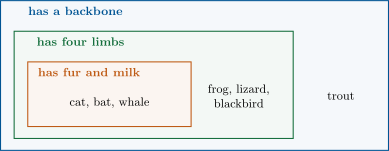
Checked across many species, attributes fall into nested sets — every animal with fur also has four limbs; every four-limbed animal also has a backbone; never the reverse pattern (fur without backbone) and never crossing sets (fur and feathers together). That nesting is why groups-inside-groups (Definition 21.1) fits the living world at all.
Proof. Admitted at this level. ∎
Example 44.3 (Placing three animals)
Check the boxes for the whale, the trout and the blackbird. Whale: backbone yes, four limbs yes (front flippers, and hidden vestiges behind), fur-and-milk yes — innermost box, with the cat. Trout: backbone yes, stop — outer box only. Blackbird: backbone, four limbs (two legs, two wings), feathers — the four-limbed box, in feathers’ own compartment. No animal ever demands two crossing boxes at once.
44.2 Kinship: the reason behind the nesting
Proposition 44.4 (Shared attributes mean shared ancestry)
The explanation of the nesting is inheritance (Remark 23.3: young receive from their parents). Species sharing an attribute share it because they inherited it from a common ancestor — a distant grandparent species. The more attributes two species share, the closer their kinship: the cat and the whale, both furred milk-feeders, are closer cousins to each other than either is to the trout. A classification group is, at bottom, a family: an ancestor and all its descendants.
Proof. Admitted at this level. ∎
Example 44.5 (Reading the whale correctly at last)
This is why the whale puzzle (Exercise 21.9) had to resolve as it did: fur-and-milk marks the whale’s family line — its ancestors were milk-feeding land mammals — while its fish-like shape is the water’s doing (Exercise 28.11), stamped on an unrelated family by the same way of life. Attributes of ancestry sort families; resemblances of habitat can be borrowed by strangers. Classification trusts the first and distrusts the second.
Definition 44.6 (The tree of kinship)
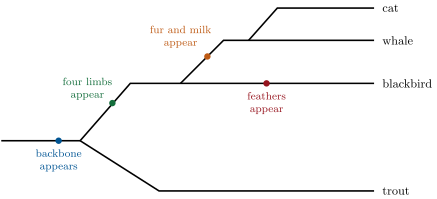
Kinship is drawn as a tree: branch points stand for common ancestors, and each attribute appears once, at the branch where it arose — every species beyond that fork inherits it. The nested boxes and the tree carry the same information: a box is a branch with all its twigs.
Method 44.7 (Building a small kinship tree)
Given a handful of species:
- table their attributes — species in rows, checkable attributes in columns, ticks where possessed;
- group by shared ticks, widest attribute first: the nesting appears in the table;
- draw the tree: one fork per attribute, the widest nearest the trunk; place each species past exactly the forks whose attributes it possesses;
- read kinship: two species’ closeness is the last fork they share.
Remark 44.8 (What the tree quietly implies)
Take the tree seriously and it says something enormous: follow any two branches back and they meet. Cat and trout share a grandparent species; so, further back, must cat and snail, daisy and child. All living things would then be one family, its unity (Proposition 29.2) a family resemblance — and species must be able to change across generations, or the branching could never have happened. Whether that is true, and how it could work, is the great question of Chapter 67’s year — this tree is the diagram that forces it.
44.3 Exercises
Exercise 44.1 ★
What is an attribute? Give three, stated checkably.
Exercise 44.2 ★
What does it mean that attributes nest? Give the chapter’s three-box example.
Exercise 44.3 ★
Why do species share attributes, by Proposition 44.4?
Solution
Solution of Exercise 44.3.
Because they inherited them from a common ancestor: an attribute travels down a family line, so its owners are that ancestor’s descendants — a family.
Exercise 44.4 ★
On the pocket tree, which attribute dot does the trout stand beyond? Which dots does the whale stand beyond?
Exercise 44.5 ★
Who are closer cousins: whale and cat, or whale and trout? Read the answer from the tree’s forks.
Solution
Solution of Exercise 44.5.
Whale and cat: they share the fur-and-milk fork, the newest one drawn; the trout parted company at the oldest fork.
Exercise 44.6 ★
Exercise 44.7 ★★
Why does classification trust fur-and-milk but distrust “shaped like a fish”? Use Example 44.5.
Solution
Solution of Exercise 44.7.
Fur-and-milk is inherited down one family line — it marks ancestry. “Shaped like a fish” can be stamped on strangers by the same watery way of life, as the whale shows: shape borrowed, family elsewhere. Classification sorts families, so it trusts the heirloom and distrusts the borrowed coat.
Exercise 44.8 ★★
Build the attribute table of Method 44.7 for: trout, frog, cat, blackbird — attributes: backbone, four limbs, fur-and-milk, feathers.
Exercise 44.9 ★★
Add the lizard to the pocket tree: which forks does it pass, and where does its branch leave?
Exercise 44.10 ★★
The bat flies like a blackbird but nurses like a cat. Which resemblance marks kinship and which is borrowed by way of life? Decide with the tree’s logic.
Exercise 44.11 ★★
“A group is an ancestor and all its descendants.” Test the sentence on the mammals and on Exercise 21.11’s platypus: does the egg-laying oddity break the family, or belong to it?
Solution
Solution of Exercise 44.11.
It belongs. The platypus descends from the mammals’ common ancestor and carries the family heirlooms (fur, milk); its egg is an old feature its early branch kept while the others lost it. The family is the ancestor and all descendants — oddities included; the bundle (Exercise 21.11) already voted it in.
Exercise 44.12 ★★★
Follow Remark 44.8 to its edge: what must be true of species over long time, if every pair of branches really meets? State the implication in one sentence — and name what kind of evidence you would demand for it.
Solution
Solution of Exercise 44.12.
If every pair of branches meets, then species must change across generations over long time — new attributes arising and being inherited — so that one ancestral line could branch into trout, cat and daisy. Implication in one sentence: all living things descend, with change, from common ancestors. Evidence to demand: traces of the change — intermediate forms, preserved remains in old rocks, and family resemblances placed exactly where the tree predicts (the business of a later year).
44.4 Problem: The Museum Drawer
Problem 44.1
Weekend problem — six specimens, one attribute table, one tree
A museum lends the class a drawer of six specimens: a trout, a frog, a lizard, a pigeon, a mouse, and a dolphin’s skull with flipper casts. The task: classify them by attributes and draw their kinship tree.
Part I — The table.
- Build the table for the six, with attributes: backbone; four limbs; dry scaly skin; feathers; fur and milk. (For the dolphin, near-hairless, the museum label vouches: milk-fed young — Example 14.5 explains why that testimony settles it.)
- Which attribute do all six share? What does the widest sharing mean, in kinship terms?
- Which specimens tick “four limbs”? Explain the pigeon’s and the dolphin’s ticks — what are wings and flippers, on the tree’s logic?
- Why does “lives in water” appear nowhere in the table, though trout and dolphin both do? Cite the chapter’s rule.
Part II — The tree.
- Draw the tree: order the forks — backbone, four limbs, then the coats (scales, feathers, fur) on their own branches — and place all six.
- Read from your tree: the mouse’s closest cousin in the drawer, and the trout’s.
- The frog stands past “four limbs” but before every coat fork. What does its bare, moist skin (Remark 21.6) mark it as, and where does its branch leave?
- A label falls off a seventh specimen: dry scaly skin, four limbs, backbone. Place it on the tree and name its class — without seeing the label.
Part III — The meaning.
- The dolphin and the trout share streamlining; the dolphin and the mouse share fur-and-milk ancestry. Which pair sits closer on the tree, and why must the tree ignore the streamlining?
- State what the fork “four limbs” claims historically: what single thing, long ago, do frog, lizard, pigeon, mouse and dolphin all descend from?
- The class’s tree makes every branch meet, eventually, at the trunk. Say in one sentence what that drawing quietly claims about all six specimens — and about the class members drawing it.
- A skeptic says: “your tree is just a filing system.” Give the two-part reply: what the nesting of attributes is a fact about, and what the tree explains that mere filing would leave unexplained.
Solution
Solution of Problem 44.1.
1. Trout: backbone. Frog: backbone, four limbs. Lizard: backbone, four limbs, dry scaly skin. Pigeon: backbone, four limbs, feathers. Mouse: backbone, four limbs, fur-and-milk. Dolphin: backbone, four limbs, fur-and-milk (the label’s testimony on milk; features decide, and milk is the deciding feature).
2. The backbone — all six are vertebrates. The widest sharing marks the oldest common ancestor: all six are one family at that depth.
3. Frog, lizard, pigeon, mouse, dolphin. The pigeon’s wings and the dolphin’s flippers are four limbs in working dress: the same inherited limbs, shaped by different lives — the tree counts the inheritance, not the dress.
4. Because a shared address is not a shared family: “lives in water” is a habitat, borrowable by strangers, not an attribute of the body’s ancestry — Definition 14.1’s old rule, now with its reason.
5. Trunk backbone fork (trout leaves after it) four-limbs fork three coat branches: dry scales (lizard), feathers (pigeon), fur-and-milk (mouse and dolphin together on the newest fork); the frog leaves after four-limbs, before every coat.
6. The mouse’s closest drawer-cousin is the dolphin (they share the fur-and-milk fork). The trout’s closest is everyone equally — it parted at the first fork, so all five others are its equally distant cousins.
7. An amphibian — four-limbed, bare moist skin, no coat fork of its own; its branch leaves between the four-limbs fork and the coats.
8. Past backbone and four limbs, onto the dry scaly branch: a reptile — classified sight unseen, because attributes, not labels, decide.
9. Dolphin and mouse sit closer: fur-and-milk is an inherited fork. The streamlining is the water’s uniform, issued alike to unrelated swimmers (Exercise 28.11); counted, it would file borrowed dress as family and wreck the nesting.
10. A single common ancestor species — an early four-limbed vertebrate — from which frog, lizard, pigeon, mouse and dolphin all descend, each carrying its four limbs in different dress.
11. That all six — and the class drawing them — belong to one branching family, descended with change from common ancestors, humans on the fur-and-milk branch among the rest.
12. The nesting is a fact about the living world — attributes really do fall into boxes-in-boxes, which no filing clerk decreed. The tree explains the fact: inheritance from common ancestors must produce nested attributes, while mere filing would leave the world’s obliging tidiness a miracle.