Primary & Middle School Biology · Grades 1–9
50Digestion and Nutrients
Chapter 25 followed the bite of bread down the tube and promised that “digestive juices dismantle it”. This year we open the workshop doors: what exactly do the juices do, what are the nutrients they produce, and how does the small intestine’s wall manage the greatest border crossing in the body? The bite of bread is back — under better instruments.
50.1 The juices at work
Proposition 50.1 (Digestion is chemical dismantling)
Chewing and churning only break food smaller; the real dismantling is chemical. The digestive juices — saliva, the stomach’s juice, the juices poured into the small intestine — contain working substances that cut food’s large components into small ones: starch into sugars, meat and eggs’ building matter into its small units, fats into theirs. Each juice has its specialties, and each works best at its own station’s conditions.
Proof. Admitted at this level. ∎
Example 50.2 (The bench version)
The classic experiment runs digestion in glass. Two tubes of cooked starch paste at body warmth: one gets fresh saliva, one gets boiled (spoiled) saliva. An hour later, the starch test finds tube 2 unchanged — still starch — while tube 1’s paste has turned to sugars, exactly the sweetness of Example 25.4, produced without any mouth. The juice alone did the dismantling — and the boiled control shows its working substance is destroyed by heat, as delicate machinery would be.
Remark 50.3 (Why dismantle at all?)
Food’s large components can no more cross the intestine’s wall than a wardrobe can pass a letterbox. And the body does not want them whole: it wants parts — small units it can rebuild into its own substance (Proposition 41.1). Digestion is dismantling for transport and for reassembly: furniture to flat-pack, at every meal.
50.2 The nutrients
Definition 50.4 (The nutrient families)
The dismantling yields the nutrients — the small, blood-ready components:
- sugars (glucose above all, Proposition 49.1’s fuel), from starchy and sweet foods;
- the small units of building matter, from meat, fish, eggs, dairy and pulses — the bricks of Proposition 18.1’s construction;
- the units of fats — dense fuel and building material both;
- plus passengers needing no dismantling: vitamins, mineral salts, and water itself.
The food families of Definition 18.3 are, at bottom, suppliers of these nutrient families — the shopping list behind the shopping list.
Example 50.5 (One lunch, itemized)
The balanced lunch of Example 18.4, re-read as nutrients: pasta — starch, dismantled to glucose by the litre; fish — building matter, cut to its units; the oil on the beans — fat units; beans and apple — vitamins, minerals, water, plus fibre. Fibre, note, is the exception that proves the system: no juice of ours can cut it, so it crosses nothing and travels on — the leftovers’ bulk (Proposition 25.5), doing its own useful sweeping.
50.3 The great crossing
Proposition 50.6 (Absorption at the villi)
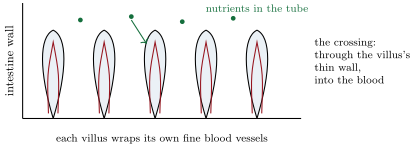
The crossing promised in Proposition 25.5 happens across the small intestine’s inner wall, and the wall is built for it: folded, and carpeted with millions of villi — finger-shaped bumps a millimetre high, each wrapping its own fine blood vessels. The villi are why the crossing surface reaches its carpet-a-room size (Remark 25.6): folds on folds on fingers. Nutrients cross their thin walls into the blood, and the blood carries them first to a great sorting-and-storing organ — the liver — before general delivery.
Proof. Admitted at this level. ∎
Example 50.7 (The specification again)
Large, thin, moist, blood-lined: the villi meet exactly Proposition 47.1’s specification — for nutrients instead of oxygen. Lungs’ pockets, gills’ feathers, intestine’s villi: wherever the body must move much across a border, it builds the same machine. Spot the specification once, and you recognize it everywhere.
Method 50.8 (Tracing a nutrient end to end)
For any mouthful, trace one nutrient:
- name the food’s family and its main components;
- station by station, note where its dismantling starts and finishes, and which juices worked on it;
- cross at the villi with it, into the blood, via the liver;
- deliver it: to a working cell as fuel (Proposition 49.1), or to a building site as material (Definition 41.4).
Example 50.9 (The trace, run on bread)
Bread: starchy family, mainly starch. Dismantling starts in the mouth (saliva — the long-chew sweetness), pauses in the stomach’s acid, finishes in the small intestine’s juices: glucose. Crossing: villi, blood, liver — which banks part of the glucose for later, one of its many services. Delivery: a thigh muscle mid-sprint burns it within the hour. The bite of grade four, fully accounted.
50.4 Exercises
Exercise 50.1 ★
What do digestive juices do that teeth and churning cannot?
Solution
Solution of Exercise 50.1.
They dismantle food chemically: cutting its large components — starch, building matter, fats — into small, blood-ready units. Teeth and churning only make pieces smaller; the juices change what the pieces are.
Exercise 50.2 ★
Describe the two-tube saliva experiment: setup, result, and both conclusions.
Solution
Solution of Exercise 50.2.
Two tubes of starch paste at body warmth: one with fresh saliva, one with boiled saliva. After an hour the fresh tube’s starch has become sugars; the boiled tube is unchanged. Conclusions: the juice alone dismantles starch — no mouth needed — and boiling destroys its working substance.
Exercise 50.3 ★
List the nutrient families and one food source of each.
Exercise 50.4 ★
Which food components need no dismantling? And which one defeats our juices entirely — to what useful end?
Solution
Solution of Exercise 50.4.
Vitamins, mineral salts and water cross as they are. Fibre defeats our juices entirely: uncut, it crosses nothing and travels on as the leftovers’ useful sweeping bulk.
Exercise 50.5 ★
What is a villus? What does each one wrap?
Solution
Solution of Exercise 50.5.
A finger-shaped bump of the small intestine’s inner wall, about a millimetre high, one of millions. Each wraps its own fine blood vessels.
Exercise 50.6 ★
Where does blood from the intestine go before general delivery, and name one service that organ renders.
Exercise 50.7 ★★
Explain the flat-pack image of Remark 50.3: the two reasons food must be dismantled.
Solution
Solution of Exercise 50.7.
Transport: food’s large components cannot cross the intestine’s wall — the wardrobe and the letterbox. And reassembly: the body builds its own substance from small units, so it wants parts, not furniture — flat-pack for the journey and for the rebuild.
Exercise 50.8 ★★
Why does the boiled-saliva tube matter? Name the method, and what the boiling shows about the juice’s working substance.
Solution
Solution of Exercise 50.8.
It is the control of a fair test: identical in everything but the juice’s working state. Its unchanged starch pins the dismantling on fresh saliva specifically — and shows the working substance is heat-fragile, destroyed by boiling like delicate machinery.
Exercise 50.9 ★★
Set the villi beside the lungs’ pockets and the gills’ feathers: state the shared specification, and each machine’s cargo.
Exercise 50.10 ★★
Run Method 50.8 on a boiled egg (building matter), to a repair site in a healing scrape (Exercise 45.10).
Solution
Solution of Exercise 50.10.
Egg: building-matter family. Dismantling starts in the stomach’s acid juice (the cubes’ fate in the glass gut), finishes in the small intestine: small building units. Crossing: villi, blood, liver. Delivery: to the healing scrape, where dividing skin cells take the units as material for the rebuild.
Exercise 50.11 ★★
A crash diet skips all building-matter foods for weeks. Using Definition 50.4 and Definition 41.4, predict what runs short and what suffers first in a still-growing body.
Solution
Solution of Exercise 50.11.
The building-matter units run short. First to suffer is everything under construction and renewal: growth itself, muscle upkeep, repairs, and the constantly renewed linings and blood components — fuel-nutrients cannot substitute, because bricks and firewood are not interchangeable.
Exercise 50.12 ★★★
“Digestion turns a meal into a delivery list.” Defend the sentence end to end — juices, nutrients, villi, liver, deliveries — in one paragraph.
Solution
Solution of Exercise 50.12.
For example: a meal enters as furniture — starch, building matter, fat. Station by station its juices cut each into its units: sugars, building units, fat units — the delivery list. At the villi the list crosses into the blood, the liver sorts, banks and releases, and the blood distributes: fuel to working muscles, bricks to building sites, the rest to stores. What sat on the plate as food circulates within hours as deliveries with addresses.
50.5 Problem: The Glass Gut
Problem 50.1
Weekend problem — building digestion on the bench, tube by tube
The class builds a “glass gut”: a rack of tubes at body warmth, each simulating one station of the tract. Tube M (mouth): starch paste plus fresh saliva. Tube M: starch paste plus boiled saliva. Tube S (stomach): egg white cubes plus stomach juice from the pharmacist. Tube S: the same cubes in plain water. All run for two hours; then the tests — for starch, for sugars, and a look at the cubes.
Part I — Predictions and results.
- Predict the two-hour results of all four tubes.
- M turns sugary, M does not. State the conclusion, and the exact role of M.
- S’s cubes shrink, soften and clear; S’s sit unchanged. What has the stomach juice done — and what kind of nutrient family is being produced?
- No tube was chewed or churned. What does the rack prove about where digestion’s real work lies?
Part II — Improving the model.
- A student proposes running tube M at fridge temperature “for tidiness”. Object, with Proposition 42.8’s pattern applied to juices.
- Another proposes one big tube with both juices mixed. What station-by-station fact of Proposition 50.1 would the mixture blur?
- The glass gut has no wall: nothing is absorbed. Which structure would a full model need next, and what two properties must its material have?
- Add fibre — bran flakes — to a fifth tube with every juice available. Predict its two-hour state, and its meaning for the model.
Part III — From glass to gut.
- In the body, M’s sugars would next meet the villi. Continue their journey in four stops.
- The stomach’s juice works in strong acid; the intestine’s juices need that acid neutralized. What does this say about “each juice at its own station’s conditions” — and about swallowing the stations in order?
- A pharmaceutical company sells juice capsules for people whose own stations underperform. Explain, with the rack, why such a therapy is even possible.
- Summarize the practical in one sentence containing juices, nutrients and control tubes.
Solution
Solution of Problem 50.1.
1. M: starch gone, sugars present. M: starch unchanged. S: cubes attacked — shrunken, softened. S: cubes unchanged.
2. Saliva’s working substance dismantles starch into sugars. M is the control: identical but for the boiled juice, it proves the dismantler was the fresh saliva and nothing else in the tube.
3. It has begun dismantling the egg’s building matter — cutting it toward its small units, the building-matter nutrients. (The clearing, shrinking cubes are that cutting made visible.)
4. That the real work is chemical: with no tooth and no churn in any tube, dismantling ran wherever the right juice met the right food. Mechanical breaking only serves the chemistry.
5. Juices are working substances with working conditions: chilled, they idle — like every worker from decomposer to yeast. The tube would sit undigested, and prove only that fridges pause chemistry.
6. That each juice has its specialties and its own station’s conditions: mixed in one tube, neither works at its best, and the model loses the tract’s station-by-station order — the very thing it is meant to teach.
7. The absorbing wall: a villus-carpeted surface. Its material must be thin (an easy crossing) and selective-but-permeable to the small units — with, in the body, blood vessels behind it to carry the crossers away.
8. Unchanged flakes: no juice of ours cuts fibre. Meaning: the model correctly predicts fibre’s real fate — crossing nothing, sweeping on — the exception that maps the system’s limits.
9. Across the villi’s thin walls; into the blood; through the liver, which banks part; out on general delivery to the body’s cells — a working muscle burning them within the hour.
10. Conditions are part of the machinery: each station is tuned — acid here, neutralized there — so the juices must meet food in the right order, which is exactly what swallowing through the stations provides. The tract is a production line, not a bucket.
11. Because digestion’s workers are substances, not organs: as the rack shows, a juice dismantles its food wherever the two meet in the right conditions. A capsule delivering the missing juice to the right station can therefore do the station’s chemistry.
12. “The juices, each at its station, cut food into nutrients — and the control tubes proved it was the juices, and nothing else, doing the cutting.”