Primary & Middle School Biology · Grades 1–9
33The Brain in Command
A ball flies toward you; you catch it. Half a second, no thought at all — yet in that half-second, your eyes reported a flying object, something computed its path, and dozens of muscles were ordered into exactly the right catch. The something is the brain, and this chapter follows its commands along the body’s wiring.
33.1 The command network
Definition 33.1 (The nervous system)
The nervous system is the body’s command network:
- the brain, in the skull’s shelter (Definition 17.1), is the center: it receives all reports and issues all orders;
- the spinal cord, a thick cable of nerve tissue, runs from the brain down inside the spine’s protective column;
- the nerves, white threads branching from brain and spinal cord to every organ, carry the messages — at more than for the fastest.
Proposition 33.2 (Report, decide, order)
Every action runs the same loop (Proposition 5.4 was its first sketch):
- the sense organs report: nerves carry their messages to the brain;
- the brain puts reports together, decides, and composes orders;
- nerves carry the orders from the brain to the muscles (Definition 17.6), which contract on command.
Sense organs report, muscles obey — neither ever decides.
Proof. Admitted at this level. ∎

Example 33.3 (The catch, replayed slowly)
Replay the half-second: eyes track the ball and report, continuously; the brain, comparing report after report, works out where the ball will be; orders stream out to legs (a step left), trunk (lean), arm and fingers (open — now close). No single organ “caught the ball”: eyes, brain and muscles each played their line of Proposition 33.2.
Remark 33.4 (More than movement)
The same brain that catches balls also stores your memories, holds your attention on this page, dreams at night — and runs services you never think about: it keeps breathing going day and night (Definition 26.1) and adjusts the heart’s pace to the body’s needs (Example 27.7). Some commands are yours to give; others the brain gives for you.
33.2 Measuring the loop: reaction time
Definition 33.5 (Reaction time)
The loop is fast but not instant: report, decision and order each take their share. The delay between a signal and the body’s response is the reaction time — for a simple task (catch, press, grab), about a fifth of a second in a practiced person, a little more in children.
Method 33.6 (The ruler test)
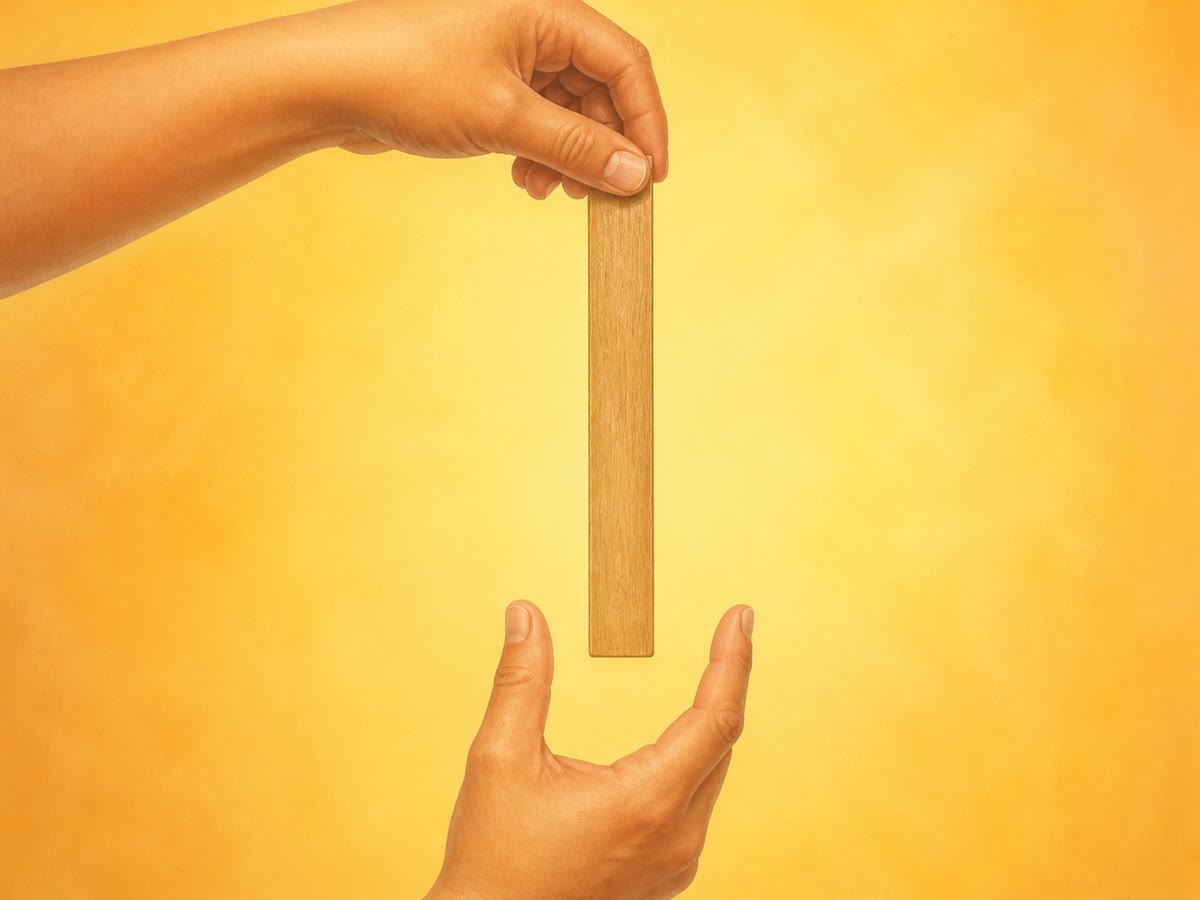
Reaction time with no instrument but a ruler:
- a partner holds a ruler hanging vertically, zero mark down, between your open thumb and finger;
- without warning, the partner lets go; you catch the ruler as fast as you can;
- read where you caught it: the fewer centimetres slid past, the faster your loop;
- repeat several times and keep your typical value — single tries jump around.
The falling ruler turns time into centimetres: about corresponds to a sixth of a second.
Example 33.7 (Why the passenger seat gasps first)
A fifth of a second seems nothing — until speed multiplies it. A car at highway speed covers about during a fifth-of-a-second reaction: the driver has not yet touched the brake, and the car has crossed a classroom. Reaction time is why distances between cars exist, and why a driver’s attention is a safety organ.
Remark 33.8 (Training the loop)
Practice shortens and sharpens the loop — not the nerves’ speed, but the brain’s routing. The beginner juggler drops everything; a month later the same brain orders the same hands through three balls without apparent effort. Learning a skill is the brain laying down better paths — one more thing that grows with exercise, like the muscles of Method 17.9.
33.3 Protecting the commander
Proposition 33.9 (Sleep, food, safety)
The brain is the body’s most protected organ — skull helmet, spine column — and the most demanding: though a small part of the body’s weight, it consumes a large share of its energy and oxygen (Proposition 27.1), and it does its filing and repairs during sleep (Proposition 6.8). A tired brain commands badly: slower reactions, scattered attention, grumpy decisions.
Proof. Admitted at this level. ∎
Example 33.10 (Helmets are for the loop)
Bones mend (Remark 17.3); the brain’s tissue, once badly hurt, mostly does not. That is the calculation behind bicycle helmets: skull plus foam where the body’s own protection might not be enough. Cheap insurance for the organ running everything else.
33.4 Exercises
Exercise 33.1 ★
Name the three parts of the nervous system and each one’s role.
Exercise 33.2 ★
State the loop of every action in three steps. Which parts report, which decides, which obey?
Solution
Solution of Exercise 33.2.
Sense organs report to the brain; the brain decides and composes orders; nerves carry the orders to the muscles, which contract. Sense organs report, the brain decides, muscles obey.
Exercise 33.3 ★
Where are the brain and the spinal cord each protected, and by which bones?
Solution
Solution of Exercise 33.3.
The brain in the skull; the spinal cord inside the spine’s column of stacked small bones.
Exercise 33.4 ★
What is reaction time? Give its rough value for a simple task.
Solution
Solution of Exercise 33.4.
The delay between a signal and the body’s response — about a fifth of a second for a simple task in a practiced person, a little more in children.
Exercise 33.5 ★
Replay slowly, as in Example 33.3: you step on something sharp and your foot jerks away. Who reported, who decided, who obeyed?
Solution
Solution of Exercise 33.5.
The skin of the foot reported (touch and pain), the nervous system decided the retreat, and the leg muscles obeyed by jerking the foot away. (So fast a retreat is handled partly by the spinal cord itself — the command center’s emergency desk.)
Exercise 33.6 ★
Give two services the brain runs without your thinking about them, from Remark 33.4.
Exercise 33.7 ★
Why does a tired brain command badly? Name two of its needs from Proposition 33.9.
Exercise 33.8 ★
Try it: run the ruler test of Method 33.6, five tries. Report your typical catch distance — and whether practice improved it.
Solution
Solution of Exercise 33.8.
Open answer. Typical catches run around – cm; several tries usually improve and steady the value a little.
Exercise 33.9 ★★
Why is there no such thing as an instant catch, however skilled the catcher? Answer with the loop’s three steps.
Exercise 33.10 ★★
Using Example 33.7: why do road rules demand distance between cars rather than merely good brakes? What does attention change in the loop?
Solution
Solution of Exercise 33.10.
Because the best brakes act only after the driver’s loop has run — and at highway speed the car covers about before the order “brake!” even reaches the foot. The gap between cars is room for the loop. Attention shortens the report-and-decide steps; a distracted brain adds metres.
Exercise 33.11 ★★★
The juggler of Remark 33.8 improved without her nerves conducting any faster. What part of the loop improved instead? Compare with training a muscle: what grows in each case?
Solution
Solution of Exercise 33.11.
The brain’s part — the deciding and ordering: practice laid down better paths, so the same reports now route to the right orders quickly and without effort. Muscle training grows the muscle’s strength; skill training grows the brain’s routing. One builds the motor, the other the commander.