Primary & Middle School Biology · Grades 1–9
19Food Chains
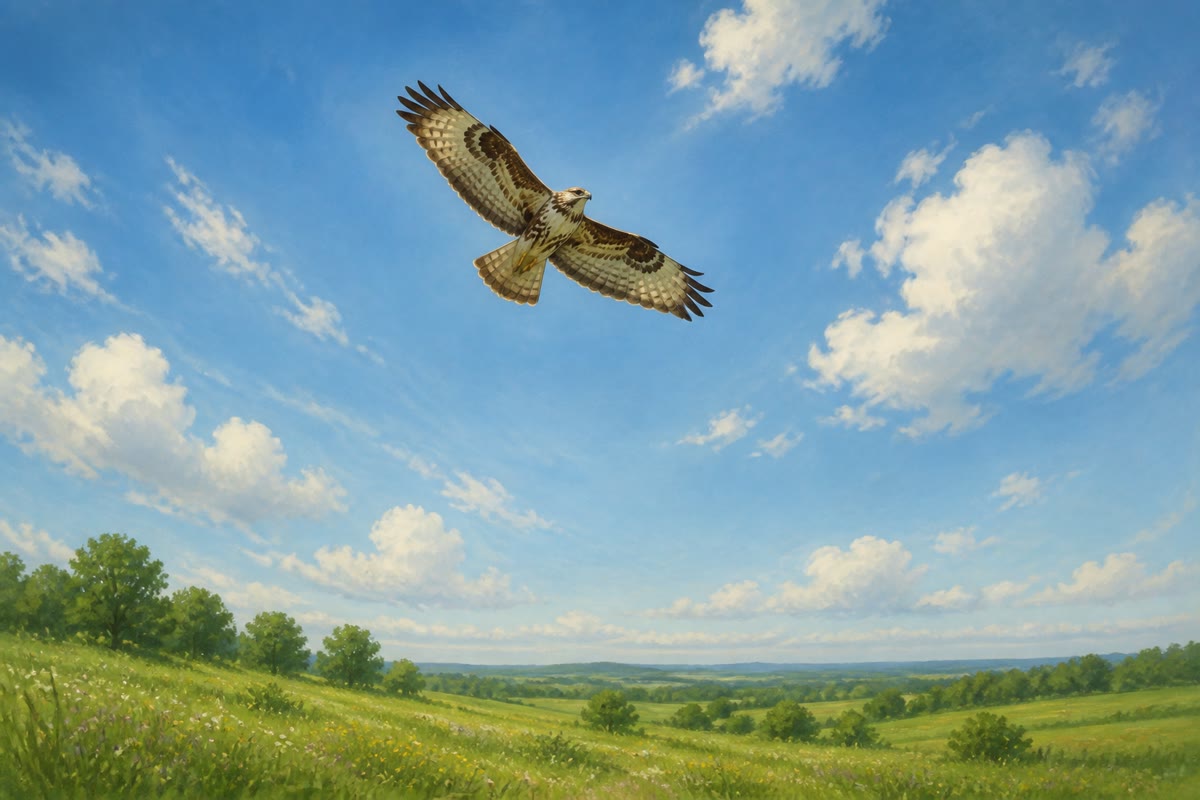
Grass grows in the meadow. A grasshopper eats the grass. A lizard catches the grasshopper. A buzzard, circling high, takes the lizard. Four meals — and suddenly the buzzard’s afternoon depends on how green the grass grew. Nature’s meals link up into chains, and learning to read them is learning how a whole meadow holds together.
19.1 Reading and writing a food chain
Definition 19.1 (Food chain)
A food chain is a line of living things in which each one is eaten by the next. It is written with arrows, each arrow meaning “is eaten by”:
Each living thing is a link of the chain.
Remark 19.2 (Mind the arrow’s direction)
The arrow points from the eaten to the eater — it follows the food. “Grass grasshopper” reads “grass is eaten by the grasshopper”. Writing the arrows backward — toward the meal — is the commonest mistake in food chains; remember that the arrow shows where the food goes.
Proposition 19.3 (Every chain starts with a plant)
The first link of a food chain is always a plant (or another living thing that makes its own food). Plants alone feed without eating anyone — from light, water and air, as Definition 3.1 said. Every animal link lives, directly or through others, on that first green link.
Proof. Admitted at this level. ∎
Example 19.4 (Chains from three habitats)
In the pond: water plants tadpole dragonfly larva stickleback heron. In the forest: oak leaves caterpillar blue tit sparrowhawk. In the garden: salad snail hedgehog. First link: always green.
Method 19.5 (Building a food chain)
- Choose an animal and ask: what does it eat? Write the food to its left, arrow pointing at the eater;
- ask the same question of the food, and continue leftward until you reach a plant;
- ask: who eats my starting animal? Extend rightward while there is an eater;
- check every arrow reads “is eaten by” — food flowing to the right.
19.2 When a link changes
Proposition 19.6 (Links depend on each other)
In a food chain, every link depends on the ones before it, and feeds the ones after it. If one link becomes scarce, the next links go hungry — and the link before it, no longer eaten so much, may multiply. A change in one link travels along the whole chain.
Proof. Admitted at this level. ∎
Example 19.7 (The dry summer)
A drought browns the meadow grass. Grasshoppers, short of food, grow few; the lizards that hunted them go hungry and feed the buzzard poorly in their turn. One brown first link, and the whole chain above it thins — the buzzard never ate grass, yet it feels the drought.
Example 19.8 (Removing the hunter)
Suppose the buzzards vanish from the valley. Lizards, less hunted, multiply; grasshoppers are then eaten harder and dwindle; the grass, less nibbled, may even thicken. Removing the last link also travels down the chain — in the other direction.
Remark 19.9 (Real meadows are webs)
Our chain is a single thread, but the buzzard also takes mice, the lizard also eats flies, and the grass feeds rabbits too. Many chains crossing make a net — the food web that a later year will study (Chapter 10 already hinted at it with the fox, the rabbit and the grass). Chains first: they are the threads the net is woven from.
19.3 Exercises
Exercise 19.1 ★
What does the arrow of a food chain mean? Which way does it point?
Solution
Solution of Exercise 19.1.
“Is eaten by”. It points from the eaten to the eater — following the food.
Exercise 19.2 ★
What kind of living thing is always the first link? Why?
Solution
Solution of Exercise 19.2.
A plant (or another living thing that makes its own food). Because plants alone feed without eating anyone — from light, water and air; every animal link lives off that first green link, directly or through others.
Exercise 19.3 ★
Write the meadow chain of this chapter with its four links and its arrows.
Solution
Solution of Exercise 19.3.
Grass grasshopper lizard buzzard.
Exercise 19.4 ★
Correct this chain: fox rabbit grass.
Solution
Solution of Exercise 19.4.
The arrows are backward: grass rabbit fox — grass is eaten by the rabbit, which is eaten by the fox.
Exercise 19.5 ★
Build a chain from these links: blue tit, oak leaves, sparrowhawk, caterpillar.
Exercise 19.6 ★
In the garden chain salad snail hedgehog, who is eaten by the snail? Who eats the snail?
Exercise 19.7 ★
Use Method 19.5 to make a chain of at least three links ending with the heron of the pond.
Exercise 19.8 ★
In the dry summer of Example 19.7, why does the buzzard suffer although it never eats grass?
Solution
Solution of Exercise 19.8.
Because its food’s food’s food is grass: fewer grasshoppers on the browned grass means fewer lizards, and fewer lizards means lean hunting for the buzzard. A change in the first link travels up the whole chain.
Exercise 19.9 ★★
Gardeners who poison every snail sometimes lose their hedgehog — and then meet more slugs and snails than before. Explain both halves with Proposition 19.6.
Solution
Solution of Exercise 19.9.
Poisoning the snails starves their eater: the hedgehog leaves or dies. Later, with the hedgehog — the snails’ main enemy — gone, the surviving slugs and snails multiply harder than before: removing links travels both up the chain (hungry hedgehog) and back down it (unhunted snails).
Exercise 19.10 ★★
“The lizard depends on the grass.” True or false? Defend your answer with the meadow chain — and say in which direction a grass failure travels.
Solution
Solution of Exercise 19.10.
True — through the middle of the chain. The lizard eats grasshoppers, and grasshoppers eat grass: if the grass fails, the failure travels up, link by link, from grass to grasshopper to lizard. The lizard never touches grass, and depends on it all the same.