Primary & Middle School Biology · Grades 1–9
23How Animals Reproduce
In May the pond is loud with frog song; by June it is black with tadpoles. The song, it turns out, was the beginning of the story: reproduction — how animals make the next generation — follows rules that hold from frogs to elephants, with marvellous variations in the details.
23.1 It takes two
Definition 23.1 (Sexual reproduction)
In animals, making young usually takes two parents: a female and a male. The female produces egg cells; the male produces sperm cells. A young animal begins when one sperm cell joins one egg cell — that joining is fertilization. Reproduction with two parents is called sexual reproduction.
Example 23.2 (Why the frogs sing)
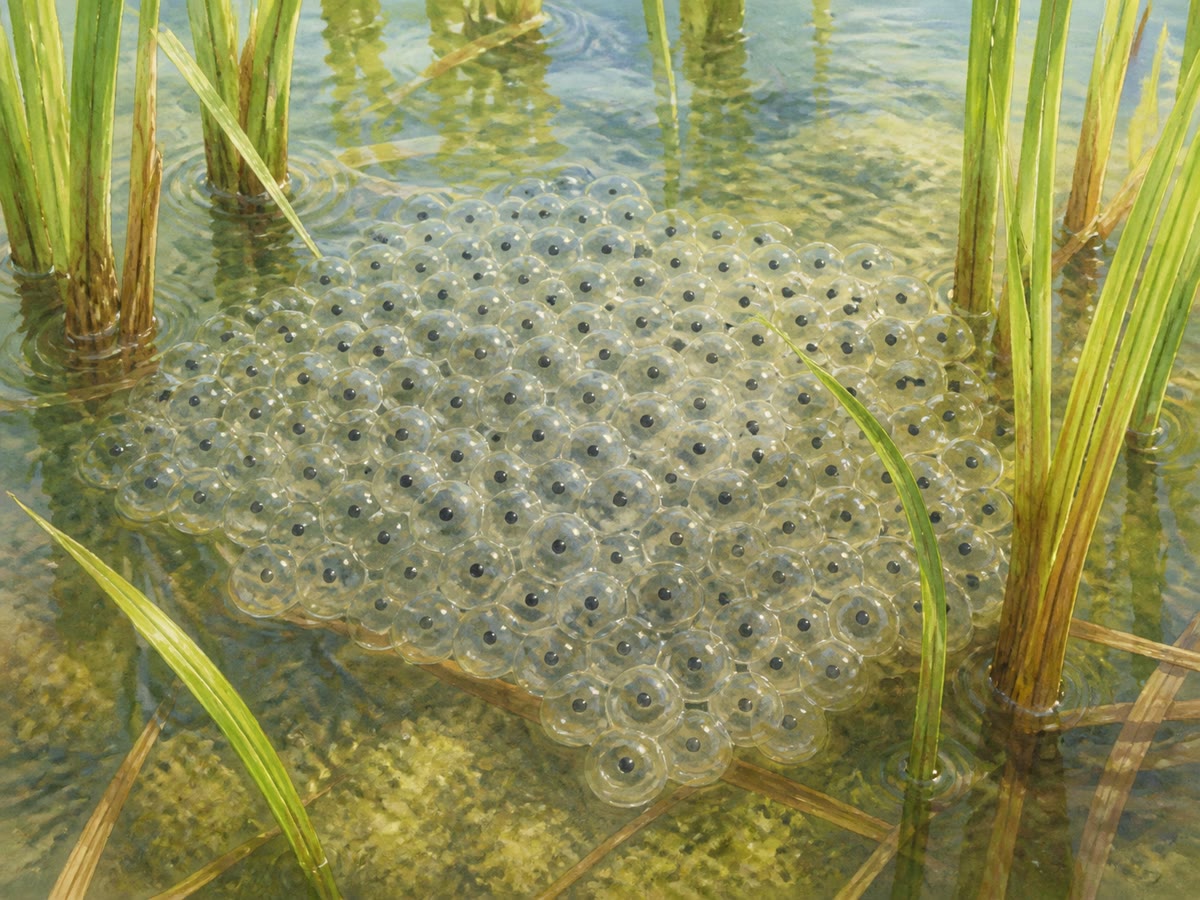
The May chorus is the males calling the females to the pond. Each pair then releases its cells into the water — the female’s eggs, the male’s sperm — where fertilization happens. The black dots in the jelly a few days later are the young already growing: the song was step one of Chapter 8’s frog cycle.
Remark 23.3 (Two parents, blended luck)
A young animal gets something from each parent — which is why a foal can have its mother’s color and its father’s white blaze. What exactly each parent hands over, and how, is one of the great questions ahead in this book; for now, note simply that every sexually produced animal has two parents and resembles both.
23.2 Eggs laid, or young born alive
Definition 23.4 (Oviparous and viviparous)
Definition 8.1’s two ways of being born now get their scientific names:
Example 23.5 (Two nurseries)
The hen’s chick spends three warm weeks in a shelled egg, living off the yolk (Remark 8.3); the foal spends eleven months inside the mare, fed continuously by her body, and is born ready to stand within the hour. Same goal, two nurseries: one packed lunch in a shell, one room service inside.
Proposition 23.6 (Where fertilization happens)
For water-dwellers like fish and frogs, fertilization commonly happens in the water, outside the female’s body — eggs and sperm are released together and meet by the thousands. For land animals — birds, reptiles, mammals, insects — the cells would dry out in the open, so the male places his sperm inside the female’s body during mating, and fertilization happens there.
Proof. Admitted at this level. ∎
23.3 Few young and much care, or many and none
Proposition 23.7 (Two strategies for the next generation)
Compare the counts: a codfish releases millions of eggs a year and cares for none; an elephant has one calf every few years and guards it for a decade. Between these extremes, a rule holds across the animal world: the more young a species produces, the less care each one gets — and the fewer it produces, the more each is protected and fed. Both strategies succeed: on average, enough young survive to replace the parents.
Proof. Admitted at this level. ∎
Example 23.8 (Counting the pond)
One frog pair’s clutch holds thousands of eggs. Herons, sticklebacks and dragonfly larvae (see Example 19.4) eat tadpoles all spring — and out of the thousands, a handful of froglets climb the bank in July. The enormous clutch is not waste: it is the frog’s answer to the pond’s dangers, with no parental guard at all.
Example 23.9 (The other extreme)
The whale calf is born alone, swims at once beside its mother, drinks her rich milk for many months and is defended against every danger. One young at a time — but that one gets everything. Mammals, with their milk (Definition 8.1), are the great specialists of the few-and-cared-for strategy.
Method 23.10 (Reading a species’ strategy)
Given a species, ask:
- How many young at a time — one, a dozen, thousands?
- Who guards and feeds them — both parents, the mother, nobody?
- Where do they start — egg outside, or grown inside?
- Check the balance of Proposition 23.7: many young with little care, or few with much.
23.4 Exercises
Exercise 23.1 ★
What is fertilization? Which cell comes from each parent?
Solution
Solution of Exercise 23.1.
The joining of one sperm cell with one egg cell, which starts a new young animal. The egg cell comes from the female, the sperm cell from the male.
Exercise 23.2 ★
Define oviparous and viviparous, with two animals of each kind.
Solution
Solution of Exercise 23.2.
Oviparous: the female lays eggs and the young finishes growing in the egg, outside her body — the hen, the frog (also trout, lizards, snails, insects). Viviparous: the young grows inside the mother, fed by her, and is born alive — the mare, the whale (nearly all mammals).
Exercise 23.3 ★
Why were the frogs singing in May? Retell the pond’s story in three steps.
Exercise 23.4 ★
Where does fertilization happen for the trout, and where for the hen? Why the difference, by Proposition 23.6?
Exercise 23.5 ★
Compare the chick’s and the foal’s nurseries: where does each grow, and what feeds it?
Solution
Solution of Exercise 23.5.
The chick grows in a shelled egg outside the hen, living off the yolk packed with it. The foal grows eleven months inside the mare, fed continuously by her body, and is born alive.
Exercise 23.6 ★
State the rule linking the number of young to the care they receive. Give the two extreme examples of the chapter.
Solution
Solution of Exercise 23.6.
The more young a species produces, the less care each gets; the fewer, the more care. Extremes: the codfish’s millions of uncared-for eggs, and the elephant’s single calf guarded for a decade.
Exercise 23.7 ★
The codfish’s millions of eggs mostly never become adult cod. Why is the strategy successful anyway?
Solution
Solution of Exercise 23.7.
Because success only requires that, on average, enough young survive to replace the parents. Out of millions of eggs, a few always slip through the sea’s dangers — the huge number is the protection.
Exercise 23.8 ★
Run Method 23.10 on the cat: typical litter of about five, nursed and guarded by the mother for weeks, grown inside her. Which strategy side is she nearer to?
Solution
Solution of Exercise 23.8.
Few young (five is few compared to thousands), grown inside the mother, nursed and guarded: the cat sits clearly on the few-and-cared-for side — like the mammals generally.
Exercise 23.9 ★★
A foal often resembles both its parents at once. What does this show about what the young receives, by Remark 23.3?
Solution
Solution of Exercise 23.9.
That it receives something from each parent — the young is not a copy of its mother alone. Both parents contribute to what the foal becomes.
Exercise 23.10 ★★
The stickleback male builds a nest, fans the eggs and chases off intruders — rare devotion for a fish. Using Proposition 23.7, what would you predict about the size of his clutch, compared with the codfish’s millions?
Exercise 23.11 ★★★
Sea turtles crawl ashore to bury their eggs in warm sand, then return to the sea. Oviparous or viviparous? Cared for or not? And why must this reptile, a swimmer all its life, still lay on land? (Use Proposition 21.4’s reptile features.)
Solution
Solution of Exercise 23.11.
Oviparous — and uncared for: the buried clutch is left to the sand’s warmth, and the hatchlings dash to the sea alone (their large numbers are their strategy). She must lay on land because reptile eggs are shelled and breathe air — laid in the sea they would drown. Her class’s features, not her habits, set the rule.