Primary & Middle School Physics · Grades 1–9
1Observing the World: The Five Senses
A bird sings somewhere above you. The bread smells warm. The pavement feels cold through your socks. Before doing anything else, physics looks, listens and touches: this chapter is about observing the world with the five senses — and about the tricks they can play on us.
1.1 The five senses
Definition 1.1 (The five senses)
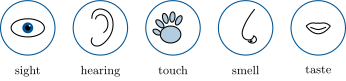
A sense is a way the body finds out about the world. We have five:
- sight — the eyes see light, colors and shapes;
- hearing — the ears hear sounds;
- touch — the skin feels rough or smooth, warm or cold;
- smell — the nose smells the warm bread;
- taste — the tongue tastes sweet, salty, sour.
Example 1.2 (One apple, five senses)
Eating an apple uses every sense: you see its red skin, you feel it smooth and round in your hand, you hear the crunch, you smell its perfume, you taste its sweet juice. Five senses, one apple.

Example 1.3 (Try it: the sound walk)
Sit still, close your eyes, and count the sounds around you for a little while: a car, a voice, the wind, your own breathing. With eyes closed, the ears notice sounds that the busy eyes made you miss. Most people find or sounds they had not noticed before.
Remark 1.4 (Senses that protect us)
The senses are also guards. The nose smells smoke before the eyes see a fire; the skin pulls the hand back from a hot pan; a bitter taste warns “do not swallow this”. Never taste or smell something unknown on purpose: ask an adult first. The guards work best when we treat them carefully.
1.2 Observing carefully
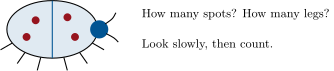
Looking is not yet observing. Everyone has seen a ladybug; who can say how many legs it has?
Definition 1.5 (Observation)
To observe is to use the senses carefully, on purpose, to answer a question — and then to say or draw exactly what was noticed, not what was expected. An observation is what careful watching found out.
Method 1.6 (How to observe)
- Choose a question: how many legs does the ladybug have?
- Watch (or listen, or touch) slowly, without hurrying;
- say what you notice with precise words: not “it is small”, but “it is smaller than my fingernail”;
- draw or tell it, so someone else can check.
A good observation can be checked by a friend: if you both look, you should both find legs.
Example 1.7 (Precise words)
Compare “the stone is nice” with “the stone is gray, smooth, round, and colder than my hand”. The second sentence is an observation: another child can pick that stone out of a whole basket.
1.3 When the senses are fooled
The senses are wonderful, but they can be tricked. That is exactly why, in the chapters to come, we will learn to measure.
Example 1.8 (Two lines)
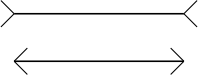
In the picture below, which line is longer? Almost everyone answers “the top one”. Now check with a piece of string: the two lines are exactly as long as each other. The eyes were fooled by the arrow tips.
Example 1.9 (Try it: three bowls)
Ask an adult to prepare three bowls of water: one cool, one lukewarm, one comfortably warm. Keep one hand in the cool bowl and the other in the warm bowl while you slowly count to . Then put both hands together in the middle bowl: the same water feels warm to one hand and cool to the other! Touch alone cannot be trusted about hot and cold — the next chapter takes up exactly this problem.
Remark 1.10 (Helpers for the senses)
People build tools that help the senses: glasses and magnifying glasses help the eyes, a doctor’s stethoscope helps the ears. Later in this book, tools called instruments will do even better: they will turn looking and touching into counting and measuring, and counting is much harder to fool.
1.4 Exercises
Exercise 1.1 ★
Name the five senses, and for each one the part of the body that does the job.
Solution
Solution of Exercise 1.1.
Sight — the eyes; hearing — the ears; touch — the skin; smell — the nose; taste — the tongue.
Exercise 1.2 ★
Which sense tells you: (a) that the radio is on? (b) that the soup is too salty? (c) that your pullover is scratchy? (d) that the lights went out?
Exercise 1.3 ★
A cake is baking in the oven, door closed, in another room. Which sense finds it first? Which senses will you use when you finally get a slice?
Solution
Solution of Exercise 1.3.
Smell finds the cake first — the perfume slips under the door. Eating the slice uses sight, touch, smell and taste, and even hearing if the crust crunches.
Exercise 1.4 ★
Do the sound walk of Example 1.3: eyes closed, count the sounds around you. How many did you hear? Which one surprised you?
Solution
Solution of Exercise 1.4.
Answers vary; most children count or sounds, and the surprise is often a quiet one — the refrigerator humming, or their own breathing.
Exercise 1.5 ★
Give an observation of your shoe using three precise words, as in Example 1.7. “Nice” and “pretty” are not allowed!
Solution
Solution of Exercise 1.5.
For example: “My shoe is blue, rubbery, and longer than my hand.” Any three precise words that a friend could check are correct.
Exercise 1.6 ★
Ana says: “The cat is soft.” Bob says: “The cat is the best cat.” Which sentence is an observation, and which sense made it? What is the other sentence?
Solution
Solution of Exercise 1.6.
Ana’s sentence is the observation, made by touch. Bob’s sentence is an opinion: nobody can check “best” by looking or touching.
Exercise 1.7 ★
Which sense warns you of each danger: (a) smoke somewhere in the house; (b) a pan too hot to hold; (c) a car coming from behind you?
Solution
Solution of Exercise 1.7.
(a) Smell. (b) Touch — the skin feels the heat, even from a small distance. (c) Hearing.
Exercise 1.8 ★
A friend closes their eyes. You put a spoon, a sponge and a pebble in front of them, one at a time. Can they name all three just by touch? Which was easiest to recognize?
Solution
Solution of Exercise 1.8.
Touch alone names all three easily: metal spoon (hard, cold, smooth), sponge (soft, light), pebble (hard, heavy, round). The spoon is usually easiest — cold metal is hard to mistake.
Exercise 1.9 ★★
Look at the two lines of Example 1.8. Explain to a friend how to find out for sure which line is longer, without trusting the eyes. Can your method also compare a line with a curvy piece of string?
Solution
Solution of Exercise 1.9.
Lay a piece of string along the first line and cut or pinch it to the same length, then lay it along the second line: the string compares them without the eyes deciding. The same string can follow a curvy line too, then be pulled straight — so the method even compares a curve with a straight line.