Primary & Middle School Physics · Grades 1–9
49Sources of Light and Propagation
Why can you read this page? A lamp shines — but the page is no lamp, and yet your eye receives light from every printed line. Between the things that make light and the things that merely hand it on lies a distinction optics cannot live without; and with it comes the full answer to the oldest question in this book: what does it take to see something?
49.1 Makers and forwarders
Definition 49.1 (Primary sources)
A primary source makes its own light: the Sun and the stars, flames, glowing filaments, the white-hot steel of the forge, fireflies, lightning. Its light exists whether or not anything else shines — switch off the world, and a primary source still glows.
Definition 49.2 (Diffusing objects)
Every other visible thing is a diffusing object: it receives light and re-sends — diffuses — part of it in all directions. The page, the apple, the Moon, your own face: none makes a glimmer of its own; each scatters received light generously to every side. A diffuser in the dark is simply invisible.
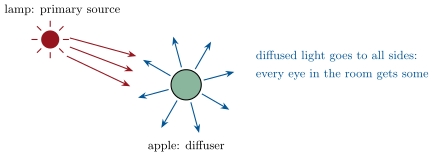
Example 49.3 (Diffusion is not mirroring)
Both mirrors and pages send received light back — but with opposite manners. The mirror bounces in one disciplined direction (equal angles — your old bounce rule), preserving the picture; the page’s microscopic roughness sprays light everywhere, destroying the picture but offering itself to every eye at once. That is why a mirror shows the lamp, while the page merely shows itself, from wherever you stand.
Example 49.4 (The Moon’s file, closed)
The childhood verdict now has its formal words: the Moon is no primary source; it is a diffusing object of planetary size — gray rock scattering sunlight in all directions, our way included. So moonlight is secondhand sunshine, and the “dark side” is simply the half whose file holds, at that moment, no light to forward.
49.2 Seeing, settled
Proposition 49.5 (The two conditions of vision)
An eye sees an object exactly when
- light leaves the object — made, if the object is a primary source; diffused, if a forwarder — and
- that light travels in a straight, unblocked line into the eye.
Break either condition — an unlit diffuser, or a wall across the sight line — and the object is unseen. Every visibility puzzle in this book unpacks into these two checks.
Example 49.6 (The beam made visible)
In clean air, a torch beam crossing the room cannot be seen from the side — air forwards almost nothing, and no light from the beam turns toward your eye. Shake a dusty cloth: the beam leaps into view. Each dust mote is a tiny diffuser, catching beam-light and scattering some your way — thousands of specks drawing the beam’s straight line for you. Fog, mist and smoke perform the same service for lighthouse beams and cinema projectors.
49.3 Three coats for light
Definition 49.7 (Transparent, translucent, opaque)
Materials meet light in three manners:
- transparent: light crosses nearly undisturbed, keeping its order — clear glass, still water, air; images pass intact;
- translucent: light crosses, but scrambled — frosted glass, tracing paper, a thin curtain; brightness passes, images do not;
- opaque: light is stopped — absorbed or diffused back — wood, stone, metal, your hand; behind an opaque thing lies shadow.
Method 49.8 (Sorting materials by torchlight)
A dark room, a torch, a printed page, and the specimen between:
- hold the specimen over the print with the torch behind it;
- read the print through it? — transparent;
- see glow but no letters? — translucent;
- see darkness, and a shadow beyond? — opaque.
Test honestly: many materials change team with thickness — a sheet of water is transparent, the deep sea is night-dark; one paper sheet is translucent, the closed book opaque.
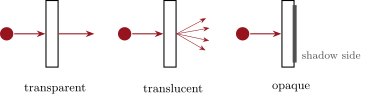
Example 49.9 (Architecture’s three teams)
Builders deploy all three on purpose. Transparent window glass: view and light together. Translucent bathroom panes and frosted office partitions: daylight in, privacy kept — brightness without images is exactly their job description. Opaque walls and shutters: darkness on demand. Lampshades are translucency in service of comfort: the blazing filament’s glare is scrambled into a soft, sourceless glow.
Remark 49.10 (Nothing to forward, nothing to see)
Riddle: an astronaut between the stars looks sideways across a sunbeam-filled void. What does she see? Blackness — though sunlight floods past her eyes. Space carries no dust worth mentioning: nothing diffuses the passing light toward her, and light that does not enter the eye paints nothing. The daytime sky is blue precisely because our air does forward sunlight down to us — a planet’s worth of gentle diffusion overhead. No air, black sky, even at noon: the Moon’s astronauts stood in sunshine under a starless black dome.
49.4 Exercises
Exercise 49.1 ★
Sort: candle flame; the Moon; a firefly; this page; a red traffic light; the planet Venus at dusk.
Solution
Solution of Exercise 49.1.
Primary sources: the candle flame, the firefly, the red traffic light. Diffusers: the Moon, this page, Venus — the planet shines by diffused sunlight, however star-like it looks.
Exercise 49.2 ★
What does a diffusing object do with the light it receives — and what becomes of it in a dark room?
Solution
Solution of Exercise 49.2.
It re-sends part of the received light in all directions. In a dark room it receives nothing, forwards nothing — and is invisible.
Exercise 49.3 ★
State the two conditions of vision, and use them: why can you not see a perfectly clean mirror’s own surface, only the things it reflects? (Careful — fine question; answer simply: what does its polish refuse to do with light?)
Exercise 49.4 ★
Why does everyone around the table see the same apple, while only one lucky eye position catches the lamp’s reflection in a spoon?
Solution
Solution of Exercise 49.4.
The apple diffuses to all directions at once — every eye gets a share. The spoon’s polish sends the lamp’s light in one direction only, and just one eye position sits on that single road.
Exercise 49.5 ★
Why is a torch beam invisible from the side in clean air, and visible in mist? Name the process.
Solution
Solution of Exercise 49.5.
Clean air forwards almost nothing sideways, so no beam-light enters an eye off the beam’s path. Mist fills the beam with tiny diffusers, each scattering a share toward you: diffusion draws the line.
Exercise 49.6 ★
Classify: window glass; tracing paper; a brick; shallow clear water; a frosted lightbulb’s envelope; aluminium foil.
Solution
Solution of Exercise 49.6.
Transparent: window glass, shallow clear water. Translucent: tracing paper, the frosted envelope. Opaque: the brick, the foil.
Exercise 49.7 ★
What job does translucency do in a bathroom window and in a lampshade? What passes, what is stopped?
Solution
Solution of Exercise 49.7.
Brightness passes; images are stopped (scrambled). The bathroom window admits daylight and denies onlookers; the shade converts a blinding point-filament into a broad gentle glow.
Exercise 49.8 ★
The Moon is sunlit — yet lunar astronauts saw a black sky at noon. Explain with Remark 49.10, and say why Earth’s noon sky is bright blue instead.
Solution
Solution of Exercise 49.8.
The Moon has no air: nothing above the astronauts diffused the passing sunlight toward their eyes, so the sky offered nothing to see — black at noon. Earth’s air forwards a share of sunlight from every direction of the sky: our bright blue dome is diffusion overhead.
Exercise 49.9 ★★
A single sheet of paper glows warmly in front of a torch; the closed book stops the light entirely. What does thickness do to a material’s team membership? Give a second example of a team-changer.
Solution
Solution of Exercise 49.9.
Each added layer scrambles and steals a little more: teams are thickness-dependent. Water is the chapter’s second example — transparent by the glassful, opaque by the ocean. (Thin paper translucent, the closed book opaque.)
Exercise 49.10 ★★
Cinema trick: projectors’ beams are invisible in a clean hall, yet films show them slicing dramatically through the air. What must the set crew add to the air, and what physics are they buying?
Solution
Solution of Exercise 49.10.
Something for the beam to strike: theatrical haze or smoke — crowds of tiny diffusers that catch beam-light and scatter a share to every seat. They are buying diffusion, the only way a sideways eye ever sees a beam.
Exercise 49.11 ★★
You see a friend’s face by a campfire. Trace the light’s full journey — source, diffusion, straight lines — and count how many diffusers stand in the chain if you then also see that face reflected in the lake.
Solution
Solution of Exercise 49.11.
Fire (primary source) straight line to the face the face diffuses straight line to your eye: one diffuser in the chain. Via the lake: face-diffused light travels straight to the still water, is mirror-bounced (not diffused — the lake is polished), and continues straight to your eye: still one diffuser, plus one mirror-bounce — the face, then the lake’s disciplined fold.
Exercise 49.12 ★★★
Nature’s own light show: on a bright day, the sky away from the Sun is blue, the Sun’s disc blinding white — and at sunset the low Sun turns orange while the clouds above catch pink. Using only “air diffuses a little of the light passing through it, and more so the longer the path”, explain why the low sun is robbed of part of its light — and who receives the stolen share. (The full color story is next year’s spectra chapter; reason here only with more-path, more-diffusion.)
Solution
Solution of Exercise 49.12.
Sunlight crossing air loses a share to diffusion all along its path — the longer the path, the greater the theft. At sunset the Sun’s light grazes the atmosphere along its longest road, so the direct beam reaches you robbed and weakened — the tamed orange disc. The stolen share has not vanished: it was scattered along the way, delivered to other skies as their daylight — and some, scattered late, paints the high clouds pink. (Which colors are stolen soonest is next year’s story.)
49.5 Problem: Lighting the Museum
Problem 49.1
Weekend problem — the new sculpture hall; a lighting designer’s night shift; sources, diffusers and three kinds of glass
The museum’s new hall opens Monday: one marble statue, paintings on the walls, a glass display case, and a nervous curator. You assist the lighting designer.
Part I — First principles on site.
- The curator asks why the statue, “so brilliantly white”, still needs lamps at all. Answer with the two conditions of vision.
- List the primary sources and the diffusers in the hall once the lamps are on: lamps, statue, paintings, visitors, the case’s glass.
- The marble seems to glow from everywhere, with no blinding spot. Which manner of returning light is at work, and why does every visitor position receive it?
- One polished brass plaque, by contrast, throws one dazzling reflection of a lamp. Name the other manner, and state the rule governing where that dazzle goes.
Part II — Taming the glare.
- Bare bulbs glare in visitors’ eyes. The designer sheathes each in a frosted globe. Which material team is the globe on, and what does it do to the filament’s light?
- The paintings must be lit, but no lamp may appear reflected in their varnish from the main viewing spot. Using the mirror rule, where does the designer place the lamps relative to painting and viewer?
- The display case’s clear glass is nearly invisible — until a visitor’s white sleeve appears in it like a ghost. Why does clear glass both transmit and faintly mirror? What does the designer’s black-walled niche behind the case achieve?
- Dust motes sometimes drift through the spotlights’ beams, drawing bright threads in the air. Curator: “Beautiful! Keep it.” Designer: “It means dirty air.” Who is right about the physics, and what are the threads?
Part III — The night test.
- Lights out, shutters sealed: the guard reports the hall “absolutely black — not even the white statue”. Explain with the two conditions why whiteness is helpless in the dark.
- A skylight is proposed: frosted glass overhead. What will it deliver by day, and what will it refuse to deliver (views of clouds, direct sun-dazzle)?
- The curator fears sunlight fading the paintings and asks for “light without any sun”. The designer smiles: by day, even the north-facing windows’ soft light is sunshine. Explain — what has forwarded it?
- Write the designer’s report: three sentences — one on why diffusion is the museum’s best friend, one on where mirror-manner reflections must be watched, and one on the team of glass chosen for each duty.
Solution
Solution of Problem 49.1.
1. Marble makes no light: seeing needs light leaving the object into the eye, and an unlit diffuser sends nothing. White is a promise about forwarding, worthless without a delivery. 2. Primary sources: the lamps, alone. Diffusers: statue, paintings, visitors — and the case’s glass faintly (mostly it transmits). 3. Diffusion: marble’s surface scatters received light to all directions, so every position in the hall is served and none is dazzled. 4. Mirror-manner reflection: the polished brass bounces the lamp’s light at equal angles into one direction — the dazzle lands only where that single road goes. 5. Translucent: the globe passes the brightness and scrambles the image — the filament’s point-glare becomes a soft ball of light. 6. By the bounce rule, a lamp shows in the varnish when lamp and viewer sit at equal angles on either side of the painting’s surface. The designer places lamps high and steep, so their bounced road dives to the floor in front of the painting — never into the main viewing spot’s eyes. 7. Glass mostly transmits but always mirror-bounces a faint share — clear windows are weak mirrors, seen against darkness behind. The black niche gives the transmitted view a dark ground so the faint reflections cannot compete — ghost sleeves fade. 8. Both: physically the threads are diffusion by dust motes — beam-light scattered to the visitors’ eyes; and dusty air is indeed what makes them possible. The physics is with the designer; the poetry with the curator. 9. No source, no leaving light, nothing to receive: whiteness is a high forwarding rate applied to nothing. Condition one fails for every object at once. 10. Soft, even, shadowless daylight over the hall — brightness without images: no cloud views, and no direct sun-dazzle on the marble. 11. The sky itself: air diffusing sunlight. North light is sunshine forwarded by a hemisphere of air — gentle, sourceless, and still solar; only the direct beam has been declined. 12. For example: “Diffusion is our best friend: it hands every artwork to every visitor without a single dazzle. Mirror-manner surfaces — varnish, brass, case glass — must be watched, for they deliver lamps to eyes along exact, predictable roads. And each glass serves by team: transparent for seeing in, translucent for glare and skylight, opaque for the dark.”