Primary & Middle School Physics · Grades 1–9
60Lenses and Images
The pinhole camera bought its sharp little image at a cruel price: almost no light. Yet your own eye paints a bright, crisp world on its back wall all day long, and no pinhole is in sight. The eye’s secret is a disc of curved glassy stuff that gathers a whole beam and bends it to order — the lens, star of cameras, spectacles, magnifiers and this chapter.
60.1 Two families of lens
Definition 60.1 (Converging and diverging lenses)
A lens is a piece of transparent material — glass or clear plastic — with curved faces, built to bend light in a controlled way (light bends when it crosses into glass; the exact law of that bending is High School treasure). Two families:
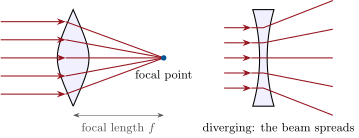
- converging lenses — thicker in the middle than at the rim — bend a beam’s rays toward each other;
- diverging lenses — thinner in the middle — spread them apart.
Run a fingertip across a spectacle lens: a middle bulge or a middle hollow sorts every lens on Earth into its family.
Definition 60.2 (Focal point and focal length)
Send a bundle of parallel rays — sunlight serves — through a converging lens: the bent rays all cross at one point behind it, the focal point. The distance from lens to focal point is the focal length : the lens’s one defining number. Strongly curved, fat lenses bend hard — short ; gently curved ones bend little — long .
Method 60.3 (Measuring a focal length)
For any converging lens, one minute and a far window:
- face a wall opposite a bright distant scene — the window and the world beyond;
- hold the lens near the wall and back it away slowly until the scene snaps into a small sharp picture on the wall (upside down — as expected by now);
- measure the lens-to-wall distance: for a distant scene, that distance is the focal length — far-off rays arrive practically parallel, and parallel rays gather at the focus.
A magnifier measures around ; spectacle lenses, tens of centimetres; a camera’s stubby lens, a few.
Remark 60.4 (The burning glass)
At the focal point of a converging lens, a whole beam-width of sunlight crowds into one blazing dot — concentrated enough to char paper and start fires within seconds. Treat it as what it is: the solar cooker’s principle in pocket form. Never focus sunlight near anything flammable, never toward skin or clothing — and, twice over the old law, never look at the Sun through any lens: the eye’s own focusing plus the lens’s makes an instant, painless, permanent burn.
60.2 The lens as image-maker
Proposition 60.5 (Real images)
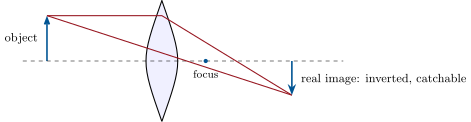
A converging lens gathers the rays diffused by each point of an object and delivers them to a matching point on the other side: point by point, it assembles a genuine picture — a real image — that can be caught on a screen. The image is inverted, like the pinhole’s, but bright: the lens harvests a whole lensful of light per point where the pinhole passed a single thread. Geometry’s rules of thumb: a distant object images small and near the focus; as the object approaches the lens, its image retreats and grows.
Example 60.6 (Camera and eye, one architecture)
A camera is the image-maker boxed: converging lens in front, a light-sensitive screen behind, image formed inverted on it (software politely rotates the file). Your eye is the same machine in living tissue: a converging lens behind the pupil, the retina as screen at the back, image inverted — the brain turns it over, as noted when the pinhole first taught us. Focusing differs beautifully: the camera moves its lens; the eye’s soft lens changes shape, tugged fatter for near things, relaxed thinner for far ones — feel the effort after an hour of close reading.
Example 60.7 (Spectacles)
When the eye’s own focusing falls short, a lens in front tops it up. The short-sighted eye focuses too strongly — distant scenes assemble before the retina and arrive blurred: a diverging spectacle lens un-bends the light just enough. The long-sighted (and most older) eyes focus too weakly for near work: a converging lens lends the missing strength — reading glasses are honest little magnifier-cousins. Two families of lens, two families of blur.
60.3 The magnifier
Example 60.8 (Inside the focal length)
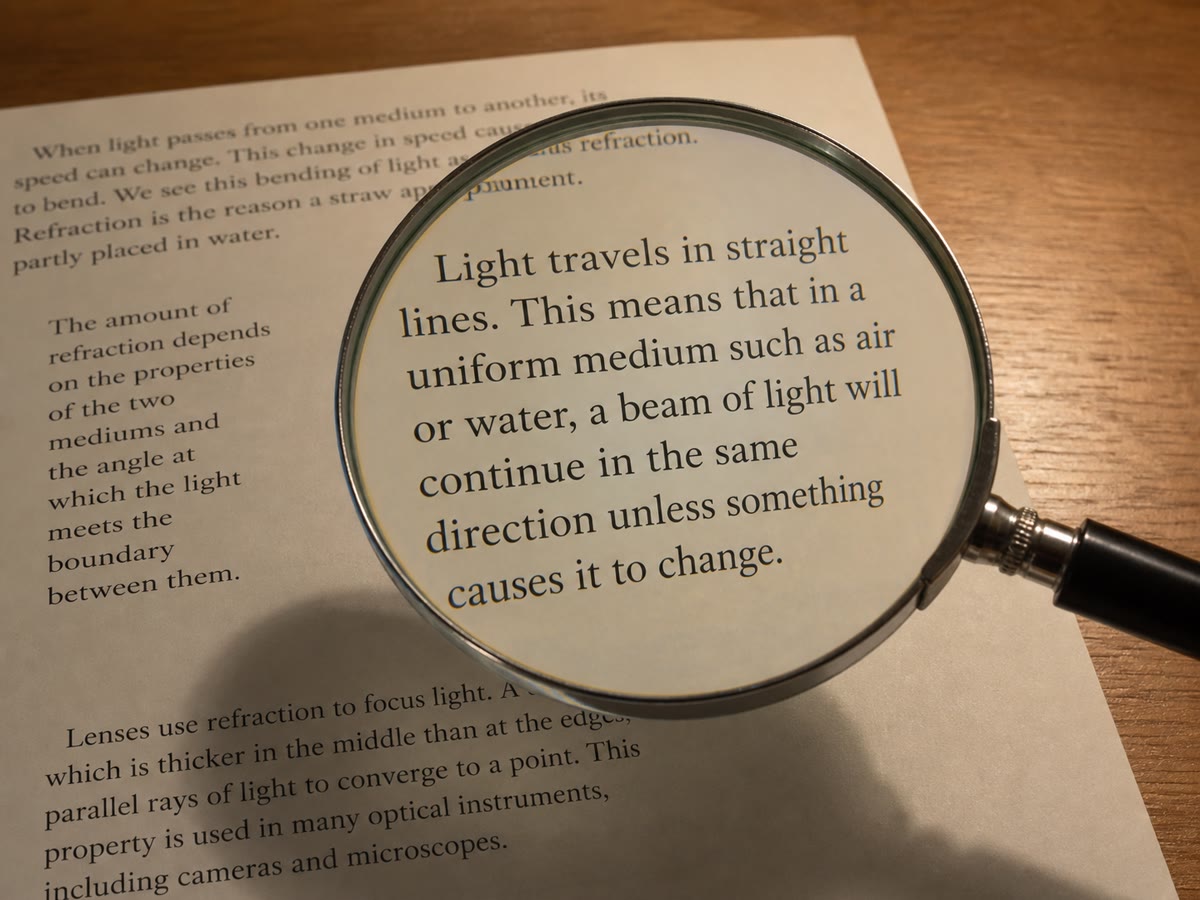
Hold a converging lens closer to a stamp than its focal length, and the picture changes character: no image lands on any screen — instead, looking through the lens, you see the stamp upright, in place, and enlarged. The lens bends the stamp’s rays so they reach the eye as if diffused by a grander stamp behind the glass — a made-to-order illusion, cousin to the mirror’s phantom world. Watchmakers, stamp collectors and your own past self with the childhood magnifying glass have all used it; the full ray-geometry of this trick is a jewel of the High School volume.
Remark 60.9 (Instruments upon instruments)
Stack lenses and the world opens. Two converging lenses make a microscope: one throws a large real image of a droplet, the second magnifies that image — molecules’ defenders got their first direct allies this way. A large lens (or curved mirror) plus a magnifier makes a telescope: the far galaxy’s faint parallel rays gathered into a real image, then enlarged into an astonished eye. Every optical instrument of civilization is this chapter’s two ideas — gather, then magnify — in various arrangements.
60.4 Exercises
Exercise 60.1 ★
Sort by touch: how does a fingertip tell a converging from a diverging lens? What does each do to a parallel beam?
Exercise 60.2 ★
Define focal point and focal length. What does a short focal length say about a lens’s curvature and bending power?
Solution
Solution of Exercise 60.2.
The focal point is where a parallel beam gathers after the lens; the focal length is the lens-to-focus distance. A short means strong curvature and hard bending.
Exercise 60.3 ★
Describe the window-and-wall measurement of . Why must the scene be distant?
Exercise 60.4 ★
State two safety rules of the burning glass, and the reason each exists.
Exercise 60.5 ★
What is a real image? Give its two signature properties, and the lens’s advantage over the pinhole.
Exercise 60.6 ★
Map camera onto eye: what plays the lens, the screen, and the focusing mechanism in each?
Exercise 60.7 ★
Which spectacle family serves the short-sighted eye, and why? The aging long-sighted eye?
Solution
Solution of Exercise 60.7.
Short sight focuses too strongly — images assemble before the retina: a diverging lens un-bends just enough. The aging long-sighted eye focuses too weakly for near work: a converging lens lends the missing strength.
Exercise 60.8 ★
What must be true of the stamp’s position for the magnifier trick — and what kind of “image” does the eye then enjoy?
Solution
Solution of Exercise 60.8.
The stamp must sit closer to the lens than its focal length. The eye then enjoys an upright, enlarged phantom — rays bent as if from a grander stamp behind the glass; nothing lands on any screen.
Exercise 60.9 ★★
A photographer’s subject walks toward the camera. Which way must the lens move to keep the image sharp on the sensor, by the rules of thumb? What does the eye do instead in the same situation?
Exercise 60.10 ★★
On a sunny day, a lens laid carelessly on dry leaves is a fire waiting to happen — but only at one particular lens-to-leaf distance. Which distance, and why exactly there?
Solution
Solution of Exercise 60.10.
At the focal length: only there does the lens crowd the Sun’s practically-parallel rays into their smallest, fiercest dot. Nearer or farther, the light spreads over a patch too gentle to ignite — the fire waits precisely at .
Exercise 60.11 ★★
Grandfather’s reading glasses double as an emergency magnifier and, on holidays, as a solar cigar-lighter — but his short-sighted grandson’s glasses do neither. Explain both family facts.
Solution
Solution of Exercise 60.11.
Reading glasses are converging: they gather sunlight to a burning focus and magnify close print — both converging-only talents. The short-sighted grandson’s diverging lenses spread every beam: no focus, no burning dot, and print viewed through them shrinks instead of growing.
Exercise 60.12 ★★★
The microscope and the telescope both stack two converging lenses — yet one magnifies droplets and the other galaxies. Contrast their two stages: what does lens one receive and produce in each instrument (near object against practically-parallel starlight), and why does the telescope want lens one large above all, while the microscope wants it strongly curved?
Solution
Solution of Exercise 60.12.
Telescope, stage one: the great lens receives a star’s practically-parallel rays and gathers them into a small real image near its focus; stage two magnifies that image. Faint starlight is precious — the front lens’s width decides how much of it is harvested per star: aperture is everything. Microscope, stage one: a strongly curved, short- lens hung close over the droplet throws a greatly enlarged real image; stage two magnifies again. Its object is bright and near — what stage one needs is not width but bending power. Same architecture, opposite appetites.
60.5 Problem: The Optician’s Bench
Problem 60.1
Weekend problem — apprenticed to the town optician; focal lengths, fittings and one cracked telescope
A day at the optician’s: lenses to sort, spectacles to match, and a customer’s telescope in pieces.
Part I — Sorting the tray. A drawer spill has mixed the stock.
- Propose two quick tests — one by touch, one with the window and wall — to sort converging from diverging lenses.
- Lens A throws a sharp image of the street onto the wall at . Its focal length and family?
- Lens B refuses to throw any image on the wall at any distance, and things viewed through it look smaller. Its family?
- Lenses C and D are both converging; C makes its window-image at , D at . Which is the more strongly curved, harder-bending lens?
Part II — Fittings.
- A customer sees distant road signs blurred but reads menus effortlessly. Diagnose the eye and prescribe the family.
- Another holds the newspaper at arm’s length and complains their arms are “too short”. Diagnose and prescribe.
- The optician warns the second customer: “your new reading glasses will blur the mountains.” Why are reading spectacles for near pages only?
- A child asks why the optician’s trial lenses make the eye-chart swim while their own eyes are “fine”. What is a corrective lens doing to a well-focused eye?
Part III — The cracked telescope. A customer brings a stargazing telescope with its front lens cracked, asking whether the spare magnifier in the box can replace it.
- Name the two lenses’ jobs in the healthy instrument: what does the great front lens receive from a star and make of it, and what does the small eye-lens do with that?
- The front lens is wide as a saucer; the eye-lens, coin-small. Why does the front lens’s width matter so much for faint stars?
- The spare magnifier is strongly curved but coin-small. Judge the replacement: what would be gained and lost at the front of the instrument?
- Close the day with the optician’s one-line creed about every instrument on the shelf — spectacles, magnifiers, cameras, telescopes — and the two-verb summary of what lenses do for civilization.
Solution
Solution of Problem 60.1.
1. Touch: bulging middle, converging; hollow middle, diverging. Window test: converging lenses throw an upside-down window on the wall at some distance; diverging lenses never do. 2. ; converging. 3. Diverging — no real image at any distance, and the shrunken view through it seals the verdict. 4. C: the shorter focal length () marks the fatter, harder-bending lens. 5. Distant blur with easy near vision: short sight — the eye bends too strongly. Prescribe the diverging family. 6. Arm’s-length reading: the aging, weakly-focusing long-sighted eye. Prescribe converging reading lenses. 7. Reading lenses add bending strength budgeted for near pages; aimed at mountains, whose rays arrive parallel and need no help, the added strength over-bends — images assemble before the retina, and the peaks blur. 8. Adding correction to a well-focused eye unbalances it: the trial lens bends light the child’s eye then must fight, assembling images off the retina — swimming charts are the healthy eye’s protest. 9. The front lens gathers the star’s parallel rays into a small real image near its focus; the eye-lens is a magnifier hung inside its own focal length of that image, enlarging it into the observer’s eye. 10. Each star delivers only a whisper of light per square centimetre; the saucer-wide lens collects centimetres by the hundred, funneling a whole dinner-plate of whisper into one bright point. Width is the astronomer’s appetite. 11. The coin-small magnifier, however strongly curved, would harvest a coin’s worth of starlight where a saucer’s worth is needed: images sharp perhaps, but starved — faint stars gone. Gained: nothing the eye-lens did not already give. Verdict: no replacement; order proper glass. 12. For example: “Everything on this shelf does two verbs: gather light, then deliver it where the eye needs it — and civilization’s whole optical toolkit, from spectacles to observatories, is those two verbs in different sizes.”