Primary & Middle School Physics · Grades 1–9
27How Sound Travels
The flash of lightning — then one, two, three seconds of silence — and only now the growl of thunder. Yet flash and growl were born together in the same cloud! Sound, we learned, is a trembling that travels. This chapter follows it on the road: what it travels through, how fast it runs, and what happens when it hits a wall.
27.1 Sound needs a carrier
Proposition 27.1 (No carrier, no sound)
Sound travels only through things: through air, through water, through wood, brick and steel. Where there is nothing at all — no air, no stuff of any kind — sound cannot travel: the trembling has nothing to tremble.
Example 27.2 (The bell in the jar)
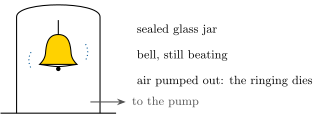
A famous experiment, three centuries old: an electric bell rings inside a glass jar — clearly heard. A pump then sucks the air out of the sealed jar while the bell’s hammer keeps visibly beating. The ringing fades… and dies. Let the air rush back in: the ringing returns. The bell never stopped — its carrier was taken away and returned. And now you can settle an old question: the silent Moon, where a shout dies unheard, is silent because it has no air at all.
Example 27.3 (Better carriers than air)
Solids and water carry sound wonderfully — often better than air. Press your ear flat on the table and have a friend scratch its far end very softly: through the air you hear nothing, through the wood the scratch is loud and crisp. Swimmers hear the pool’s underwater clanks from end to end; whales sing to each other across whole seas. And thick walls carry the neighbor’s drilling into every room — solids are almost too good at this.
Method 27.4 (The string telephone)
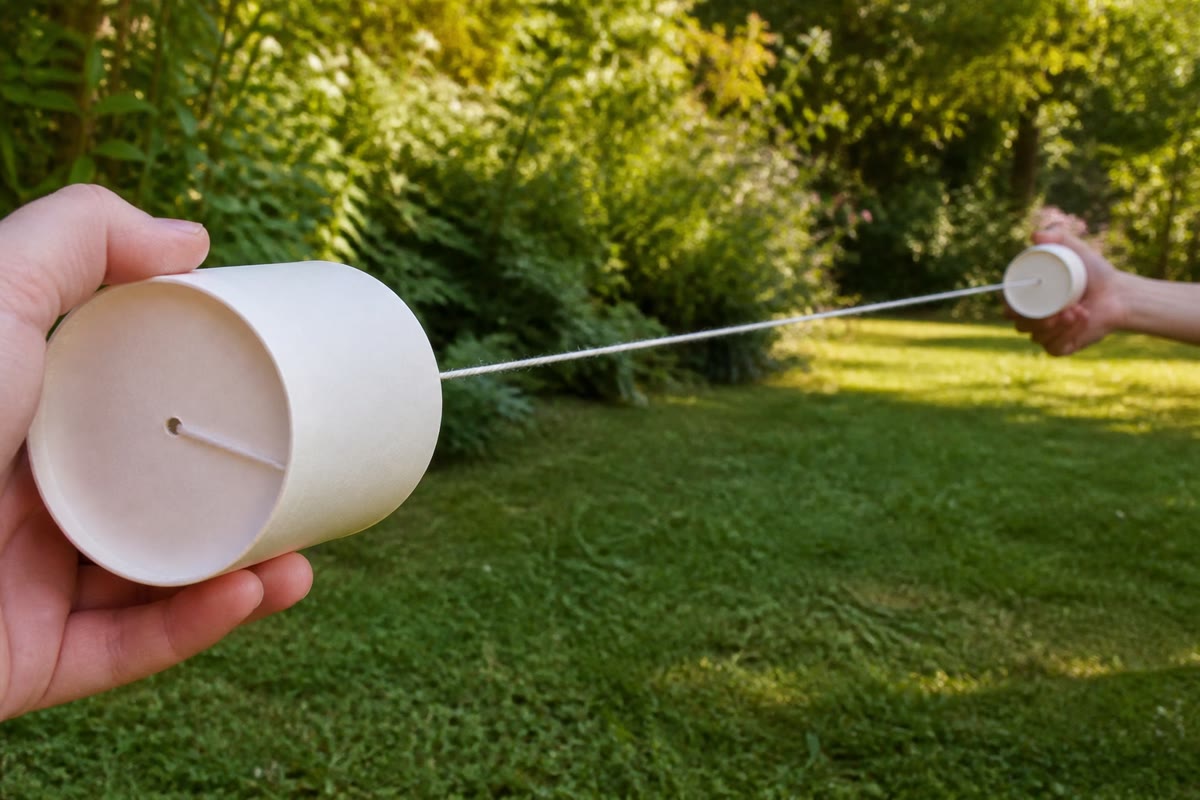
- Punch a small hole in the bottoms of two paper cups;
- thread the ends of a long string in, knotting each so it cannot slip out;
- walk apart until the string is stretched tight and touches nothing on the way;
- one speaks softly into a cup; the other holds theirs to the ear.
The whisper arrives clear across the playground: your voice makes the cup tremble, the trembling runs along the taut string, and the far cup replays it. Let the string sag or pinch it with two fingers, and the telephone dies — the road is cut.
27.2 Sound takes time
Proposition 27.5 (Fast, but not instant)
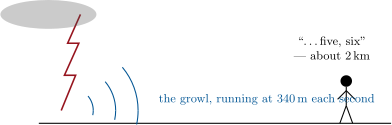
Sound is a runner, not a magician: in air it covers about in each second — three seconds for roughly a kilometre. Light, by contrast, arrives so fast that for any scene you can watch, its trip counts as instant. That difference is the whole story of the thunderstorm.
Method 27.6 (How far is the storm?)
- See the flash — start counting seconds steadily: one little crocodile, two little crocodiles, …;
- stop at the first growl of thunder;
- divide your count by : that is roughly the storm’s distance in kilometres.
Six seconds: about . Counts growing shorter between strikes mean the storm is coming closer — time to head indoors.
Example 27.7 (Echoes)
Shout toward a big cliff or a lone building far across a field: “HELLO!” — a moment of silence — “Hello!” answers your own voice. Sound bounces off large hard walls, and a bounced sound that returns to you late enough to hear separately is an echo. The farther the wall, the longer your voice’s round trip, the later the echo. In a small room the bounce comes back too quickly to hear apart — it only makes your voice sound fuller.
Remark 27.8 (Sonar: the echo put to work)
Ships measure the sea’s depth by shouting downward — a click into the water — and timing the echo from the bottom. Deep water, late echo; shallow water, quick echo. Dolphins and bats were born knowing the trick: they click and listen, reading the echoes to hunt in dark water and pitch-black caves. Counting thunder-seconds, you have already used their method: time the sound, know the distance.
27.3 Exercises
Exercise 27.1 ★
Name three carriers of sound from this chapter, and one place where sound cannot travel at all.
Exercise 27.2 ★
In the jar experiment, the bell’s hammer keeps beating while the ringing dies. What exactly was taken away, and what does that prove?
Exercise 27.3 ★
Why is the Moon a silent world? Answer with the proposition of the chapter.
Exercise 27.4 ★
In the string telephone, what carries the whisper? Give both rules for keeping the telephone working.
Solution
Solution of Exercise 27.4.
The taut string carries it: voice shakes the cup, the cup shakes the string, the string replays it in the far cup. Rules: keep the string stretched tight, and let it touch nothing (no sagging, no pinching fingers).
Exercise 27.5 ★
About how far does sound travel through air in one second? In three seconds?
Solution
Solution of Exercise 27.5.
About in one second — roughly a kilometre in three.
Exercise 27.6 ★
You count nine seconds between flash and thunder. How far is the storm? Your friend counts only three seconds at the next strike — what has changed, and what should you both do?
Solution
Solution of Exercise 27.6.
: about away. Three seconds later means about : the storm has come much closer — head indoors.
Exercise 27.7 ★
Why does pressing an ear to the table let you hear a scratch that the air never delivered?
Exercise 27.8 ★
What is an echo? Why does a bigger, farther cliff answer later than a near one?
Exercise 27.9 ★
How does a ship’s sonar tell deep water from shallow? Which two animals play the same game, and where?
Exercise 27.10 ★★
Old westerns show scouts pressing an ear to the steel rail to catch a still-distant train. Why does the rail betray the train long before the air does? Give both advantages the rail offers to the sound. (One is about carrying well; for the other, remember that the rail runs straight to the train while sound in air spreads out in every direction like pond rings, thinning as it goes.)
Solution
Solution of Exercise 27.10.
First, steel carries sound far better than air, so the rumble survives the long trip. Second, the rail guides the sound straight along one road to the scout’s ear, while in the open air the train’s noise spreads out in every direction like pond rings, thinning with every metre — so the rail’s message arrives both stronger and clearer, long before the air’s.
Exercise 27.11 ★★
Standing in a big empty courtyard, you clap once and hear the slap of your own clap return from the far wall after one full second. Sound ran to the wall and back in that second. How far away is the wall — careful, think about the round trip!
Solution
Solution of Exercise 27.11.
In one second sound covers about — but that second paid for going and coming back. The wall stands at half: about away.