Primary & Middle School Physics · Grades 1–9
7Measuring Length
Two doors, in two different houses: which one is taller? You cannot carry a door across town to stand it against the other. Last year we compared things side by side; this year we learn the greatest trick of science — turning a length into a number that can travel.
7.1 Comparing without numbers
Example 7.1 (Side by side)
To find the longer of two pencils, stand them together on the table: the one that sticks out wins. To compare your height with a friend’s, stand back to back. This works beautifully — as long as the two things can be brought together.
Example 7.2 (The string trick)
The two doors cannot meet — but a string can visit both. Stretch a string across the first door and cut it to exactly that height. Carry the string to the second door: if the string is too short, the second door is taller. The string carries the first door’s height across town. One step better: what if we could send the height in a letter? For that, we need numbers.
7.2 Measuring with steps and spans
Definition 7.3 (Measuring a length)
To measure a length is to count how many times a chosen unit — a step, a hand span, a small stick — fits along it, end to end with no gaps and no overlaps. The answer is a number of units: “the room is steps long.”
Example 7.4 (Try it: pace the room)
Cross your bedroom heel-to-toe, counting your foot-lengths. Ask a grown-up to do the same. You might count feet and the grown-up only — for the same room! Nobody counted wrong: your feet are shorter, so more of them fit. A measurement made with my foot cannot be checked with your foot.

Remark 7.5 (The argument in the marketplace)
For a long time, people really did measure in feet, thumbs and arm spans, and markets rang with arguments: whose foot? the tall merchant’s or the short customer’s? The fix, agreed upon all over the world, was to choose one unit for everyone — a unit that belongs to nobody’s body.
7.3 The centimetre and the metre
Definition 7.6 (Centimetre and metre)
The centimetre (written ) is a small unit of length, about the width of a fingernail; it is printed on every ruler. The metre (written ) is a big unit, exactly centimetres, the length of a very big step. These units are the same for everyone on Earth: your and my are exactly equal.

Method 7.7 (Measuring with a ruler)
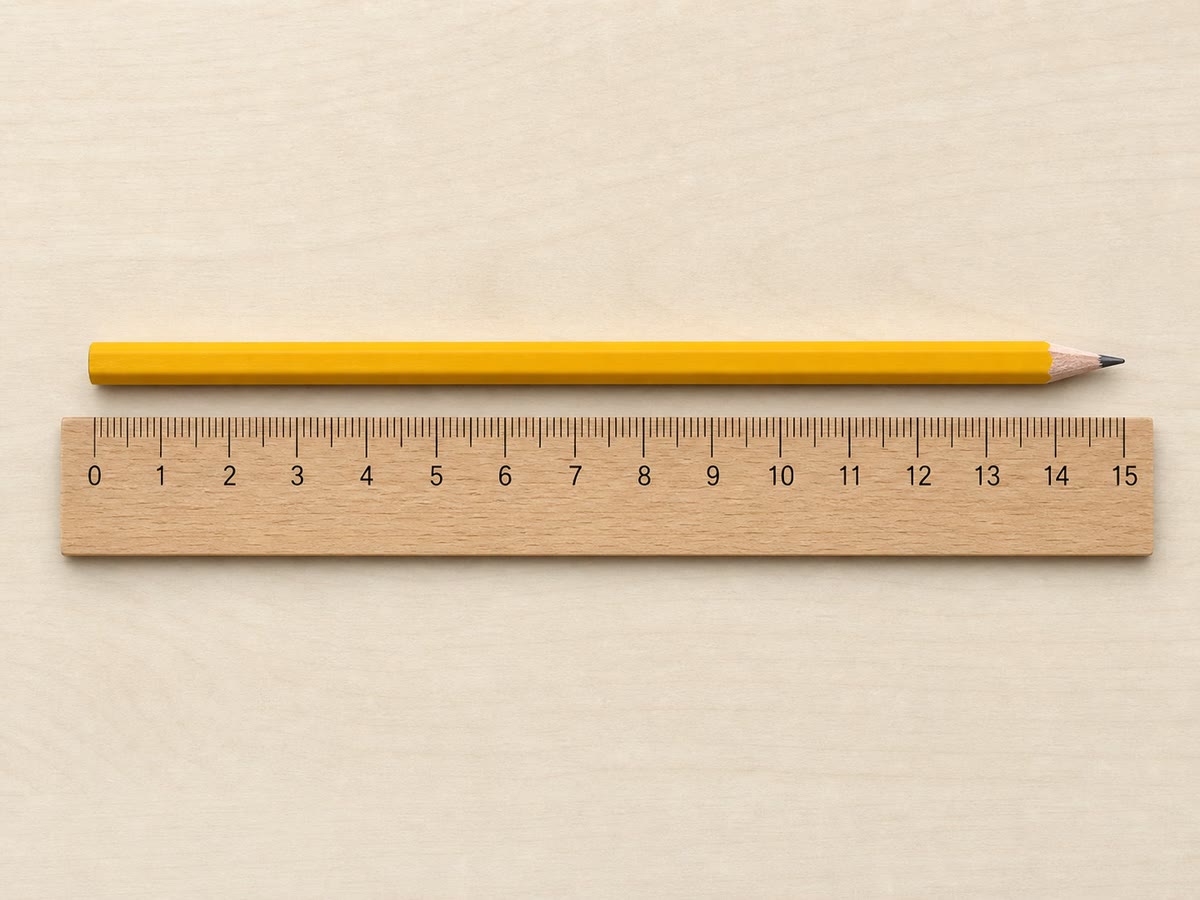
- Lay the ruler along the object, touching it;
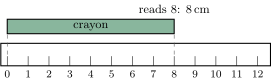
- put the ruler’s zero mark exactly at one end of the object — not the ruler’s edge, the ;
- read the number at the other end: that is the length in centimetres.
If the end lands between two marks, say “between and , closer to ” — honest words beat a made-up number.
Example 7.8 (Which unit for which job?)
Small things like a beetle, a stamp or your hand are measured in centimetres. Big things like a corridor, a bus or a swimming pool are measured in metres: the pool is long — imagine counting that in fingernail-widths! Choosing a sensible unit is half the work of measuring.
Example 7.9 (Estimate, then check)
Before measuring, players guess: how long is the kitchen table? Papa says , Lina says and a bit. Then the metre stick decides: and almost a half — point for Lina. Guessing first trains your eye; measuring keeps everyone honest.
7.4 Exercises
Exercise 7.1 ★
How can you compare your height with a friend’s without any ruler? And with the height of a friend who lives in another town?
Solution
Solution of Exercise 7.1.
Nearby: stand back to back. Far away: measure yourself in centimetres and send the number — a number can travel in a letter, a back-to-back comparison cannot.
Exercise 7.2 ★
Mara measures the classroom in steps and finds ; her teacher finds . Who counted wrong? Explain.
Solution
Solution of Exercise 7.2.
Neither counted wrong. Mara’s steps are shorter, so more of them fit in the same classroom. Different units give different numbers for the same length.
Exercise 7.3 ★
What is special about the centimetre, compared to a foot-length or a hand span? Why did people agree on it?
Solution
Solution of Exercise 7.3.
The centimetre is the same for everyone — it belongs to nobody’s body. A measurement in centimetres can be checked by any other person with any ruler.
Exercise 7.4 ★
Which unit fits better, or : the length of an ant; the height of a door; the length of the schoolyard; the width of this book?
Solution
Solution of Exercise 7.4.
The ant: (even less!); the door: ; the schoolyard: ; the width of this book: .
Exercise 7.5 ★
Tim puts the edge of his ruler — not the zero mark — against the end of his pencil, and reads . Is his pencil really long? What did he forget from Method 7.7?
Solution
Solution of Exercise 7.5.
No — there is usually a small blank space between a ruler’s edge and its zero mark, so the pencil is a little shorter than centimetres. Tim forgot to put the zero mark, not the edge, at the pencil’s end.
Exercise 7.6 ★
Measure with a ruler: the width of your hand; the length of a spoon; the height of a mug. Write each answer with its unit.
Solution
Solution of Exercise 7.6.
Answers vary; typical: hand about wide, spoon about , mug about . The important part: each number carries its .
Exercise 7.7 ★
A door is tall. How many centimetres is that? (Remember: is .)
Solution
Solution of Exercise 7.7.
: the door is tall.
Exercise 7.8 ★
First guess, then measure: how many metres long is your bed? Was your guess too big, too small, or nearly right?
Solution
Solution of Exercise 7.8.
Answers vary; most beds are close to . The point is to compare the guess with the measured number.
Exercise 7.9 ★★
A ribbon is long, another is long. Which is longer, and by how many centimetres? Could you have decided without numbers? Which way is easier to write in a letter?
Solution
Solution of Exercise 7.9.
The ribbon is longer: , so by . Without numbers, laying them side by side also finds the longer one — but “” fits in a letter, and “side by side” does not.
Exercise 7.10 ★★
Grandpa says: “My garden is paces long.” Explain to Grandpa, kindly, why “ paces” cannot be checked by someone else, and what he should use instead. What would happen if a small child paced the same garden?
Solution
Solution of Exercise 7.10.
Nobody else has Grandpa’s legs: a small child pacing the same garden might count little paces, and a visitor could not check “ paces” without Grandpa there. Measured in metres — the same for everyone — the garden’s length can be written down, sent, and checked by anybody.