Primary & Middle School Physics · Grades 1–9
4Day and Night: The Sun
Every morning the Sun comes back, as if it had never left. It climbs, slides down the other side of the sky, disappears — and the street lamps take over. Day, night, day, night: the oldest rhythm in the world. Where does the Sun go at night? Let us follow it.
4.1 The Sun’s journey
Example 4.1 (One day of Sun)
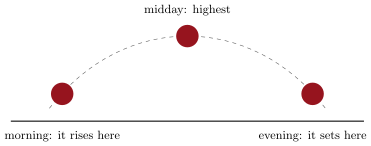
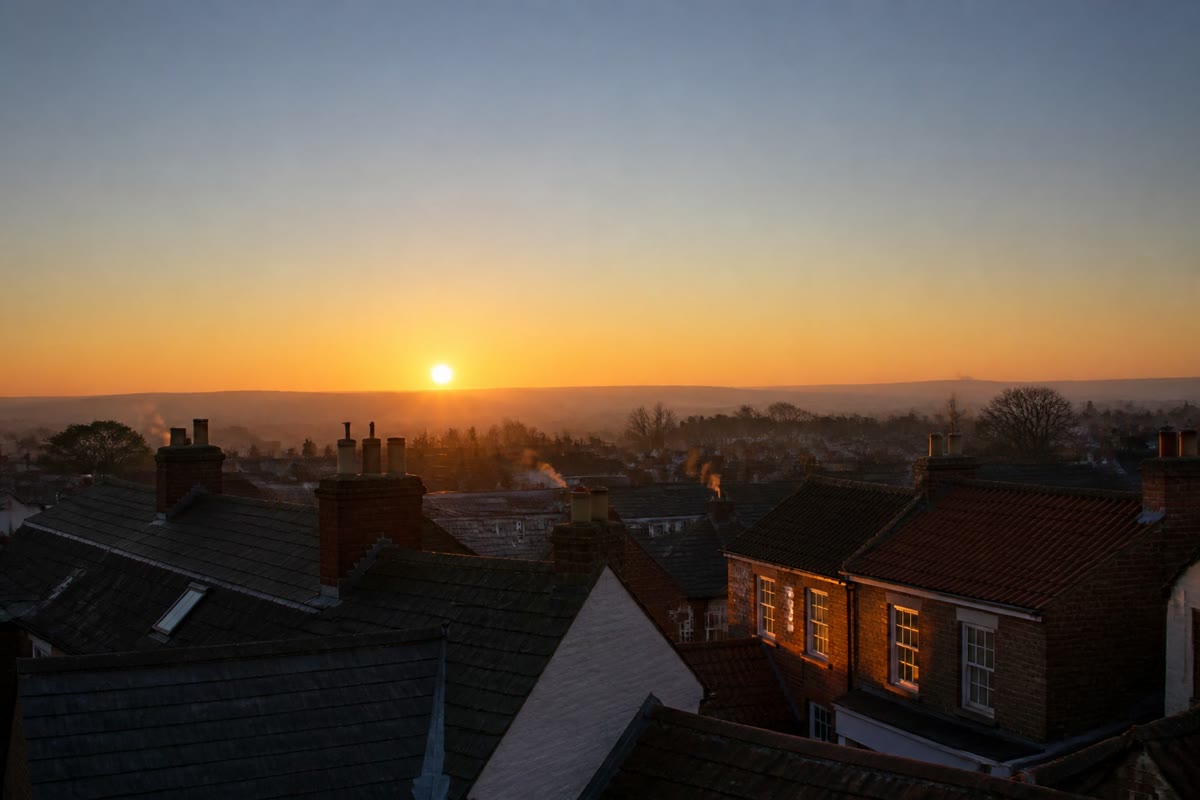
Watch the Sun’s place in the sky through one day (sideways, never straight at it!). In the morning it sits low, near the rooftops, on one side of the sky. Through the morning it climbs. At midday it stands at its highest. In the afternoon it comes down on the other side, and in the evening it slips below the rooftops there. The side where it rises in the morning is always the same — tomorrow it will rise there again.
Definition 4.2 (Day and night)
Daytime is the part of the day when the Sun is up in our sky, giving us light. Night is the part when the Sun is gone from our sky and the world around us goes dark. The moment the Sun appears is the sunrise; the moment it disappears is the sunset.
Remark 4.3 (The great lamp of the day)
Remember the light sources of the last chapter: by day, the Sun is the source that lights the whole world at once — every street, every playground, every sea. At night we make do with small sources: lamps, torches, and the stars. That is why night is dark even though the lamps are on: no small lamp can replace the great one.
Example 4.4 (The rhythm repeats)
Morning, midday, evening, night — and then morning again. The rhythm has never skipped once: after every night, a day; after every day, a night. A whole turn of this wheel, one day and one night together, is what the calendar counts: Monday, Tuesday, Wednesday, each is one turn of the wheel.
4.2 Where does the Sun go at night?
At night the Sun still shines — but not on us. While we sleep, its light falls on children on the other side of the world, who are having their midday. The Sun does not go out; we turn away from it.
Example 4.5 (The spinning Earth)
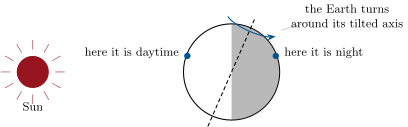
The Earth — the huge ball we all live on — spins slowly, like a merry-go-round, and we spin with it. When our side of the ball faces the Sun, we have daytime. As the Earth keeps turning, our side slides away from the sunlight into the dark: evening comes, then night. Keep turning, and our side swings back into the light: sunrise! The Sun only seems to travel across our sky — the real traveler is the ground under our feet.
Method 4.6 (Try it: be the Earth)
You need a lamp in a dark room, and yourself.
- The lamp is the Sun; your head is the Earth; your nose is your town.
- Face the lamp: light on your face — your town has daytime.
- Turn slowly on the spot. The light slides off your cheek: that is evening.
- Back of your head to the lamp: your face is in the dark — night in your town.
- Keep turning until the light returns to your cheek: sunrise!
One full turn of you is one full day and night for your nose.
Remark 4.7 (The Sun never switches off)
In the game of Method 4.6, the lamp stayed on the whole time — only your turning made light and dark take turns on your face. It is the same for the real Sun: it shines all night long, on the other side of the world. Night is not the Sun resting; it is our side of the ball looking the other way.
4.3 Exercises
Exercise 4.1 ★
Put in order, starting from the morning: midday; sunrise; night; sunset; afternoon.
Exercise 4.2 ★
Where is the Sun at midday: low near the rooftops, or at its highest point? And your shadow at that moment — long or short? (Think of the last chapter.)
Solution
Solution of Exercise 4.2.
At midday the Sun stands at its highest — and the shadow is at its shortest.
Exercise 4.3 ★
Does the Sun rise every morning on the same side of your house, or on a different side each day? How could you check tomorrow?
Solution
Solution of Exercise 4.3.
Always on the same side. To check: notice tomorrow morning which window the first sunlight comes through — it will be the same window as today.
Exercise 4.4 ★
True or not true: “At night, the Sun switches off.” Explain your answer with Remark 4.7.
Solution
Solution of Exercise 4.4.
Not true. The Sun shines all night long — on the other side of the Earth. Night comes because our side of the spinning Earth has turned away from the light, like the back of your head turned away from the lamp.
Exercise 4.5 ★
While you are having breakfast in the morning light, what are children on the opposite side of the Earth most likely doing?
Solution
Solution of Exercise 4.5.
It is night for them, so they are most likely asleep — their side of the Earth is turned away from the Sun while ours faces it.
Exercise 4.6 ★
Play Method 4.6 with a lamp. When the light shines on your right cheek and you keep turning the same way, what comes next for your nose: sunrise or sunset?
Exercise 4.7 ★
Which is the real traveler, the Sun across our sky or the ground under our feet? Say it in your own words.
Solution
Solution of Exercise 4.7.
The ground under our feet. The Earth spins, carrying us around; the Sun only seems to cross our sky because we are turning.
Exercise 4.8 ★
Count with the calendar: how many sunrises are there in one week? How many nights?
Solution
Solution of Exercise 4.8.
Seven sunrises and seven nights — one of each for every day of the week.
Exercise 4.9 ★★
Zoe says: “If the Earth stopped turning, our town would keep daytime forever.” Could she be right — and what would children on the other side of the Earth say about her idea?
Solution
Solution of Exercise 4.9.
She could be right: if our side kept facing the Sun, it would stay daytime here. But children on the far side would then keep night forever — they would not thank Zoe for her idea!