Primary & Middle School Physics · Grades 1–9
55Current Intensity and the Ammeter
“Strong current, weak current” — we have talked this way for years, dosing brightness and grip by feel. Feel retires today. The current’s strength gets a name, a unit and an instrument; and the first thing the instrument proves is a law you have long suspected but never once measured.
55.1 Intensity and its unit
Definition 55.1 (Intensity)
The intensity of an electric current measures how strong the march is: how much electric charge parades past a point of the circuit each second — the current’s flow rate, as a river’s is water-per-second. Its unit is the ampere (), honoring a great pioneer of electricity’s laws; everyday circuits often speak in milliamperes: , a thousandth.
Example 55.2 (Amperes to know by sight)
A little indicator lamp sips about — ; a flashlight bulb, around ; the great lamp of a car’s headlight, ; a kettle at full roar, ; a starting car engine gulps from its battery; a lightning stroke, for its millisecond, rams tens of thousands of amperes down its channel. And the danger scale is sobering: currents of a few hundredths of an ampere across a human body can already be fatal — respect begins well below one ampere.
Remark 55.3 (The person and the unit)
Written out, the unit is lowercase — “a current of two amperes” — while the capitalized word names the person, as with every unit honoring a scientist. The symbol stays capital. You will meet this convention again shortly, twice.
55.2 The ammeter
Definition 55.4 (Ammeter)
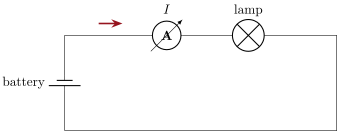
An ammeter measures intensity. It counts the march that passes through itself — so it must be inserted in series, into the very loop it measures, like a tollbooth on the road. Built to disturb the march as little as possible, it opposes the current almost not at all — which is also why an ammeter misconnected straight across a battery is a short circuit with a dial: the classic way to break one.
Method 55.5 (Measuring an intensity)
- switch the circuit off; break the loop where the current is to be counted;
- insert the ammeter into the gap: current in by its terminal, out by its common terminal, so the conventional direction enters the meter’s front door;
- on a multi-range meter, start on the largest range, then step down until the reading sits comfortably on the dial — protecting the meter from surprises;
- close the switch, read — and write the unit.
Backward connection on a needle meter slams the needle against its stop; digital meters merely show a minus sign, forgiving students daily.
55.3 The first measured law
Proposition 55.6 (One loop, one intensity)
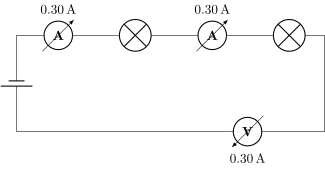
In a series circuit, the intensity is the same at every point of the loop. Move the ammeter anywhere — before the lamp, after it, beside the battery: the reading does not change. What five years of equal-brightness bulbs suggested, the meter now states in numbers: nothing is consumed en route; one road, one march, one .
Example 55.7 (Reading the law’s fine print)
The law says along one loop, not whatever you do to the loop. Add a second lamp in series and the march weakens everywhere at once — perhaps drops to — but it weakens equally everywhere: the three tollbooths agree on the new number too. One loop, one intensity — whatever that intensity currently is.
Example 55.8 (A glance at the junction)
Set tollbooths on a parallel pair instead: main road ; branch one ; branch two . The suggestive sum is no accident — the marches into a junction and out of it must balance, since charge is neither created nor destroyed at a fork in the road. The full law, with its partner for voltage, holds court in the chapter after next; your meters have already met it.
Remark 55.9 (The multimeter)
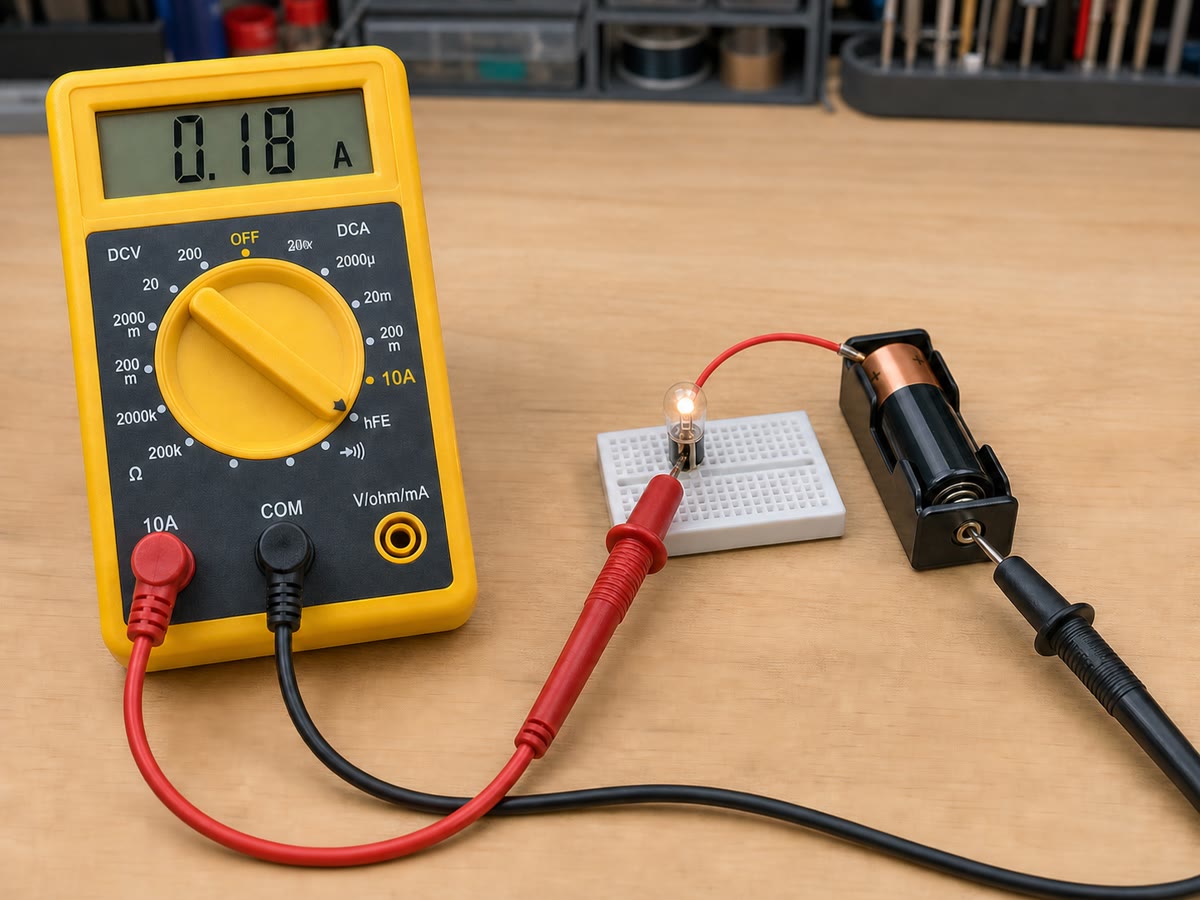
The workshop’s yellow brick — the multimeter — folds the ammeter and several other instruments into one box with a selector dial. Dial on or , leads in the marked sockets, and it is your ammeter, series rules and all. Two chapters of this book live inside it already; a third moves in next chapter — with, beware, opposite wiring rules.
55.4 Exercises
Exercise 55.1 ★
What does intensity measure, in river-language? Give its unit and symbol, and convert to amperes.
Exercise 55.2 ★
Match the intensity to its scene: ; ; ; — kettle, indicator lamp, starting engine, flashlight bulb.
Solution
Solution of Exercise 55.2.
: indicator lamp. : flashlight bulb. : kettle. : starting engine.
Exercise 55.3 ★
Why must an ammeter be inserted in series? What is it built to oppose almost not at all, and what accident does that make possible?
Solution
Solution of Exercise 55.3.
It counts only the march passing through itself, so it must stand in the road — in series. It opposes the current almost not at all; wired straight across a battery it therefore becomes a short circuit with a dial.
Exercise 55.4 ★
List the four steps of a proper intensity measurement. Why start on the largest range?
Solution
Solution of Exercise 55.4.
Switch off and break the loop; insert the meter with the current entering by the terminal and leaving by common; start on the largest range and step down; switch on, read, write the unit. The largest range first, so an unexpectedly strong current meets the sturdiest setting instead of wrecking a delicate one.
Exercise 55.5 ★
State the one-loop-one-intensity law. Which old equal-brightness observation did it turn into numbers?
Solution
Solution of Exercise 55.5.
In a series circuit the intensity is the same at every point of the loop. It turned into numbers the old observation that two identical series bulbs glow exactly equally, wherever they sit.
Exercise 55.6 ★
An ammeter before a series motor reads . What will it read after the motor? And beside the battery?
Exercise 55.7 ★
A second lamp joins a series loop and the ammeter’s becomes . Has the law failed? Explain the fine print.
Solution
Solution of Exercise 55.7.
No. The law promises one value around the loop at a given moment, not the same value after the loop is rebuilt. The second lamp weakened the march — equally everywhere: all tollbooths now agree on .
Exercise 55.8 ★
A digital ammeter reads . What has the student done, and how grave is it?
Solution
Solution of Exercise 55.8.
Wired the meter backward — current entering by the common terminal. On a digital meter, harmless: the minus sign is the whole penalty (a needle meter would have slammed its stop).
Exercise 55.9 ★★
Main road ; branch one . What does branch two carry, and by what reasoning? What does the second junction’s tollbooth read?
Exercise 55.10 ★★
A student wires the ammeter in parallel with the lamp “to compare them”. Predict the two consequences — for the lamp, and for the meter — and name the villain the student has accidentally built.
Solution
Solution of Exercise 55.10.
In parallel, the near-effortless meter is a bypass: the lamp, deserted, dims to nothing, while the meter carries a rushing current limited by almost nothing — a short circuit through the instrument, blowing its internal fuse if fortune smiles. The student built the villain of the safety chapter.
Exercise 55.11 ★★
Two identical bulbs in parallel each carry . The battery’s main road carries how much? A third identical bulb joins in parallel: predict the main road’s new burden, and name what drains faster.
Exercise 55.12 ★★★
Design the full measurement plan for a two-branch parallel circuit (lamp and motor): how many ammeter positions are needed to know every current in the circuit; the minimum number of measurements that suffices (one may be deduced — by which balance?); and the order of operations that never leaves a meter wired dangerously.
Solution
Solution of Exercise 55.12.
Currents to know: the main road’s , and each branch’s (, ) — three in all (the loop segments beyond the junctions repeat these). Two measurements suffice: measure any two, and the junction balance hands over the third. Safe order: circuit off; insert the meter into the chosen road; largest range; on; read; off before moving the meter — and the meter never, at any step, bridges two points of different roads.
55.5 Problem: The Metrology Bench
Problem 55.1
Weekend problem — qualifying day at the electronics workshop; four stations, one ammeter each; the apprentice’s license
To earn workshop privileges, each apprentice tours four measurement stations. Bring the chapter.
Part I — Station one: the simple loop. Battery, switch, one lamp.
- Describe, step by step, inserting the ammeter to measure the lamp’s current.
- The reading: . Express it in amperes.
- The examiner moves your meter to the battery’s other side. Predict the reading, citing the law.
- “And if I had two ammeters in this loop at once?” Where could they sit, and what would they show?
Part II — Station two: series pair. Two different lamps, A brighter than B, in series.
- An apprentice predicts: “Brighter A carries more current than dim B.” Test the prediction with the law — and reconcile the equal currents with the unequal brightness (what must differ between the lamps?).
- The meter reads between A and B. Write down every other current in the loop.
- Lamp B is short-circuited by a clip lead. Predict the new reading and both lamps’ behavior.
- The examiner asks for one sentence on why the workshop forbids clip leads across the battery while permitting the demonstration across B.
Part III — Station three: the junction. A lamp branch and a motor branch in parallel.
- Main road: ; lamp branch: . The motor branch’s current, by balance?
- The motor jams (still connected, not turning) and its branch climbs to . Assuming the lamp branch keeps its , what does the main road carry now — and which workshop guard is listening?
- The lamp is unscrewed. Predict all three tollbooth readings.
- Why does the battery drain fastest with both branches healthy — where is generosity paid?
Part IV — The license.
- Write the apprentice’s pledge: three lines — where an ammeter belongs and never belongs; what one loop guarantees; what a junction balances.
Solution
Solution of Problem 55.1.
1. Off; break the loop between lamp and battery; insert the ammeter, current in by , out by common; largest range, step down; on; read; write the unit. 2. . 3. again — one loop, one intensity: the tollbooth counts the same march on either side. 4. Anywhere on the loop — both in series, any positions: both show . 5. The law vetoes the prediction: series lamps carry the identical current. The difference lies in the lamps themselves — unequal builds turn the same march into unequal light (the next chapters name what differs). 6. Every point of the loop: — before A, after B, beside the battery. 7. B dies (deserted by the bypass) and the loop, having lost one opposer, carries a stronger march: the meter climbs — and lamp A brightens accordingly. 8. “Across B the bypass still leaves lamp A guarding the loop; across the battery it would leave nothing at all — and an unguarded march is the fire chapter, not a demonstration.” 9. . 10. — and the branch fuse (or breaker) guarding the motor’s line is listening closely: jammed motors are how guards earn their keep. 11. Lamp branch: ; motor branch: its own unchanged (parallel independence); main road: . 12. Generosity is paid at the battery: two healthy branches drink two full marches, and the summed main-road current empties the store fastest. 13. For example: “An ammeter stands in the road, never across it. One loop guarantees one intensity — everywhere, always. And a junction balances its books: marches in equal marches out, to the milliampere.”