Primary & Middle School Physics · Grades 1–9
13Balance and Equilibrium
A seesaw hangs level with a child on each end. A tower of blocks stands — one block more, and it crashes. An acrobat walks a rope thinner than her shoe. All three are playing the same deep game: the game of balance, where forces cancel and nothing moves.
13.1 Standing still is a balance
Definition 13.1 (Equilibrium)
A thing is in equilibrium — we also say balanced — when the pushes and pulls on it cancel each other out, so it stays exactly as it is. The tug-of-war ribbon standing still between two mighty teams: equilibrium. Not a world without forces — a world where the forces are having a perfect tie.
Example 13.2 (The book on the table)
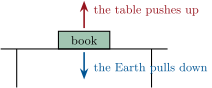
A book lies on the table, perfectly still. Boring? Look closer with last chapter’s eyes. The Earth pulls the book down — so why does it not fall? Because the table pushes it up, exactly as hard as the Earth pulls down. Two arrows, equal and opposite: a tie. Take the table away and the tie is broken: down goes the book.
Remark 13.3 (Still does not mean force-free)
Before this chapter, “nothing is happening to the book” seemed obvious. Now you know better: two forces act on it every moment. All around you, chairs, lamps, houses and mountains are held in quiet ties of pulling and pushing. Stillness is not emptiness — it is balance.
13.2 The seesaw
Example 13.4 (A tie on the playground)
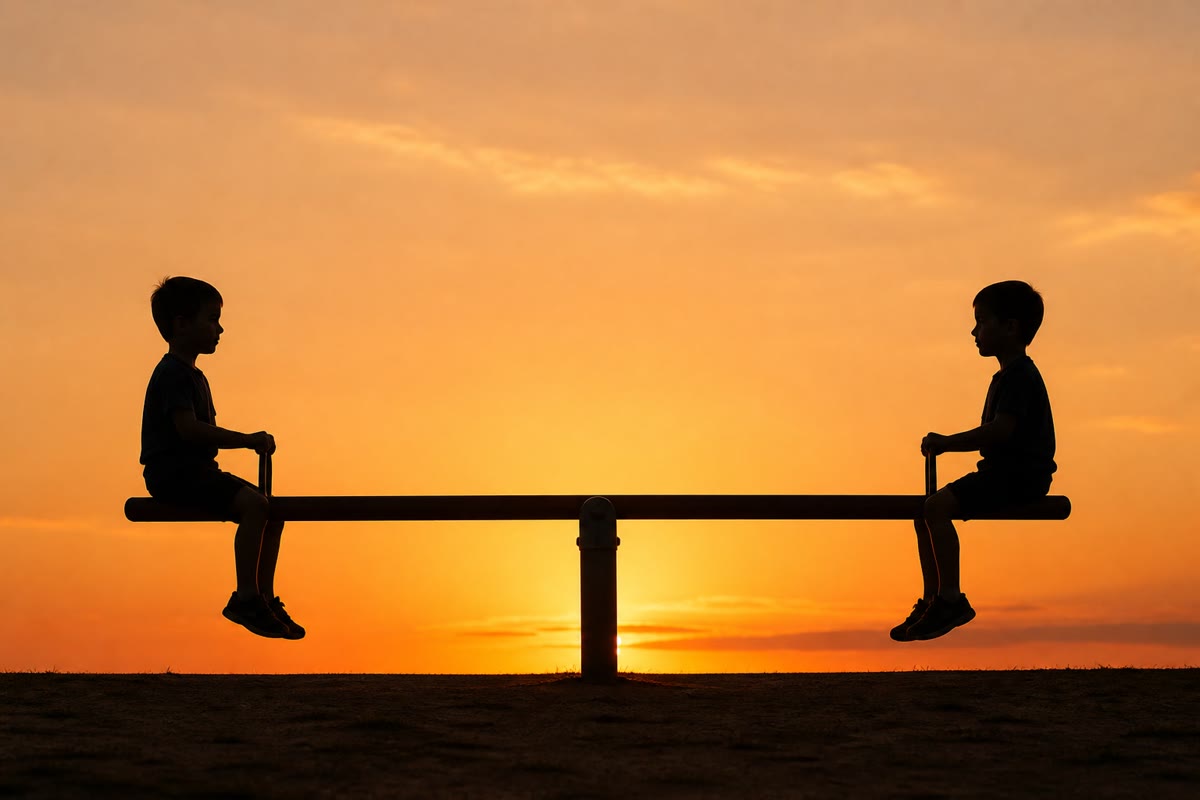
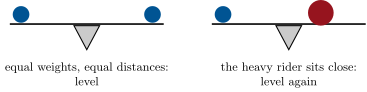
Two friends of about the same size sit at the two ends of a seesaw: it hangs level — a tie. Now Papa sits on one end: down he goes, and up flies the child. To play fair, Papa scoots toward the middle: the closer he sits to the pivot, the weaker his side presses — until, at just the right spot, the seesaw hangs level again. A big weight near the middle can tie with a small weight far out.
Proposition 13.5 (The seesaw rule)
Equal weights at equal distances from the pivot balance. A heavier rider tips the seesaw — unless the heavier rider moves closer to the pivot, or the lighter one moves farther out. Weight and distance both count.
Remark 13.6 (A promise)
How close must Papa scoot, exactly? There is a beautiful, precise rule hiding in the seesaw — with real numbers in it. It is waiting for you next year, in the chapter on levers and scales; today’s seesaw games are its perfect training.
13.3 Toppling and the balance point
Example 13.7 (The tower that leaned too far)
Build a tower of blocks, each block sticking out a little more than the one below. It stands, it stands… and suddenly it crashes. A leaning thing topples when it leans too far out past its own base. That is why a wide-based pyramid of blocks is so hard to knock over, while a single tall column falls at a breath: broad feet make steady towers.
Definition 13.8 (Balance point)
The balance point of an object is the special spot where it can be held up level — as if all its weight gathered there. A ruler carries its balance point in the middle; a hammer hides it near the heavy head. Held right under its balance point, any object rests level on one finger.
Method 13.9 (Finding the balance point)
To find the balance point of a ruler, a broom, or a wooden spoon:
- rest it across two stretched index fingers, one near each end;
- slide your fingers slowly toward each other;
- they will meet — always with the object still balanced — at one spot: the balance point.
Try the broom: your fingers meet far from the middle, on the side of the heavy brush. The balance point loves the heavy side.

Example 13.10 (The acrobat’s pole)
Why does the tightrope walker carry that long, drooping pole? It is her balance helper: when she starts tipping to one side, the long pole makes the lean slow and lazy instead of quick, and gives her time to shift back over the rope. You use the same trick with bare arms when you walk along a curb — arms out, wobble slowed, balance saved.
13.4 Exercises
Exercise 13.1 ★
A lamp stands still on the desk. Name the two forces acting on it and say why it does not move.
Solution
Solution of Exercise 13.1.
The Earth pulls the lamp down; the desk pushes it up, exactly as hard. The two forces tie — equilibrium — so the lamp stays put.
Exercise 13.2 ★
In tug-of-war, when is the ribbon in equilibrium? What breaks the tie?
Solution
Solution of Exercise 13.2.
When the two teams pull equally hard in opposite directions: the pulls cancel. The tie breaks the moment one team pulls harder than the other.
Exercise 13.3 ★
Two equal twins sit on a seesaw at equal distances. What does the seesaw do? One twin scoots backward, farther from the pivot — which side goes down now?
Solution
Solution of Exercise 13.3.
It hangs level — equal weights at equal distances. When one twin scoots farther out, that twin’s side goes down: distance counts too.
Exercise 13.4 ★
Papa is much heavier than Lina, yet their seesaw hangs level. Where must Papa be sitting? State the rule that saves the game.
Solution
Solution of Exercise 13.4.
Close to the pivot, with Lina far out on her side. The rule: a heavier rider near the middle can tie with a lighter rider far away — weight and distance both count.
Exercise 13.5 ★
Where is the balance point of a ruler? And of a hammer — toward the handle’s end or the heavy head? How could you check with one finger?
Solution
Solution of Exercise 13.5.
The ruler’s balance point is at its middle; the hammer’s is near the heavy head. Check: rest each on one finger and find the spot where it lies level.
Exercise 13.6 ★
Do the two-finger trick of Method 13.9 with a broom. On which side do your fingers meet, and what does that tell you?
Solution
Solution of Exercise 13.6.
They meet close to the brush — the heavy end. The balance point sits toward the heavy side of an object.
Exercise 13.7 ★
Which stands more steadily, and why: a pyramid of blocks with a wide bottom, or a one-block-wide tower of the same height?
Solution
Solution of Exercise 13.7.
The wide pyramid: it can lean a long way before its weight hangs out past its broad base. The narrow tower topples at the smallest lean.
Exercise 13.8 ★
Why does a tightrope walker carry a long pole? What do you do with your arms when you walk along a curb, and why does it help?
Solution
Solution of Exercise 13.8.
The pole slows every wobble, giving the walker time to shift back over the rope. On a curb you stretch your arms out for the same reason: slower wobbles, easier catching.
Exercise 13.9 ★
Stand with your right shoulder and right foot pressed against a wall, and try to lift your left foot. You cannot — without falling! Explain with the tower of Example 13.7: what would your body have to do to balance on the right foot, and what does the wall forbid?
Solution
Solution of Exercise 13.9.
To stand on the right foot alone, your body must lean to the right, so that your weight sits over that foot — like the tower keeping its weight over its base. The wall is exactly where you need to lean: it forbids the move, your weight stays hanging over the lifted foot’s empty place, and you tip.
Exercise 13.10 ★★
A crane on a building site lifts heavy loads on its long front arm — yet it does not tip over. On its short back arm sit huge concrete blocks. Explain the crane with the seesaw rule of Proposition 13.5: what are the two riders, and why is the back arm short?
Solution
Solution of Exercise 13.10.
The crane is a giant seesaw with its tower as the pivot. Rider one: the load, far out on the long front arm. Rider two: the concrete blocks — much heavier, so they may sit close, on the short back arm. Heavy-close ties with light-far, exactly the seesaw rule; the back arm is short because its rider is the heavyweight.