Primary & Middle School Physics · Grades 1–9
34Heat and Insulation
Why does the metal slide feel icy when the wooden bench beside it does not? That mystery has trailed us since the first year of this book. Today it falls — together with the secrets of the thermos, the double window, and the puffed-up winter sparrow. The key is to stop asking how things feel and start following where heat flows.
34.1 Heat is on the move
Definition 34.1 (Heat)
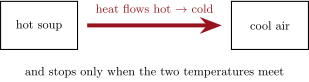
Heat is energy on the move from a hotter thing to a colder one. The soup passes heat to the spoon, the radiator to the room, your hand to a snowball. Heat is not a stuff hiding inside hot things — it is a flow, and it always has a direction.
Proposition 34.2 (Heat flows downhill)
By itself, heat always flows from the hotter body to the colder one — never the other way. The flow runs as long as the two temperatures differ, and dies away as they meet: left together long enough, hot and cold neighbors end up at one shared temperature.
Example 34.3 (Reading the direction)
The teaspoon in the tea grows hot: heat flowed tea spoon. The lemonade with ice grows cold — careful! Nothing called “cold” flowed in: heat flowed out of the lemonade into the ice, melting it. Cold is not a flow; it is only the name we give the loser’s side. Physics books all say “the drink loses heat”, never “the drink gains cold”.
34.2 Fast lanes and slow lanes
Definition 34.4 (Heat conductors and insulators)
Stuffs differ wildly in how fast they let heat flow through them. A heat conductor is a fast lane — metals above all. A heat insulator is a slow lane: wood, wool, plastic, feathers — and the champion, still air, trapped so it cannot swirl. (The words are borrowed on purpose from electricity’s conductors and insulators; the two properties often, but not always, go together.)
Example 34.5 (The slide mystery, solved)
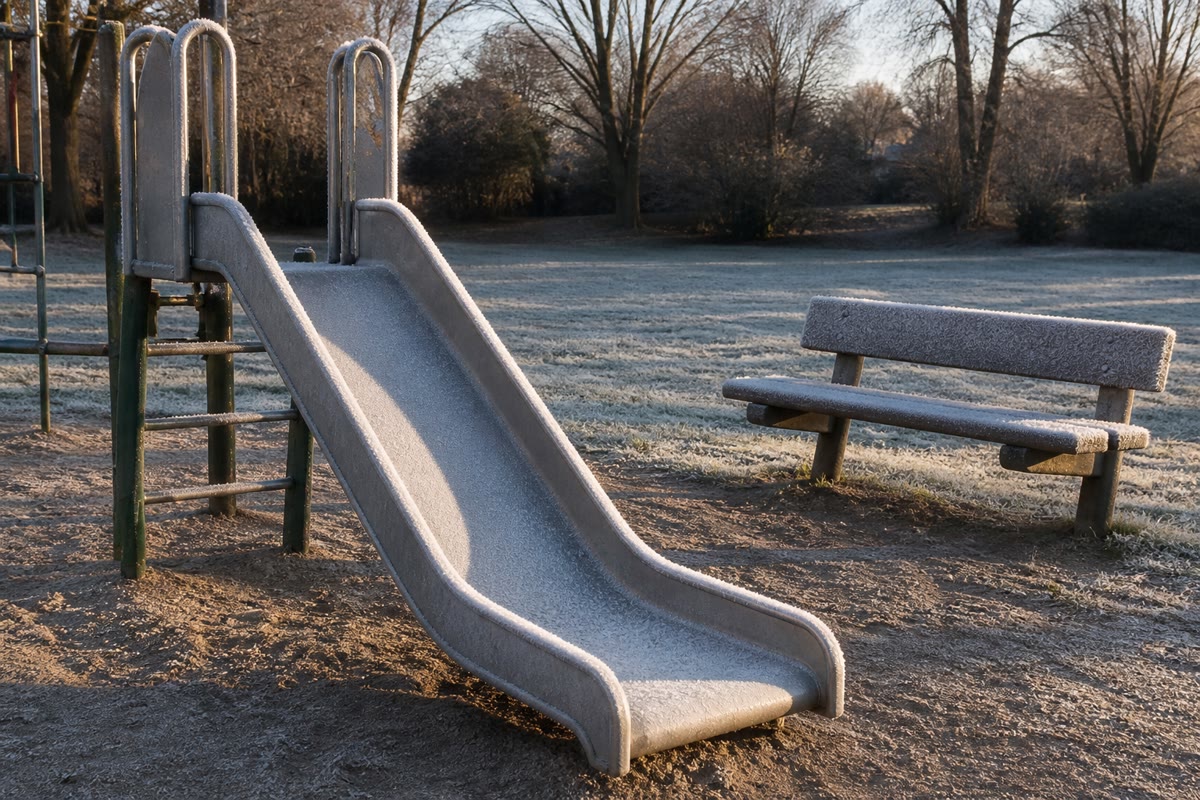
The metal slide and the wooden bench spent the night at the same chilly temperature — the thermometer swore it long ago. Touch them: your hand is warmer than both, so heat flows from you into each. But the metal is a fast lane — it whisks your heat away in a rush, and that rush is what “icy” feels like. The wood takes your heat only in a trickle: barely cool. Your skin was never measuring temperature — it measures the speed of its own heat loss. Case closed, after four years.
Method 34.6 (The cooling race)
Watch insulation win, with numbers:
- fill two identical mugs with equally hot tap water (ask an adult for hand-hot, not boiling);
- wrap one mug thickly in a wool scarf; leave the other bare;
- plant a thermometer in each and write both temperatures in a table every five minutes, six times;
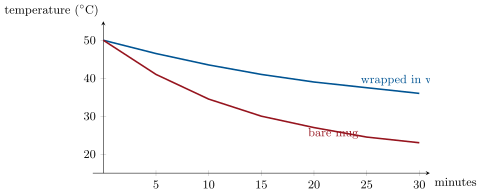
- draw both records as two lines on one graph, temperature against time.
The bare mug’s line dives; the wrapped mug’s line slopes gently. Same start, same room — the wool made heat’s exit a slow lane.
Remark 34.7 (Insulation only slows)
Look where both curves are headed: toward the room’s . No scarf, no thermos, no igloo wall ever stops heat’s downhill flow — insulation only makes the slow lane slower. That is also why the coat on the snowman (remember him?) delayed his melting but could not save him: the summer’s heat still trickled in.
34.3 The art of trapping air
Example 34.8 (Winter engineering)
Almost every warm thing you own is a machine for trapping air. Wool keeps you warm not by the fibers themselves but by the countless air pockets between them; feather duvets, fleece and the sparrow puffed into a ball on a frozen wire all play the same card. Houses join in: double windows imprison a layer of air between two panes, and insulated walls are filled with fluffy, air-hoarding padding. Still air is the champion slow lane — the trick is keeping it still.
Example 34.9 (The thermos)
The thermos flask is insulation’s masterpiece: a bottle inside a bottle, with the air between them pumped away to almost nothing — and where there is almost no stuff, heat’s flow finds almost no lane at all (a trick worth remembering: the same emptiness that silenced the bell in the jar). Add shiny walls to bounce warmth’s glow back in, and hot chocolate meets the afternoon still hot — or lemonade still cold: the thermos knows nothing of hot or cold, it only closes the lanes, both ways.
Remark 34.10 (Keeping warm, said properly)
Now the old coat question closes for good. A coat is trapped air around a heat maker — you. Your body streams heat outward all day; the coat turns that stream into a trickle, and you stay warm on your own production. On the snowman — no heat maker inside — the same coat merely slows the inward trickle of summer. Insulation has no favorites: it slows the flow, whichever way it runs.
34.4 Exercises
Exercise 34.1 ★
What is heat, and in which direction does it flow by itself? When does the flow stop?
Solution
Solution of Exercise 34.1.
Heat is energy on the move from a hotter body to a colder one; by itself it flows only downhill, hot to cold, and stops when the two temperatures have met.
Exercise 34.2 ★
“Close the door, you are letting the cold in!” Rewrite grandmother’s sentence the way a physics book would.
Exercise 34.3 ★
Sort into fast lanes and slow lanes for heat: a copper pan; a wool scarf; a steel spoon; still air; a wooden spoon; a duvet.
Solution
Solution of Exercise 34.3.
Fast lanes: the copper pan, the steel spoon. Slow lanes: the wool scarf, still air, the wooden spoon, the duvet.
Exercise 34.4 ★
Why do pans have metal bottoms but plastic or wooden handles? Answer with lanes.
Exercise 34.5 ★
At last, in your own words: why does metal feel colder than wood at the same temperature? What does skin really measure?
Solution
Solution of Exercise 34.5.
Both stand at the same temperature, but metal is a fast lane: it whisks heat out of your warmer hand in a rush, and the rush is the “icy” feeling. Skin measures the speed of its own heat loss, not temperature.
Exercise 34.6 ★
In the cooling race, why must the two mugs be identical and start equally hot? What single difference is the experiment testing?
Solution
Solution of Exercise 34.6.
A fair race changes one thing only — the wrapping. Identical mugs, equal starting heat and the same room make sure the scarf alone explains any difference between the two curves.
Exercise 34.7 ★
Read the cooling graph: about what temperature is each mug showing after minutes? Toward what temperature are both curves heading, and why?
Solution
Solution of Exercise 34.7.
After minutes: the wrapped mug about , the bare mug about . Both curves head for the room’s : the flow runs until the temperatures meet, and insulation only slows the journey.
Exercise 34.8 ★
Why does a sparrow puff itself into a ball on a freezing wire? Name three human inventions playing the same card.
Solution
Solution of Exercise 34.8.
Puffed feathers trap a thick blanket of still air — the champion slow lane — around the bird’s warm body. The same card: wool clothes, feather duvets, double windows (or fleece, insulated walls).
Exercise 34.9 ★★
The same thermos keeps chocolate hot in January and lemonade cold in July. Explain how one device manages both jobs — what does the thermos actually do, and to what?
Solution
Solution of Exercise 34.9.
The thermos neither makes heat nor cold: it closes heat’s lanes — emptiness between its two walls, shine to bounce the glow. In January it slows the chocolate’s heat from escaping out; in July it slows the summer’s heat from creeping in. One device, both ways, because flow is all it manages.
Exercise 34.10 ★★
An ice-cream seller wraps her tubs in thick wool blankets on a hot day, and a customer laughs: “Wool is for keeping things warm!” Defend the seller with Remark 34.10 — which way is heat trying to flow, and what does the wool do to it?
Exercise 34.11 ★★
Two houses stand in the same winter: one with single windows, one with double windows. Explain with lanes and trapped air why the double-windowed house burns less fuel — and why, by Remark 34.7, it still needs some heating.
Solution
Solution of Exercise 34.11.
The double window imprisons a layer of still air — a slow lane — between its panes, so the house’s heat trickles out where the single window lets it stream. Less escaping heat, less fuel to replace it. But insulation only slows the downhill flow, never stops it: some heat always leaks winter-ward, and the stove must keep topping it up.