Primary & Middle School Physics · Grades 1–9
45States of Matter and Changes of State
Six years of solids that keep their shape, liquids that lie level, gases that fill every corner — and never once did we ask why. This year, physics opens the lid. Underneath the three states hides one of the greatest ideas humans ever had: everything, absolutely everything, is made of particles too small to see. Grant that one idea, and the rules you have collected since childhood explain themselves in a single stroke.
45.1 The great idea
Definition 45.1 (Molecules)
All matter is made of molecules: unimaginably small particles, far below what any eye or school microscope can see. A single drop of water holds more molecules than there are drops of water in all the seas. Each pure substance is built of its own kind of molecule — water of water-molecules, iron of iron’s own particles — and a substance’s molecules are all identical.
Remark 45.2 (Believing without seeing)
No one has ever watched a single molecule with the naked eye — so why believe in them? Because the idea earns belief: it predicts, correctly, everything this chapter contains, and mountains more. That is how physics accepts an invisible guest: not on faith, but on relentless usefulness. (Direct images from marvelous modern instruments finally arrived a century ago — long after physicists were already sure.)
Proposition 45.3 (The particle model of the three states)
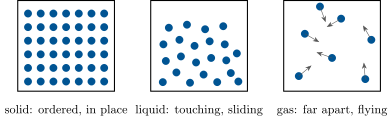
The three states are three arrangements of the same molecules:
- solid: molecules packed tight in an orderly stack, each trembling in place but holding its position — hence the fixed shape;
- liquid: molecules still touching, but disordered and free to slide past one another — hence flowing, and the level surface;
- gas: molecules far apart, flying fast in all directions, colliding and rebounding — hence filling every corner offered.
Example 45.4 (Six years of rules, one explanation)
Run the old rules through the model. Solids keep their shape: every molecule holds its post. Liquids take the container’s shape and lie level: the sliding crowd slumps until no molecule can slide lower. Gases fill all the room offered: nothing holds the flyers back. The perfume crossing the room: gas molecules flying, colliding, spreading. Sand pouring like a liquid: not molecules sliding, but grains — each grain itself a tiny orderly solid of trillions of molecules.
45.2 The empty space test
Method 45.5 (Two syringes)
The model claims gas molecules fly far apart, liquid molecules touch. Then gas should squeeze, and liquid should not. Test it:
- fill a plastic syringe with air, cap the nozzle with a fingertip, and push the plunger: it yields — you can halve the air’s room, feeling a springy fight-back;
- fill the same syringe with water, cap, and push: the plunger stands like a wall — water refuses to shrink by even a hair;
- release each plunger: the air springs back; the water never moved.
Proposition 45.6 (Gases squeeze; liquids and solids do not)
A gas can be compressed — forced into less room — because most of a gas is empty space between flying molecules. Liquids and solids are practically incompressible: their molecules already touch, and matter that touches cannot be packed tighter by any push a hand — or a hydraulic press — can give.
Example 45.7 (Squeezed air at work)
The bicycle pump squeezes room-fulls of air into the tire — possible only because air is mostly emptiness. The squeezed crowd, molecules hammering the tire walls faster and thicker, holds the bicycle up: a gas’s push is its molecular hailstorm. Divers’ tanks pack an afternoon of breathing into a steel bottle; the incompressible brake fluid, meanwhile, carries your foot’s push to the wheels undiminished — each state hired for its own talent.
45.3 Changes of state, reread
Example 45.8 (The doors, molecule by molecule)
Warm a solid and its trembling molecules shake harder; at the melting point the shaking bursts the orderly stack — the crowd begins to slide: melting. Warm the liquid further and the fastest molecules tear free of the crowd’s grip entirely and fly: evaporation — and at the boiling point the escape becomes a stampede from within the liquid itself. Cooling runs the film backward: flyers caught (condensation), sliders locking into ranks (solidification). The six doors of last year are one story of molecular grip against molecular shaking.
Example 45.9 (Old laws for free)
Two hard-won laws now come free of charge. Mass survives changes of state: melting rearranges molecules but neither creates nor destroys a single one — same particles, same mass. Temperature plateaus: at the melting point, incoming warmth is spent breaking the stack’s grip, molecule by molecule, not on faster shaking — the thermometer waits until the last rank is broken. What measurement discovered, the model explains.
Remark 45.10 (Water’s odd swelling)
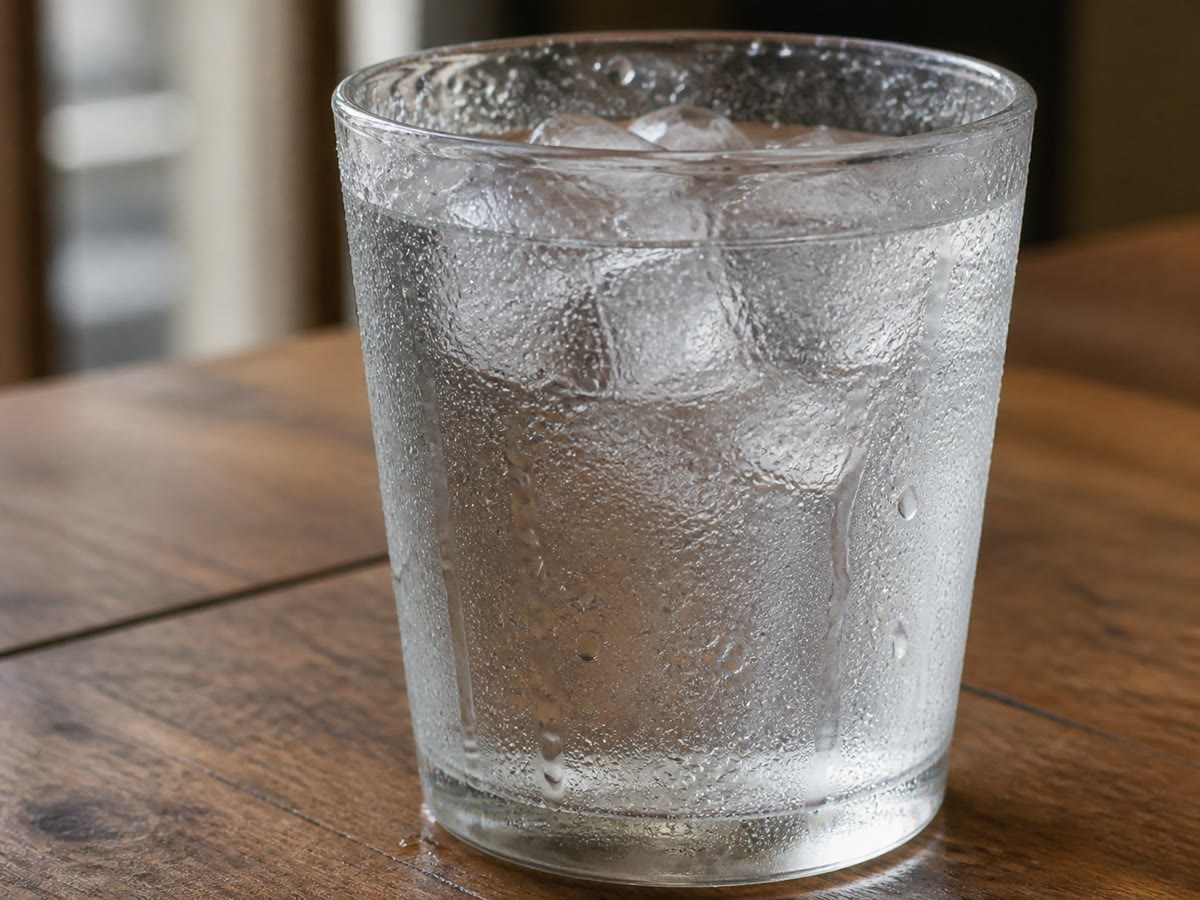
Even water’s strange freeze-swelling joins in: water-molecules happen to lock into an unusually airy stack — an open lattice with more empty space than the sliding crowd had. Airier stack, more room, lower density: ice floats on its own liquid. Most substances stack tighter than they slide; water’s architecture is the beautiful exception.
45.4 Heat, seen from inside
Proposition 45.11 (Temperature and molecular motion)
Temperature measures the liveliness of molecular motion: the hotter a substance, the faster its molecules tremble, slide or fly. Heat flowing from hot to cold is the lively crowd calming down as it stirs up the sluggish one — collision by collision — until both share one pace: one temperature. The old downhill law of heat is molecular table tennis.
Example 45.12 (Cold is not a stuff)
The model retires an old temptation for good: nothing called “cold” ever flows. There is only slower and faster molecular motion; the lively lends liveliness, never the reverse. At the coldest imaginable — molecules as still as nature permits — lies a true floor of temperature, far below any freezer; its strange and famous number belongs to the High School volume.
45.5 Exercises
Exercise 45.1 ★
State the particle model’s picture of each of the three states, in one line each.
Exercise 45.2 ★
Why does a solid keep its shape while a liquid takes its container’s? Answer with molecules, not with rules.
Exercise 45.3 ★
In the syringe test, why does the air yield and spring back, while the water stands like a wall?
Exercise 45.4 ★
A bicycle pump packs many room-fulls of air into one tire. What does this prove about the spacing of gas molecules? Could a pump do the same with water?
Exercise 45.5 ★
Tell the story of melting in molecular language: what does warmth do, and what breaks at the melting point?
Solution
Solution of Exercise 45.5.
Warmth makes the stacked molecules tremble harder and harder; at the melting point the trembling overpowers the stack’s grip, the ranks break, and the molecules begin to slide: the solid has become liquid.
Exercise 45.6 ★
Why does mass survive every change of state, according to the model? What would have to happen to molecules for mass to be lost?
Exercise 45.7 ★
What does temperature measure, in the model? Describe heat’s downhill flow as molecular table tennis.
Solution
Solution of Exercise 45.7.
The liveliness of molecular motion. When hot touches cold, the lively molecules batter the sluggish ones, handing over liveliness collision by collision — the lively calm down, the sluggish quicken — until both crowds share one pace: equal temperatures.
Exercise 45.8 ★
Perfume opened at one end of a still room is smelled at the other end a minute later. Explain the journey — and why a breeze speeds it up.
Exercise 45.9 ★★
Evaporation cools what it leaves behind: sweat chills your skin, and a wet finger held up feels the wind’s cold side. Explain with the escape of the fastest molecules — what kind of crowd stays behind?
Solution
Solution of Exercise 45.9.
Only the fastest molecules can tear free of the liquid’s grip, so evaporation is a tax on liveliness: the escapees carry away more than their share, and the crowd left behind is, on average, slower — that is, cooler. Sweat and the wet finger chill by exporting their liveliest.
Exercise 45.10 ★★
A sealed balloon left in the summer sun swells; in the refrigerator it sags. The number of molecules inside never changed. Explain both changes with molecular speed and the hailstorm on the walls.
Solution
Solution of Exercise 45.10.
In the sun the trapped molecules fly faster and hammer the skin harder and more often: the hailstorm inflates the balloon until the stretched skin balances it. In the cold the same molecules slow, the hammering weakens, and the outside air’s push squashes the balloon smaller.
Exercise 45.11 ★★
Why does ice float, in molecular language? What is unusual about the stack water-molecules build, and what would ponds do in winter if water stacked like ordinary substances?
Solution
Solution of Exercise 45.11.
Freezing water locks into an unusually airy, open stack — more empty space than the sliding crowd had — so ice takes more room for the same molecules: density below the liquid’s, and it floats. Were water ordinary, ice would stack tight, sink as it formed, and ponds would freeze from the bottom up — with no sheltered water left for the fish.
Exercise 45.12 ★★★
A drop of ink released gently at the bottom of a glass of still water slowly spreads, over hours, until all the water is faintly blue — no stirring, no currents. Explain what this patient spreading reveals about the molecules of a liquid — both the water’s and the ink’s — and why the same drop spreads faster in warm water. (This humble observation was among the great early evidences for the whole molecular idea.)
Solution
Solution of Exercise 45.12.
Nothing stirred the water, yet the ink traveled: the liquid’s own molecules are in ceaseless motion, jostling the ink molecules step by random step through the crowd — both liquids are alive with motion at every instant, even when the glass looks perfectly still. Warmth quickens every jostle, so the spreading hurries. Patient ink thus made the invisible dance visible — evidence that convinced the doubters of molecules themselves.
45.6 Problem: The Molecular Theater
Problem 45.1
Weekend problem — the class stages the particle model in the gymnasium; pupils as molecules, states as choreography; the critics’ questions
The physics class stages matter itself: thirty pupils play the molecules of one substance, and the gymnasium is the container.
Part I — Three scenes.
- Scene one, the solid: how should the thirty stand, and what small motion must each keep making? What may none of them do?
- Scene two, the liquid: what changes in the arrangement, and what new freedom appears? What must the pupils still keep doing that the gas scene will abolish?
- Scene three, the gas: describe the choreography — and say why this scene needs the whole gymnasium while the first two huddle in a corner.
- The audience asks: “Is it the same thirty pupils in all three scenes?” What law of last year does the answer stage?
Part II — The critics test the play.
- A critic pushes gently on the gas scene’s crowd, herding it into half the gym. Does the scene allow it? And the same push on the liquid scene’s huddle? Name the proposition being staged.
- To stage melting, the director turns up an imaginary heat dial. What must the solid’s pupils do more and more of, and at what moment does the scene legally become the liquid scene?
- The play must show the melting plateau: while the change happens, what is the heat dial’s energy spent on — and what must the “thermometer critic” report about the pupils’ average liveliness during it?
- Stage evaporation from the liquid scene: which pupils leave the huddle — any at random, or a particular kind? What happens to the huddle’s average liveliness as they go, and what everyday chill does this explain?
Part III — Special effects.
- The balloon effect: the gas scene is fenced by pupils holding a rope-ring (the balloon’s skin). What do the molecular actors do to the rope, and what happens to the ring when the actors move faster?
- Water’s odd freezing must be staged. What unusual instruction about spacing does the director give the solid scene’s stack, and what floating fact does it explain?
- The ink-drop finale: one pupil in a blue shirt starts in a corner of the liquid scene. Without any director’s push, how does the blue shirt end up far from its corner — and why faster if the heat dial is up?
- Write the program note: in three sentences, say what one idea the whole play stages, name two old laws it explains for free, and admit honestly what no scene can show (how small and how many the real actors are).
Solution
Solution of Problem 45.1.
1. In neat rows, shoulder to shoulder, each jiggling on the spot — and none may swap places or leave their post. 2. Ranks dissolve: pupils stay shoulder to shoulder (touching!) but now weave and slide past one another. They must still keep contact with the crowd — no one may run free. 3. Pupils scatter, running fast and straight until they collide or hit a wall, rebounding endlessly — and since nothing holds them together, only walls stop them: the crowd claims every corner the gym offers. 4. Yes — the same thirty in every scene: mass survives changes of state, staged. 5. The gas scene allows it — runners crowd into half the gym (and hammer the herders harder). The liquid huddle cannot shrink: the pupils already touch. Staged: gases squeeze, liquids do not. 6. Jiggle harder and harder at their posts; the scene becomes the liquid the moment jiggling bursts the ranks and pupils begin to slide past each other. 7. The dial’s energy is spent breaking the stack’s grip — rank by rank — not on faster motion: the thermometer critic must report the average liveliness unchanged until the last rank breaks. The plateau, staged. 8. The fastest pupils — only they can tear free. The remaining huddle’s average liveliness drops: the liquid cools itself by evaporating, exactly the chill of sweat and wet fingers. 9. The actors keep colliding with the rope and shoving it outward; faster actors shove harder and more often, and the ring swells — the balloon in the sun. 10. “Stack in open order — arms’ length, airy”: water’s solid takes more room than its liquid, so the ice-scene raft would float on the liquid-scene crowd. 11. The blue shirt is jostled — bumped step by random step through the sliding crowd until it has wandered everywhere: ink diffusing. Turn the dial up and every jostle quickens, so the wandering hurries. 12. For example: “Tonight’s play stages one idea: all matter is molecules in motion. Granted, two old laws come free — mass surviving every change of state, and the melting plateau. What we cannot stage is the scale: real actors are smaller than any seeing and more numerous than all the audiences of the world.”