Primary & Middle School Physics · Grades 1–9
64Weight vs Mass: Measuring Forces
Five years ago, on a paper Moon, you split “heavy” in two: mass for the stuff, weight for the pull. The split was wisdom; now it becomes arithmetic. Forces get their unit — named for the man of the falling apple — weight gets its formula, and the rubber-band scale of your childhood returns in professional dress.
64.1 The newton
Definition 64.1 (The newton)
Forces — pushes, pulls, weights, gravitation’s grip — are measured in newtons (), honoring the author of the law of gravitation. Handy anchors: one newton is about the weight of a small apple (history smiles); your schoolbag weighs some ; a solid handshake squeezes with around ; last chapter’s Moon-lease ran to .
Definition 64.2 (Dynamometer)
A dynamometer is the force-meter: a calibrated spring in a case, stretching in proportion to the force applied, its pointer reading newtons directly. It is your rubber-band scale grown up — and like the voltmeter and ammeter before it, it retires another patch of “feels strong” into honest numbers.
Method 64.3 (Measuring a force)
- choose a dynamometer whose range suits the job — a instrument for pencil cases, a one for schoolbags;
- zero it in the position of use (hanging, if the load will hang — the spring’s own weight shifts the zero);
- apply the force steadily, along the instrument’s axis, and read at eye level;
- record with the unit — and, since forces have directions, note the direction too when it matters.
On diagrams, a measured force becomes an arrow drawn to a declared scale — “one centimetre per ten newtons” — pointing as the force points: the childhood force-arrows, now quantitative.
64.2 The weight formula
Proposition 64.4 (Weight is proportional to mass)
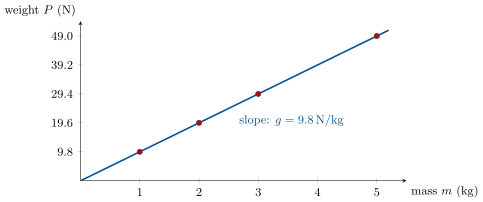
At any given place, an object’s weight (in ) is proportional to its mass (in ):
where , the gravitational strength of the place, gives the newtons of pull per kilogram of stuff. Near the Earth’s surface,
each kilogram is pulled with just under ten newtons. The formula is last chapter’s law in local dress: bundles the Earth’s mass and radius into one number for “here”.
Example 64.5 (The formula at work)
A pupil: . A football: — mind the kilograms. Backward: a crate weighing has mass . And upside down: on a mountain where a pack weighs , the local is — thins slightly with altitude, exactly as the inverse square promised.
Example 64.6 (One suitcase, many weights)
Each world sets its own , and the old astronaut story becomes a table. Your faithful suitcase:
Ten kilograms of stuff everywhere — and a different weight on every world: the mass is unchanged, while the weight follows the local .
Remark 64.7 (The two scales, judged for good)
Now the childhood verdicts close with formulas. The balance compares against : the local multiplies both pans and cancels — balances measure mass, truthful on any world. The spring scale reads directly: it measures weight, loyal to its location. The bathroom scale is a spring scale in disguise, factory-marked in kilograms by dividing your weight by the Earth’s — honest at home, a flatterer on the Moon ( read for every of you), and a slanderer on Jupiter.
64.3 Forces on paper
Example 64.8 (The book on the table, in newtons)
The oldest equilibrium in this book, at last with numbers: a dictionary rests on a desk. Its weight: , drawn as an arrow long at a scale of ten newtons per centimetre, pointing straight down from the book. The desk’s supporting push: straight up — an equal arrow, opposite way. The tie is exact, and stillness is its proof: the childhood picture, now a measured budget.
Remark 64.9 (What forces do — the missing law)
This chapter measures forces; it does not yet say what a surplus of force does to motion. The four childhood jobs — start, stop, turn, deform — await their exact law, and it is one of the greatest in all physics: the High School volume opens its mechanics with it. This year finishes the groundwork: forces in newtons, weights by formula, arrows to scale — the grammar of the sentence to come.
64.4 Exercises
Exercise 64.1 ★
Name the force unit and its instrument. Give two everyday anchors for one newton and for a hundred.
Solution
Solution of Exercise 64.1.
The newton (), measured with the dynamometer. Anchors: one newton — a small apple’s weight; a hundred — a solid handshake (or a suitcase’s weight).
Exercise 64.2 ★
Write the weight formula with units, and the meaning of in words.
Exercise 64.3 ★
Compute Earth weights: a dog; a loaf; yourself (pick your mass).
Solution
Solution of Exercise 64.3.
Dog: . Loaf: . A reader: about .
Exercise 64.4 ★
A hanging melon stretches the dynamometer to . Its mass?
Solution
Solution of Exercise 64.4.
.
Exercise 64.5 ★
Read the chapter’s graph: what does its slope mean, and what would the line do on the Moon?
Exercise 64.6 ★
The suitcase tours Earth, Moon, Mars, Jupiter. Which numbers in the table never change, and which change — and why?
Exercise 64.7 ★
Why does a balance tell the truth on every world while the bathroom scale flatters on the Moon? Formulas, not feelings.
Exercise 64.8 ★
Draw (or describe) the dictionary’s two force arrows at one centimetre per five newtons: lengths, directions, and the budget’s verdict.
Solution
Solution of Exercise 64.8.
Weight: down — an arrow about long at five newtons per centimetre, from the book downward. Support: an equal arrow upward. Equal lengths, opposite ways: budget balanced, book still.
Exercise 64.9 ★★
An airline allows per bag. A passenger argues: “On the Moon it would only weigh a few newtons!” Why does the airline’s limit — fuel and floor-strength aside — properly concern mass, and what instrument should check it at a lunar airport?
Solution
Solution of Exercise 64.9.
The plane must carry, lift and brake the bag’s stuff — its mass — and of stuff is on any world. The lunar desk needs a balance with marked masses: the only scale that survives the change of .
Exercise 64.10 ★★
On Mars, a rover’s arm weighs . Its mass? What would the same arm weigh back in the assembly hall on Earth?
Solution
Solution of Exercise 64.10.
; on Earth it weighs .
Exercise 64.11 ★★
A dynamometer zeroed lying flat, then used hanging, lies by a little — which way, and why? (What extra weight joins the load’s?)
Solution
Solution of Exercise 64.11.
It reads too high: hanging, the spring also carries its own (and its hook’s) weight, which the flat zero never included — the instrument adds a constant surplus. Zero it hanging, and the surplus is subtracted before the load arrives.
Exercise 64.12 ★★★
Design the experiment that draws the chapter’s graph and extracts : equipment, table of measurements, the plot, and how the slope is read out. Then explain what the same protocol, run in a Moon laboratory, would deliver — which numbers change, which method survives untouched.
Solution
Solution of Exercise 64.12.
Equipment: dynamometer, set of marked masses ( to ), hook. Hang each mass, record (, ) pairs, plot against : the points align through the origin, and the slope — rise in newtons over run in kilograms — is . On the Moon: identical protocol, identical straightness, new slope — the method measures whatever world it stands on; only the number is local.
64.5 Problem: The Interplanetary Outfitters
Problem 64.1
Weekend problem — the interplanetary outfitters’ fitting room; one body, four worlds; scales, dynamometers and the luggage desk
The outfitters equip travelers for the Solar System’s ports (, in : Earth ; Moon ; Mars ; Jupiter cloud-deck ). You staff the fitting room.
Part I — The fitting. A traveler of mass steps up.
- Their weight at each of the four ports?
- At which port does the classic bathroom scale (marked in kilograms, calibrated for Earth) read their mass correctly — and what does it read at the other three? (Divide each weight by Earth’s .)
- The outfitters’ honest scale is a balance with marked masses. What does it report at each port, and why?
- The traveler’s boots must never press the ground with more than (thin station floors). Any port where boots-plus-body ( total) break the rule?
Part II — The luggage desk.
- The Mars-bound trunk masses . Compute its weight at departure (Earth) and at arrival (Mars).
- The porters’ union caps hand-carried weight at at every port. What maximum mass may a porter carry at each?
- A crate labeled “ on the Moon” must clear Earth customs by mass. Do the conversion.
- The desk’s dynamometer reads a hanging duffel at on Earth. Mass, and its Moon weight for the manifest?
Part III — Complaints and curiosities.
- A bodybuilder returns from the Moon furious: “Six-fold strength gains, gone overnight!” Console them with the formula: what actually changed at each port, and what never did?
- A Jupiter-deck chef complains that whisking feels like lifting anvils, though the whisk “masses a mere ”. Compute the whisk’s deck weight and adjudicate.
- The gift shop sells “a newton of chocolate, anywhere”. At which port does the buyer get the most chocolate stuff, and how much mass at each of Earth, Moon, Jupiter?
- Write the outfitters’ motto: one sentence separating what travels with you from what each world charges.
Solution
Solution of Problem 64.1.
1. Earth ; Moon ; Mars ; Jupiter deck . 2. Correct on Earth: . Moon: ; Mars: ; Jupiter: — flattery and slander by formula. 3. at every port: the balance’s comparison cancels the local . 4. Only Jupiter’s deck: approaches the limit but stays under — no port breaks for this traveler (a heavier colleague of would break it there: ). 5. Departure: ; arrival: . 6. : Earth ; Moon ; Mars ; Jupiter — the union’s fixed newtons buy very different masses. 7. — about of crate for customs. 8. ; Moon weight . 9. Muscles and mass came home unchanged; only the opponent did. On the Moon each kilogram cost to lift; home charges again. The gains were the Moon’s discount, not the body’s growth — , with loyal and fickle. 10. — an anvil it is not: on Earth the whisk weighed , so deck whisking is two-and-a-half-fold heavier, wearying for a wrist but hardly foundry work. Complaint: sustained, partially. 11. A newton of chocolate is : Earth about ; Moon ; Jupiter . Buy your newtons on the Moon. 12. For example: “Mass travels with you; weight is each world’s toll on it — pack kilograms, and let the ports charge their newtons.”