Primary & Middle School Physics · Grades 1–9
33Stars and the Night Sky
Far from the city lamps, on a clear moonless night, the sky is crowded: thousands of sparks, faint and fierce, white and orange. Sailors steered by them, farmers planted by them, and every science began by wondering at them. What are they — and why do they wheel so tidily overhead while we sleep?
33.1 What a star is
Example 33.1 (Suns beyond counting)
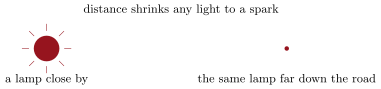
Each star is a sun: a gigantic ball of glowing-hot stuff, pouring out its own light — many are mightier than our own Sun. They look like humble sparks for one reason only: distance. The Sun is our next-door star; the others are so far that even light, the champion runner that crosses a room in no time at all, spends years on the road from the nearest of them. The night sky is a crowd of suns, shrunk by distance to glitter.
Example 33.2 (Star colors)
Look carefully and the sparks are not all white: some burn orange-red, some yellow like our Sun, some blue-white. The color is a message about heat — and it runs opposite to taps and paint pots: the orange stars are the coolest of the family, and the blue-white ones the hottest, hotter far than the Sun. A glowing coal and a white-hot blade of steel tell the same story here on Earth: hotter glows whiter.
Remark 33.3 (Where the stars go by day)
The stars never leave. They shine above you at noon exactly as at midnight — but the daytime sky is flooded with sunlight scattered by the air, a blue glare far brighter than any spark. A candle is invisible beside a bonfire. When the Sun sets and the glare drains away, the sky’s permanent crowd simply becomes visible again.
33.2 Maps made of stars
Definition 33.4 (Constellation)
A constellation is a named pattern of bright stars — a hunter, a swan, a great bear — invented by sky-watchers long ago as a map and a memory aid. The stars of a constellation are not really neighbors; they only line up as seen from Earth. But the patterns are steady: your grandparents learned the very same shapes.
Method 33.5 (Finding the North Star)
The sky offers a free compass:
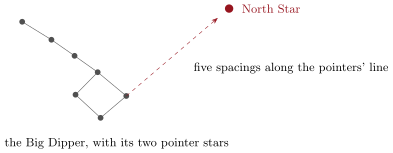
- find the Big Dipper — seven bright stars, a saucepan with a long handle, easy to spot through the year;
- take the two stars at the front edge of the pan — the pointers;
- prolong the line from one to the other, onward across the sky, about five times their spacing;
- the modest star you land on is the North Star — hang a plumb line from it down to the horizon, and there is north.
Check it against your compass: needle and star agree. Sailors bet their lives on that agreement for centuries.
33.3 The wheeling sky
Proposition 33.6 (The sky turns around the North Star)
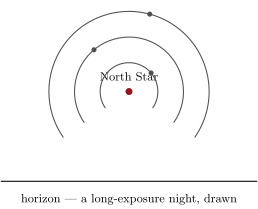
Through the night, the whole crowd of stars wheels slowly across the sky in great circles — all around one nearly motionless point: the North Star. Nothing up there truly moves so tidily; it is our own Earth spinning, as it spins the Sun across the daytime sky. The North Star barely stirs because it happens to stand almost exactly over the Earth’s spin axis — the one direction the spin leaves in peace.
Example 33.7 (Our city of stars)
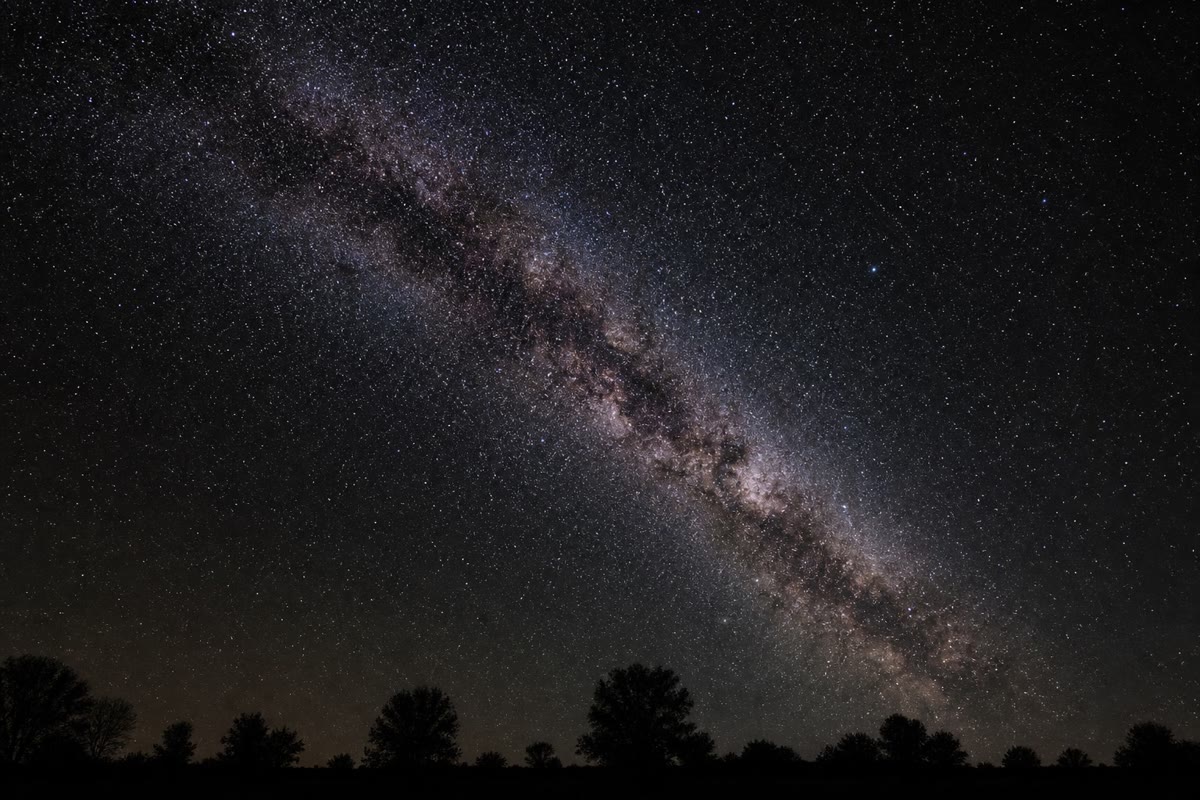
On the darkest nights, a faint milky band arches right across the sky: the Milky Way. Binoculars dissolve the milk into truth: countless stars, too faint and crowded to separate by eye. It is our home city of stars seen from inside — a flat, swirling island of more suns than there are grains of sand on a beach, with our Sun living in a quiet suburb. Every star you can see by eye is a neighbor from this one city.
Remark 33.8 (Keep looking up)
Astronomy is the oldest science, and the only one whose laboratory opens free of charge every clear night. A blanket, a dark spot away from streetlights, patience while the eyes wake to the dark — that is the whole equipment list. The Dipper, the North Star, a planet or two and the Milky Way make a fine first expedition; the deeper laws of the stars’ light will find you well prepared, years from now, near the end of this course.
33.4 Exercises
Exercise 33.1 ★
What is a star? Why do stars look like tiny sparks although many outshine our Sun?
Exercise 33.2 ★
Are the stars still in the sky at noon? Why can we not see them?
Solution
Solution of Exercise 33.2.
Yes — they shine at noon exactly as at midnight. The daytime sky is flooded with sunlight scattered by the air, and no spark can show beside that glare, as no candle shows beside a bonfire.
Exercise 33.3 ★
An orange star and a blue-white star shine side by side. Which is hotter? What everyday glow tells the same color story?
Solution
Solution of Exercise 33.3.
The blue-white one — star colors run from orange (coolest) through yellow to blue-white (hottest). A coal glowing orange versus steel heated white-hot tells the same story.
Exercise 33.4 ★
What is a constellation? Are its stars truly close to one another?
Exercise 33.5 ★
Describe, step by step, how to find the North Star from the Big Dipper.
Solution
Solution of Exercise 33.5.
Find the Big Dipper; take the two pointer stars at the front edge of its pan; prolong their line about five spacings across the sky; the star reached is the North Star, and below it on the horizon lies north.
Exercise 33.6 ★
What is special about the North Star’s place in the wheeling sky, and what everyday instrument does it replace?
Solution
Solution of Exercise 33.6.
It stands almost exactly over the Earth’s spin axis, so the wheeling of the sky leaves it nearly motionless — a fixed mark of north, replacing the compass.
Exercise 33.7 ★
The stars wheel across the night in tidy circles. What is really turning? What else does the same turning parade across the daytime sky?
Solution
Solution of Exercise 33.7.
The Earth is turning, carrying us around once a day. The same spin parades the Sun across the daytime sky — one turning, two parades.
Exercise 33.8 ★
What does the milky band across the darkest skies turn out to be, seen through binoculars? What is it really?
Exercise 33.9 ★★
Left alone all night, a camera aimed at the North Star records circles; aimed at the eastern horizon instead, it records rising slanted streaks. Explain both pictures with one spinning Earth.
Solution
Solution of Exercise 33.9.
The spinning Earth wheels the whole sky around the axis through the North Star. Near that still point, stars ride small circles — the camera records rings. Toward the east, the wheeling carries stars up over the horizon along slanting paths — the camera records rising streaks. One spin, two views of it.
Exercise 33.10 ★★
A shipwrecked sailor on a clear night has no compass, no phone — and no hurry. Explain how the sky hands her both a direction and, with patience, a clock. (Two chapter ideas, one wheeling sky.)
Solution
Solution of Exercise 33.10.
Direction: the Dipper’s pointers give her the North Star, and with it north — no needle required. Clock: the Dipper itself wheels around the North Star like the hand of a great clock, one full turn per day; watching how far it has swung tells her how the night is passing.
Exercise 33.11 ★★
The light of a far star spends years on the road to your eye. When you look at that star tonight, are you seeing it as it is now? What are you actually looking at — and why does this make every telescope a kind of time machine?
Solution
Solution of Exercise 33.11.
No: you see the star as it was, years ago, when tonight’s light left it — the messenger, not the sender. Every telescope therefore looks into the past: the farther the star, the older the news — which is precisely what makes distant light so precious to astronomers.