Primary & Middle School Physics · Grades 1–9
61The Speed of Light; Distances in the Universe
For seven years this book has whispered that light is “as good as instant” — the flash before the thunder, the seen strike starting the stopwatch. This chapter keeps the family’s oldest promise: light’s speed is not infinite, humans measured it against all odds, and the number is so vast that it becomes, in the same breath, astronomy’s ruler and its time machine.
61.1 The impossible measurement
Example 61.1 (Lanterns on two hills)
Four centuries ago, the great pioneer of experiments set two observers on distant hills at night, each with a shuttered lantern: uncover yours on seeing mine, and the round-trip delay should betray light’s speed. The delay they found was only human reflexes; between the hills, light’s true crossing took a few millionths of a second. The experiment failed magnificently — proving, at least, that light is faster than anything a hilltop could clock, and daring astronomy to find longer race-tracks.
Example 61.2 (The moon that ran late)
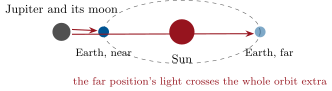
The race-track came courtesy of Jupiter. Its innermost great moon eclipses into Jupiter’s shadow on a superbly regular schedule — a clock in the sky. Yet a patient astronomer found the clock running late by many minutes in the months when the Earth’s orbit had carried us to the far side of the Sun from Jupiter, and early again as we swung near. His leap: the moon is punctual — its light is delayed, needing extra time to cross the extra width of the Earth’s orbit. From the lateness and the orbit’s size came the first estimate of light’s speed — breathtakingly close, for the sixteen-hundreds, to the truth.
Proposition 61.3 (The speed of light)
In vacuum — and in air, to excellent approximation — light travels at
three hundred thousand kilometres each second: seven and a half laps of the Earth between two heartbeats. Every color of the blend travels at this same in vacuum; nothing that carries matter or news has ever been clocked faster. Later, Earth-bound ingenuity confirmed the astronomers — a beam chopped by a spinning toothed wheel, racing eight kilometres to a mirror and back through the next tooth-gap — and modern instruments have polished to a certainty so complete that the metre itself is now defined from it.
Example 61.4 (Travel times in the neighborhood)
With , the Solar System acquires a timetable. The Moon, : — Earth–Moon radio conversations carry that awkward pause. The Sun, million km: — eight minutes twenty: sunshine is always eight-minute-old news. Mars, at a typical km: about eleven minutes — rover drivers send the day’s plan and wait; no joystick can steer across a twenty-minute round trip.
61.2 The light-year
Definition 61.5 (Light-year)
A light-year is a distance: the stretch light covers in one year — about km, nearly ten million million kilometres. The name misleads the hasty (it is no more a time than a “footstep” is a foot); astronomers use it because kilometres collapse under the sky’s true scale.
Example 61.6 (The neighborhood in light-years)
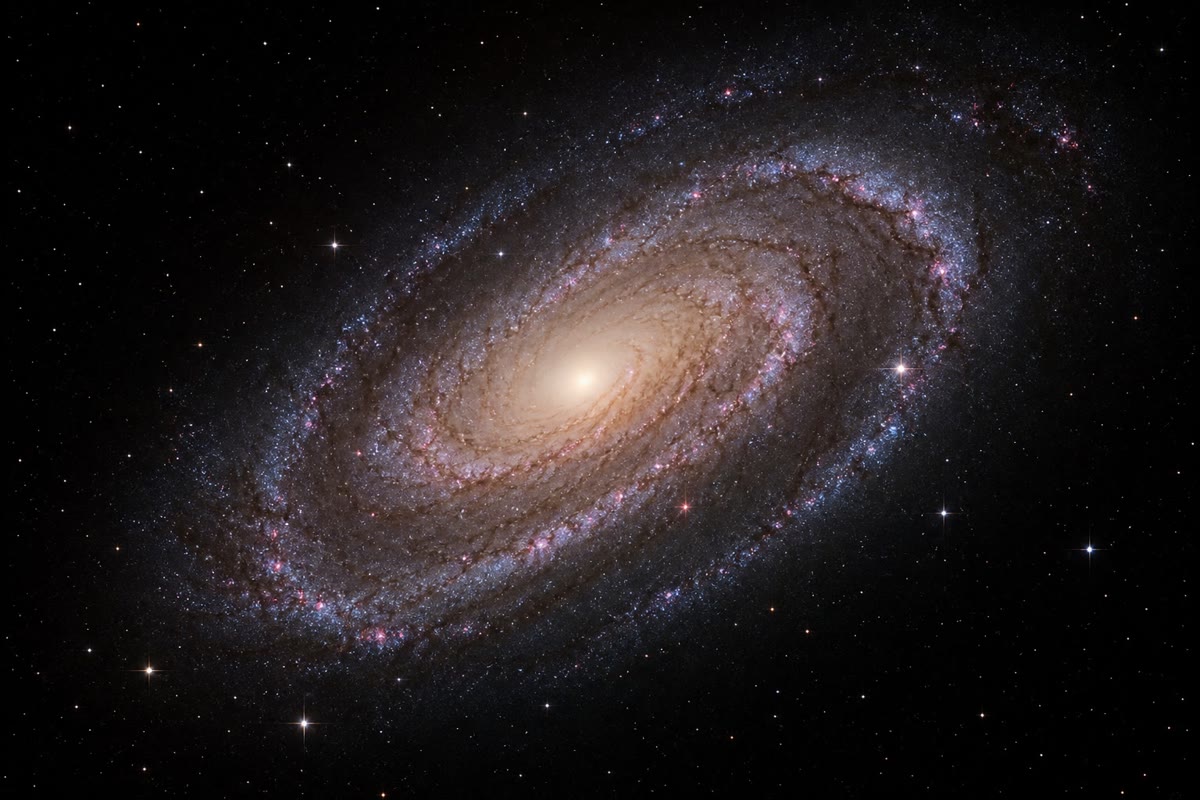
The nearest star beyond the Sun: about light-years — tonight’s photons left it while you were in your first physics chapters. The bright stars of the winter sky: tens to hundreds of light-years. The Milky Way, our city of stars: about light-years across. The nearest great neighboring galaxy: some million light-years — its faint smudge, visible to a dark-adapted naked eye, is the oldest light a human can see unaided.
Proposition 61.7 (Telescopes are time machines)
Because light’s news travels at and the universe is vast, looking far means looking back. The star at light-years shows itself as it was years ago; the neighbor galaxy, as it was when our ancestors first chipped stone tools. The g5 stargazer’s suspicion is now a theorem of arithmetic: every telescope aimed outward is aimed pastward, and astronomy is history read by starlight.
Method 61.8 (Converting distance and lookback)
- distance in light-years lookback in years: the same number — that is the unit’s whole genius;
- distance in kilometres light-time: divide by , then tame the seconds into minutes, hours or years;
- light-years kilometres (rarely worth it): multiply by — and remember why astronomers seldom do.
Remark 61.9 (What “now” means out there)
Is the four-light-year star still shining right now? Almost surely — stars live long — but no faster answer than light’s own can ever reach us: the freshest possible news is four years stale, always. For the deep sky, the question softens into strangeness: some of the faintest smudges in great telescopes are galaxies whose light left before the Earth existed. Physics will sharpen what “now at a distance” can even mean in the university years; for this year, carry the honest version: the sky is not a scene — it is an archive.
61.3 Exercises
Exercise 61.1 ★
Give in and in (powers-of-ten form). What failed on the two hills, and why?
Solution
Solution of Exercise 61.1.
. The hilltop lanterns measured only human reflexes: light crossed the hills in millionths of a second, far beneath any hand’s timing.
Exercise 61.2 ★
Retell the late-moon argument in three sentences: what was punctual, what was late, and what the lateness measured.
Exercise 61.3 ★
Compute light’s travel time: Moon (); Sun ( million km). Why is sunshine “old news”?
Solution
Solution of Exercise 61.3.
Moon: . Sun: — eight minutes twenty. Sunshine always shows the Sun as it was eight minutes ago: old news by construction.
Exercise 61.4 ★
A light-year — time or distance? Define it, and give its size in kilometres (powers-of-ten form).
Exercise 61.5 ★
The nearest star sits about light-years away. What is tonight’s lookback — and what were you doing when its light departed?
Solution
Solution of Exercise 61.5.
Four years. Answers vary — four years ago you were several grades back down this very book.
Exercise 61.6 ★
Why can no one joystick a Mars rover from Earth? Use the timetable example’s numbers.
Solution
Solution of Exercise 61.6.
At eleven-ish minutes one way, a steering correction answers a picture at least twenty-two minutes stale — the rover would be in the crevasse before the joystick’s twitch arrived. Hence plans, not joysticks.
Exercise 61.7 ★
Order by lookback: the Moon; the Sun; the nearest star; the neighbor galaxy — with each one’s rough figure.
Exercise 61.8 ★
“The metre is now defined from .” What does this say about which of the two — ruler or light — physicists trust more deeply?
Exercise 61.9 ★★
Radar ranging: a radio pulse (traveling at ) bounced off the Moon returns in about . Recover the Moon’s distance from this round trip — and name the old sonar rule that carries over.
Exercise 61.10 ★★
Sort by the archive’s depth: light in your room from a lamp (); the Sun; a star at light-years; the neighbor galaxy. For the lamp, estimate the lookback in billionths of a second ( — tame it in words).
Solution
Solution of Exercise 61.10.
Lamp: s — a hundredth of a millionth of a second: even the room is an archive, too shallow to notice. Then the Sun (eight minutes), the star (a century), the galaxy (two and a half million years) — the deeper you look, the older the page.
Exercise 61.11 ★★
A news report says “astronomers watched a star explode last Tuesday, light-years away.” Rewrite the sentence with honest tenses: when did the explosion happen, and what happened last Tuesday?
Exercise 61.12 ★★★
The late-moon lateness peaks at about seconds — light’s time to cross the full width of the Earth’s orbit, about km. Run the seventeenth-century division yourself and compare with the modern : how honest was the sky’s first answer?
Solution
Solution of Exercise 61.12.
— the modern value on the nose (the historical estimate, with rougher orbit figures, landed within about a quarter of it: for the sixteen-hundreds, an astonishing first answer).
61.4 Problem: Mission Control
Problem 61.1
Weekend problem — a shift at deep-space mission control; light-lag conversations from the Moon to the stars; the operations manual
Tonight you direct the communications desk: every message travels at , and the light-lag rules every decision.
Part I — Near operations.
- The lunar base () requests confirmation of a supply drop. How long after your “confirmed” does the base hear it, and what is the soonest you can hear their acknowledgment?
- A satellite in high orbit at relays a television feed. Compute its one-way lag — and say why intercontinental phone calls via such satellites carry a just-noticeable hesitation (round trip up and down).
- The solar observatory reports a great flare “as it happens”. Correct the operator’s phrase: when did the flare truly erupt?
- Protocol asks all clocks to allow for lag. Which near-Earth link — Moon or high satellite — needs the larger allowance, and by roughly what factor?
Part II — The Mars window. Mars stands tonight at km.
- Compute the one-way lag in seconds, then in minutes.
- The rover meets an unexpected crevasse and its cameras show it approaching at walking pace. Explain, with the round-trip figure, why a joystick rescue is hopeless — and what the rover must therefore carry on board.
- The evening’s plan upload takes of transmission plus the lag. When must the upload start to be fully received by the rover at 21:00 control time?
- Six months hence, Mars will stand at km. What becomes of the lag, and what does this teach about “the” distance to a planet?
Part III — The far desk.
- An interstellar probe has reached one full light-day from Earth. Express that distance in kilometres (powers of ten; a day holds seconds), and state the round-trip conversation time with the probe.
- Dreamers at the back desk draft a “message to the nearest star”. Draft the schedule instead: sent tonight, when is the soonest any reply arrives?
- The archive wall shows tonight’s deep image of the neighbor galaxy, million light-years out. Add the caption’s honest tense — what era of Earth’s past does this snapshot broadcast back, were anyone there to look?
- End-of-shift log: write the desk’s three rules — one about instantaneous (that nothing is), one about joysticks and lag, one about telescopes and the archive.
Solution
Solution of Problem 61.1.
1. About after you speak; the soonest acknowledgment returns after the round trip, about . 2. one way; a question-and-answer rides up and down twice — near half a second of hesitation, just at the ear’s threshold. 3. “The flare erupted eight minutes twenty before our screens lit — we watch it as it was.” 4. The Moon link: against — roughly ten times the allowance. 5. s: ten minutes one way. 6. The round trip is twenty minutes: the rescue picture is ten minutes old and the rescue command ten minutes late — the crevasse wins by nineteen minutes. The rover must carry its own reflexes: on-board hazard-stopping. 7. Last bit must arrive by 21:00; it leaves Earth at min ; transmission began three minutes earlier: start at 20:47. 8. The lag doubles to about twenty-one minutes one way: planets have no “the” distance — both worlds orbit, and every conversation is scheduled against a moving target. 9. km — twenty-six thousand million kilometres; a question-and-answer takes two full days. 10. Light reaches the star in about four years; the soonest reply lands about eight years after tonight’s transmission. 11. “This light left its galaxy two and a half million years ago: the snapshot broadcasts the Earth of the earliest stone tools — our deepest naked-eye page of the archive.” 12. For example: “Nothing is instantaneous — every signal, ours included, travels at best at . Joysticks lose to lag beyond the Moon: distant machines must think for themselves. And every telescope is an archive reader — the farther the object, the older the news, with no fresher edition printable.”