Primary & Middle School Physics · Grades 1–9
12Pushes and Pulls: Forces
Open a door, zip a zipper, kick a ball, drag a sled: your whole day is spent pushing and pulling. Physics gathers all of these under one proud name — force — and asks two simple questions: what can a force do, and which way does it act?
12.1 Pushes and pulls everywhere
Definition 12.1 (Force)
A force is a push or a pull. Pushing a swing, pulling a wagon, pressing a doorbell, stretching a rubber band, squeezing dough: every one of these is a force at work. A force always has a strength — gentle or mighty — and a direction: it pushes or pulls some way.
Example 12.2 (Push or pull?)
Sort your day: kicking a ball — a push with the foot. Opening a drawer — a pull. Closing it — a push. Zipping up a jacket — a pull. Kneading dough — many little pushes. Tug-of-war — two teams pulling the same rope opposite ways.
Method 12.3 (Drawing a force as an arrow)
Physicists draw a force as an arrow:
- the arrow starts where the push or pull grabs the object;
- it points the way the force acts;
- a stronger force gets a longer arrow.
One little arrow tells the whole story: where, which way, how hard. We will draw these arrows for years to come.


12.2 What forces do
Proposition 12.4 (The four jobs of a force)
A force can do four things to an object:
- start it moving — the kick sends the resting ball away;
- stop it — the goalkeeper’s hands stop the shot;
- turn it — a sideways tap bends the rolling ball’s path;
- change its shape — squeezing squashes the sponge, pulling stretches the rubber band.
No force, none of the four: an object left completely alone keeps doing exactly what it was doing.
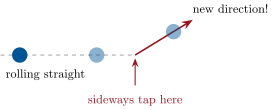
Example 12.5 (Stronger force, bigger effect)
Tap a marble: it trundles to the table’s edge. Flick it hard: it flies across the room. Same marble, same finger — only the strength of the push changed, and the marble’s flight changed with it. Gentle force, gentle effect; mighty force, mighty effect.
Example 12.6 (Try it: the shape-changers)
Gather a sponge, a rubber band, a lump of plasticine and a wooden block. Squeeze and stretch each one. The sponge springs back the moment you let go; the rubber band too. The plasticine keeps its new shape — your force made a dent forever. And the block? Your strongest squeeze changes it not at all (that you can see!). Things answer force each in their own way.
12.3 Forces without touching
Example 12.7 (The Earth’s pull)
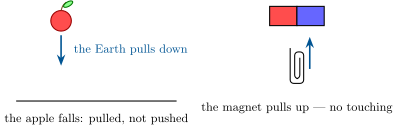
Drop a spoon: down it goes. Toss a ball as high as you like: it comes back down. Leaves, raindrops, crumbs — everything let go falls downward. Something is pulling every one of them, all the time, without touching them: the Earth itself. The Earth’s pull is the steadiest force in your life — it never lets go, and it is why “down” means the same thing everywhere on the playground.
Remark 12.8 (Old friends)
You already know another no-touch force: the magnet, pulling its paperclip across a gap of air. Magnets and the Earth’s pull are the two no-touch forces of your everyday life — rare and precious exceptions, for every other push or pull you meet needs contact. Both will grow into great chapters later in this course.
12.4 Exercises
Exercise 12.1 ★
Push or pull? Ringing a doorbell; opening a drawer; heading a football; dragging a sled uphill; squeezing toothpaste.
Solution
Solution of Exercise 12.1.
Push; pull; push; pull; push (a squeeze is pushing from both sides).
Exercise 12.2 ★
What three things does a force-arrow tell about a force?
Solution
Solution of Exercise 12.2.
Where the force grabs the object, which way it acts, and how strong it is (by the arrow’s length).
Exercise 12.3 ★
Name the four jobs of a force, and give your own example of each — different from the ones in the chapter.
Solution
Solution of Exercise 12.3.
Start, stop, turn, change shape. Examples vary — for instance: flicking a marble (start), catching a frisbee (stop), bouncing a ball off a wall (turn), squashing a snowball (shape).
Exercise 12.4 ★
A marble rolls straight toward you. Using only one finger, how do you make it: stop? speed up? swerve to the side? Say which way your finger pushes each time.
Solution
Solution of Exercise 12.4.
Stop it: push against its motion, finger toward the marble. Speed it up: push the way it already rolls, from behind. Swerve it: push sideways, across its path.
Exercise 12.5 ★
Which springs back and which keeps the dent: a sponge; plasticine; a rubber band; soft snow?
Solution
Solution of Exercise 12.5.
Spring back: the sponge and the rubber band. Keep the dent: plasticine and soft snow.
Exercise 12.6 ★
Draw a box being pushed gently to the right and the same box pushed hard to the left. How do your two arrows differ?
Solution
Solution of Exercise 12.6.
The gentle push: a short arrow pointing right. The hard push: a long arrow pointing left. Different lengths, opposite directions.
Exercise 12.7 ★
What force makes every dropped thing fall? Does it need to touch the falling spoon? Which way does it always pull?
Solution
Solution of Exercise 12.7.
The Earth’s pull. It does not need to touch — it pulls the spoon through the air, and always downward.
Exercise 12.8 ★
Give the two no-touch forces you have met, each with one example seen at home.
Exercise 12.9 ★★
In tug-of-war, both teams pull with all their might, yet the ribbon on the rope sometimes does not move at all. Draw the rope with the two teams’ arrows. What must be true about the two pulls when the ribbon stands still? What happens the moment one team pulls harder?
Solution
Solution of Exercise 12.9.
Two arrows on the rope, equally long, pointing opposite ways. The ribbon stands still when the two pulls are equally strong — they cancel each other out. The moment one team pulls harder, its arrow wins and the ribbon moves that way.
Exercise 12.10 ★★
A ball thrown straight up slows, stops for an eye-blink, and falls back. Which force is at work on the way up, at the top, and on the way down? Does it ever stop pulling? (Draw the arrow at each of the three moments.)
Solution
Solution of Exercise 12.10.
The same force all three times: the Earth’s pull, arrow pointing straight down — on the way up (slowing the ball), at the top (about to bring it back), and on the way down (speeding it up). It never stops pulling for a single moment.