Primary & Middle School Physics · Grades 1–9
58Resistance and Ohm’s Law
One question has trailed the whole electrical story: some components let the march rush, others throttle it to a trickle — lamps split voltages unequally, thin wires warm, thick ones stay cool. The opposition itself now gets a name, a unit, and — crowning four years of circuits — the single most useful law in this book: three letters that tie the push, the march and the opposition into one line of algebra.
58.1 Resistance
Definition 58.1 (Resistance)
The resistance of a component measures how strongly it opposes the electric current: at a given voltage, the greater the resistance, the weaker the march it lets through. Its unit is the ohm (symbol , the Greek capital omega), honoring the schoolmaster-physicist who found this chapter’s law with homemade wires and heroic patience.
Definition 58.2 (Resistor)
A resistor is a component manufactured to have a chosen, steady resistance — a calibrated obstacle, sold from fractions of an ohm to millions. Circuits use resistors to set currents on purpose: taming the march that would burn a delicate part, dimming, dividing, adjusting. Their striped color bands spell out their value; their symbol is a plain rectangle.
Example 58.3 (Resistances around you)
A metre of thick copper wire: hundredths of an ohm — the level road. A glowing flashlight bulb: some ohms. A small electric motor: a few ohms. The kettle’s heating coil: about . Dry human skin, hand to hand: tens of thousands of ohms — wet, catastrophically less: the old damp-hands rule is a resistance statement. An open switch: resistance beyond all measuring — the infinite obstacle.
58.2 The experiment
Method 58.4 (Measuring a component’s – portrait)
One resistor, one adjustable supply (or a growing queue of cells), both meters:
Example 58.5 (A resistor’s confession)
A session’s table, for one resistor:
| () | ||||
|---|---|---|---|---|
| () |
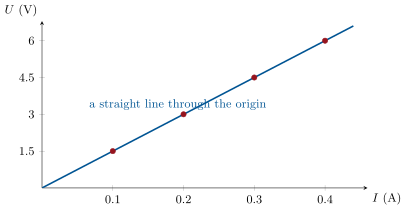
Double the push, double the march; triple, triple: and are proportional, and every ratio returns the same number: . That constant ratio is no accident — it is the resistor’s resistance, , showing itself in every row.
Proposition 58.6 (Ohm’s law)
For a resistor at steady temperature, the voltage across it and the current through it are proportional, and the constant of proportionality is its resistance:
with in volts, in amperes, in ohms. Rearranged to taste: (the current a push drives through an obstacle) and (the obstacle, unmasked by one honest pair of readings).
Example 58.7 (The law computes everything)
Once is known, the law answers in every direction. The kettle coil, on the mains: — the ten-ampere appliance explained. A resistor must limit a delicate lamp’s current to from : — pick the next standard value. Through flows : the voltage across it is . One law, three recipes, the whole workshop.
Remark 58.8 (The triangle crutch)
Some learners pencil over and in a little triangle, covering the wanted letter to read off the recipe. Harmless as a crutch — but your algebra now rearranges honestly in one line, and the honest way travels to every formula you will ever meet, triangle or none. Lean on the crutch if you must this year; plan to walk.
58.3 What resistance explains
Example 58.9 (Old mysteries on one invoice)
The unequal voltage split of the laws chapter: series lamps share one , so by the bigger takes the bigger — the harder worker’s larger drop, now computable. The throttled branch of the parallel chapter: the long thin wire added resistance, and shrank that branch’s share. The short circuit: a bypass of nearly zero , so explodes — the stampede was always division by almost-zero. Four years of qualitative circuit lore, one law’s invoice.
Example 58.10 (Wires, by the metre)
A wire’s resistance grows with its length and shrinks with its thickness — a long thin wire is a narrow mountain road, a short thick one a motorway. Hence the electrician’s fat cables for hungry appliances, the heating coil’s deliberately long thin resistive alloy — and the reason the same law that lights a lamp warms a toaster: resistance is where the march spends its push, and spent push, as the energy chapter will confirm next year, becomes warmth.
Remark 58.11 (Where the law’s writ ends)
Ohm’s law is a resistor’s law, not a universal right. Measure a filament lamp’s portrait and the points bend away from the straight line: the filament heats as the current grows, and hot metal resists more — refuses to stay put. Diodes, motors and living skin bend their portraits too, each in its own way. The straight line through the origin is the resistor’s signature, not matter’s — always ask a component for its portrait before trusting it with the law.
58.4 Exercises
Exercise 58.1 ★
What does resistance measure? Give its unit and symbol, and write Ohm’s law with its three rearrangements.
Exercise 58.2 ★
Complete each pair for a resistor: , ; , .
Solution
Solution of Exercise 58.2.
; .
Exercise 58.3 ★
A component shows at . Its resistance?
Solution
Solution of Exercise 58.3.
.
Exercise 58.4 ★
In the portrait experiment, what shape do a true resistor’s points draw, and what does a steeper line mean?
Solution
Solution of Exercise 58.4.
A straight line through the origin — proportionality. A steeper line means more volts needed per ampere: greater resistance.
Exercise 58.5 ★
From the chapter’s table, verify from the second and fourth rows. Why is getting the same number both times the whole point?
Solution
Solution of Exercise 58.5.
; . The sameness of the ratio across rows is the law: one constant serving every reading is what makes “the resistance” a property of the component.
Exercise 58.6 ★
The kettle coil is ; a second kettle’s is . On the same mains, which draws the stronger current — and how much does each draw (one decimal)?
Exercise 58.7 ★
Explain with why, of two series lamps sharing one current, the higher-resistance lamp takes the larger voltage.
Solution
Solution of Exercise 58.7.
Series lamps share one ; each lamp’s voltage is with the same — so the larger multiplies into the larger : the stronger opposer takes the bigger share.
Exercise 58.8 ★
Translate into resistance-language: the short circuit’s stampede; the open switch’s total blockade.
Solution
Solution of Exercise 58.8.
Short circuit: near zero, so explodes — the stampede is division by almost-nothing. Open switch: beyond measure, so collapses to zero — the total blockade.
Exercise 58.9 ★★
A delicate indicator lamp tolerates . What series resistor protects it on a battery, if the lamp itself takes about of the share? (Resistor’s share first, then .)
Exercise 58.10 ★★
A filament lamp’s portrait, measured: (, ), (, ). Show that no single fits both points, and tell the physical story behind the bending.
Solution
Solution of Exercise 58.10.
First point: ; second: — no single value fits. The story: the growing current heats the filament, and hot metal resists more; the portrait bends because the component changes as it works.
Exercise 58.11 ★★
Two resistors in series, and , on . Using the series laws plus Ohm’s law on each: find the loop’s current and each resistor’s voltage. (Hint: one current satisfies .)
Solution
Solution of Exercise 58.11.
One loop, one : the two drops sum to the battery’s push, , so . Then and — summing to , as the loop law demands.
Exercise 58.12 ★★★
Same two resistors, now in parallel on . Find each branch’s current, the battery’s total, and then — the elegant finish — the single resistance that would draw that same total from . Compare it with both resistors and explain, in road-language, why the team of two resists less than either member alone.
Solution
Solution of Exercise 58.12.
Each branch spans : , ; total . The stand-in: — less than either member. In road-language: two roads between the same towns carry more traffic than either alone; every added parallel road eases the passage, so the team’s opposition falls below its weakest member’s.
58.5 Problem: The Quality Control Bench
Problem 58.1
Weekend problem — inspection day at the resistor factory; portraits, tolerances and one component that is no resistor at all
The factory’s quality bench tests the day’s production — and one impostor. You run the meters.
Part I — Calibrating the bench.
- Sketch (or describe) the test circuit: supply, ammeter, the component under test, voltmeter — who is in series, who across?
- Sample one, at , passes . Its resistance?
- The label claims , tolerance five percent. Compute the acceptable band, and rule on sample one. (Five percent of first.)
- Sample two, labeled : predict its current at , so the bench knows what to expect (one decimal, in ).
Part II — Full portraits.
- Sample three’s table: , , , — volts, amperes. Fit , citing the feature of the numbers that permits a single value.
- Sample four’s table: , , , . Show the impostor: no single , and the drift’s direction.
- Sample four is, in fact, a small filament lamp from the next production line. Tell its bending story — and why the bench’s straight-line test is precisely a resistor-detector.
- The bench’s rule book says: “every portrait must be taken at steady temperature.” Which clause of Ohm’s law is the rule protecting?
Part III — Applications department.
- An order asks for a resistor limiting current to on a supply (the load’s own share negligible). Compute the value to quote.
- A customer complains their heater coil “only” draws while the fuse allows . Compute what supply voltage their complaint implies, and reassure them with the arithmetic.
- The prototype lab requests the factory’s thickest, shortest copper jumper “with as close to zero ohms as possible”. What circuit role is that jumper born for — and near what everyday villain does its near-zero resistance place it if misused?
- Close the inspection log: three sentences — the law, its portrait, and the one condition under which a component may sign it.
Solution
Solution of Problem 58.1.
1. Supply, ammeter and component in one series loop — the tollbooth in the road; the voltmeter across the component — the surveyor aside. 2. . 3. Five percent of is about : acceptable from to . Sample one’s falls outside: rejected. 4. . 5. Every row returns (, , …): constant ratio, straight-line portrait — one value fits all: . 6. The ratios run , , , : climbing with every step — resistance growing as the current grows; no single exists. 7. As the current grows the filament heats toward glowing, and hot metal resists more — the portrait bends upward. The bench’s straight-line test thus admits exactly the components whose stays put: it is, by construction, a resistor-detector. 8. The steady-temperature clause: Ohm’s law promises proportionality at steady temperature — warm a component mid-portrait and even an honest resistor drifts. 9. . 10. — exactly the mains: the coil draws precisely what Ohm’s law allots it, and the fuse’s margin is working as designed. Nothing is “only”; all is arithmetic. 11. The jumper is born to be a connecting wire — the level road, spending no push. Misused across a supply, its near-zero ohms make it the perfect short circuit: the villain was always just a very good wire in the wrong place. 12. For example: “The law: , push equals opposition times march. Its portrait: a straight line through the origin, steeper for stronger opposers. And only a component at steady temperature may sign it — heat rewrites resistance, and portraits taken feverish prove nothing.”