Primary & Middle School Physics · Grades 1–9
36Air Pressure and Weather
You live at the bottom of an ocean — an ocean of air, hundreds of kilometres deep, with the whole weight of it resting on your shoulders. Why does it not crush you? Why do you not even feel it? And what does any of this have to do with tomorrow’s weather? Air, our old invisible friend, has one more big secret to give up.
36.1 Air has weight
Example 36.1 (Weighing the invisible)
A firm football is placed on a fine balance scale and balanced exactly. Then its valve is opened and the extra air hisses out — same ball, same valve, same everything, minus some air. Back on the scale: the deflated ball is lighter. The difference is the weight of the escaped air. Air is stuff, stuff has mass, and mass is pulled down by the Earth: the ocean above us is heavy.
Definition 36.2 (The atmosphere and its pressure)
The atmosphere is the deep layer of air wrapped around the whole Earth. Its weight squeezes the air at the bottom — where we live — and squeezed air pushes hard on every surface it touches. That push is called air pressure.
Proposition 36.3 (The push from all sides)
Air pressure pushes on every surface from every direction — downward on tables, sideways on walls, even upward on ceilings and palms. And it is mighty: on an area the size of your palm, the air pushes about as hard as the weight of a large, full suitcase. We never notice, because the pushes come balanced: air inside us and behind every surface pushes back just as hard.
Method 36.4 (The card that holds back water)
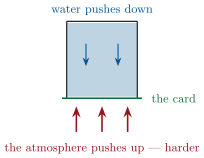
Air’s upward push, caught red-handed (do it over the sink):
- fill a glass with water to the very brim;
- lay a stiff, smooth card flat on top, touching the water all around;
- hold the card in place, turn the glass exactly upside down, and gently let the card go.
The card stays — holding back the whole glassful. The water’s weight presses down on the card, but the atmosphere presses up on it harder still. You have just seen the suitcase-push from below.
36.2 Machines run by the atmosphere
Example 36.5 (The straw)
You think you pull juice up a straw. In truth, you cannot pull a liquid at all — try pulling water with your fingers! What you really do is suck the air out of the straw. With the air gone from inside, the atmosphere pressing down on the juice in the glass pushes juice up the empty straw to your mouth. Every sip is the atmosphere doing the lifting; you only clear the road.
Example 36.6 (Suction cups and crushed bottles)
The bathroom hook’s rubber cup is pressed flat to the tiles, squeezing the air out from underneath: now the atmosphere pushes the cup against the wall with nothing behind it pushing back — pinned by the sky itself. And screw the cap onto an empty plastic bottle high on a mountain, then drive down into the valley: the bottle crumples as if squeezed by a ghost hand. More air presses outside than the thin mountain air sealed inside — the atmosphere wins, and the bottle folds.
Example 36.7 (Thinner with height)
Climb, and you leave part of the ocean below you: less air above means a weaker push. Your ears pop in a fast cable car as the pressure outside changes; mountaineers gasp in air grown thin. And here the mountain-tea mystery of last year surrenders: with the atmosphere pressing less on the water, boiling comes easier — water on great peaks boils well below , too cool for a proper brew.
36.3 The barometer and the weather
Definition 36.8 (Barometer)
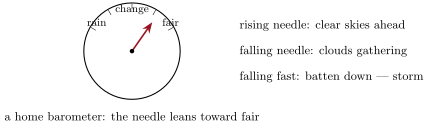
A barometer is the instrument that measures air pressure — one more member of our family of honest judges, beside the thermometer and the scale. Its needle rises when the atmosphere above presses harder, and falls when the press lightens.
Proposition 36.9 (Pressure talks about tomorrow)
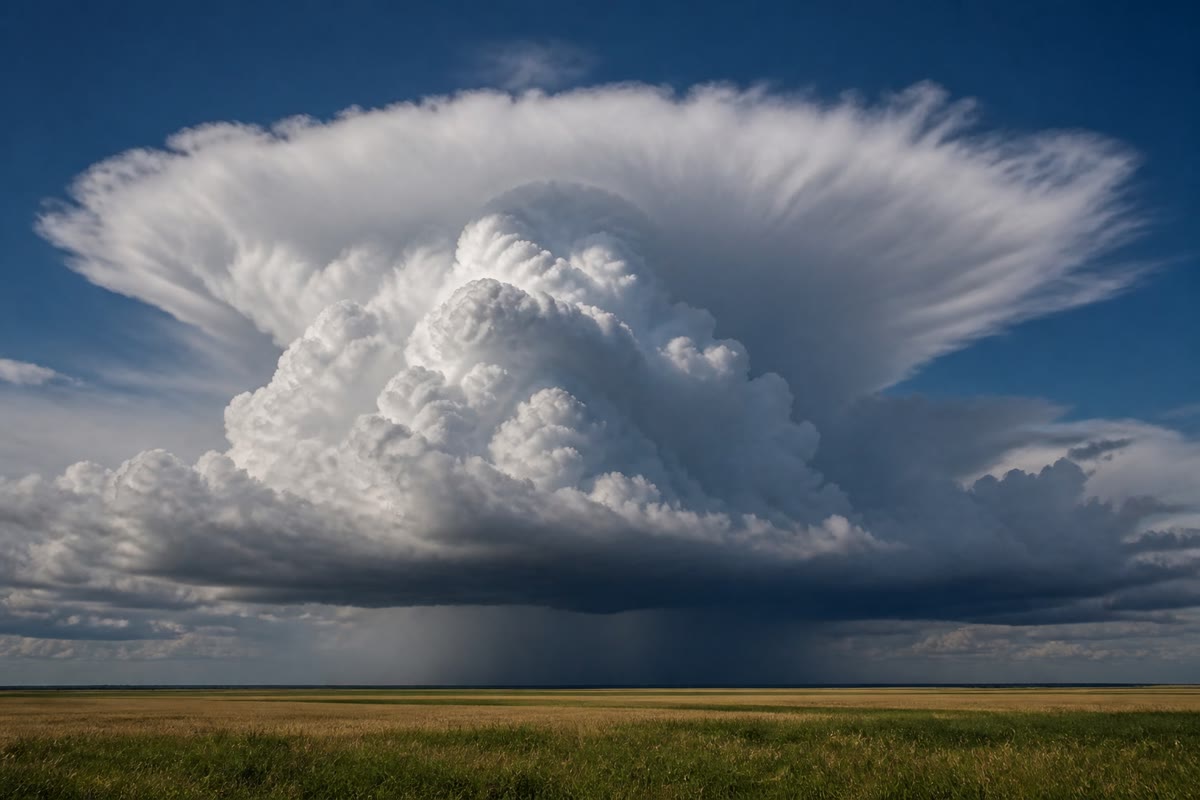
The atmosphere’s pressure is restless: heavy, sinking air brings calm, clear skies; light, rising air invites clouds and rain. So the barometer is a fortune teller of a modest, honest kind: steady or rising pressure promises fair weather; falling pressure warns of clouds coming; a fast fall means a storm may be on its way.
Remark 36.10 (The weather map’s H and L)
Tonight’s weather report will show great swirls labeled H and L: regions of high and low pressure drifting across the map like slow whales. Air forever pours from the heavy H regions toward the light L regions — and that pouring is the wind. One chapter, three old friends explained: the barometer’s forecast, the wind’s origin, and the reason your ears know when the weather is about to break.
36.4 Exercises
Exercise 36.1 ★
How does the football experiment show that air has weight? What exactly is compared?
Exercise 36.2 ★
What is air pressure, and where does it come from? In which directions does it push?
Solution
Solution of Exercise 36.2.
The push of the squeezed air at the bottom of the atmosphere on every surface it touches. It comes from the weight of the deep ocean of air above us, and it pushes from every direction — down, sideways, and up.
Exercise 36.3 ★
The atmosphere presses on your palm about as hard as a full suitcase weighs — yet you feel nothing. Why not?
Solution
Solution of Exercise 36.3.
Because the pushes come balanced: the air on the other side of your palm — and inside your body — pushes back exactly as hard. Only an unbalanced push, like on the card or the crumpling bottle, shows its might.
Exercise 36.4 ★
In the card trick, two pushes fight over the card. Name them, and say which one wins.
Solution
Solution of Exercise 36.4.
The water’s weight pushes the card down; the atmosphere pushes the card up. The atmosphere wins — the card stays and the water is held in.
Exercise 36.5 ★
“I pull the juice up the straw.” Correct this sentence: what do you really remove, and who does the lifting?
Solution
Solution of Exercise 36.5.
You remove the air from inside the straw. The atmosphere, pressing down on the juice in the glass, then pushes juice up the cleared straw: the sky does the lifting.
Exercise 36.6 ★
Why does a suction cup grip the tiles? What was squeezed out, and what holds the cup on?
Solution
Solution of Exercise 36.6.
Pressing the cup flat squeezed out the air behind it. With nothing pushing back from underneath, the atmosphere’s push pins the cup to the tiles.
Exercise 36.7 ★
What happens to air pressure as you climb a mountain, and why? Give two signs of it a traveler can notice.
Exercise 36.8 ★
What does a barometer measure? Your barometer has been falling fast since breakfast — what should the picnic plans expect?
Solution
Solution of Exercise 36.8.
The push of the atmosphere — air pressure. A fast fall warns of a storm on the way: move the picnic indoors.
Exercise 36.9 ★★
The sealed bottle crumpled on the drive down from the mountain. Explain the crumpling with pushes inside and outside — and predict: what would happen instead to a bottle sealed in the valley and carried up?
Solution
Solution of Exercise 36.9.
Sealed on the peak, the bottle kept thin mountain air inside; in the valley the outside push grew stronger than the trapped push inside, and the bottle folded. Carried the other way, a valley-sealed bottle keeps strong air inside while the outside push weakens with height: the bottle swells taut — and a sealed bag of crisps does the same on every mountain drive.
Exercise 36.10 ★★
Where does wind come from, according to the weather map’s H and L swirls? Connect it to the oldest definition in this book: wind is air on the move — moved by what?
Exercise 36.11 ★★
Mountain climbers complain that on great peaks, tea never brews strong and pasta stays hard however long it boils. Gather the whole explanation across two years: what does the thin atmosphere do to the boiling point, and why does longer boiling not help? (Two propositions, one from last year, close this case.)
Solution
Solution of Exercise 36.11.
With height, the atmosphere’s push on the water weakens, so boiling comes easier: the boiling point slides well below . And by the plateau law, boiling water can never climb past its boiling point — extra flame only makes steam. So peak-top water boils cool and is stuck there: tea weak, pasta hard, physics satisfied.