Primary & Middle School Physics · Grades 1–9
37Measurement in Science: Units and Instruments
A carpenter, a doctor and an astronomer walk into their workdays: one measures a shelf, one a fever, one the wanderings of Mars. All three trust the same quiet machinery — agreed units, honest instruments, careful reading. This year physics turns properly quantitative, so we begin by polishing the tools every later chapter will lean on.
37.1 From seeming to number
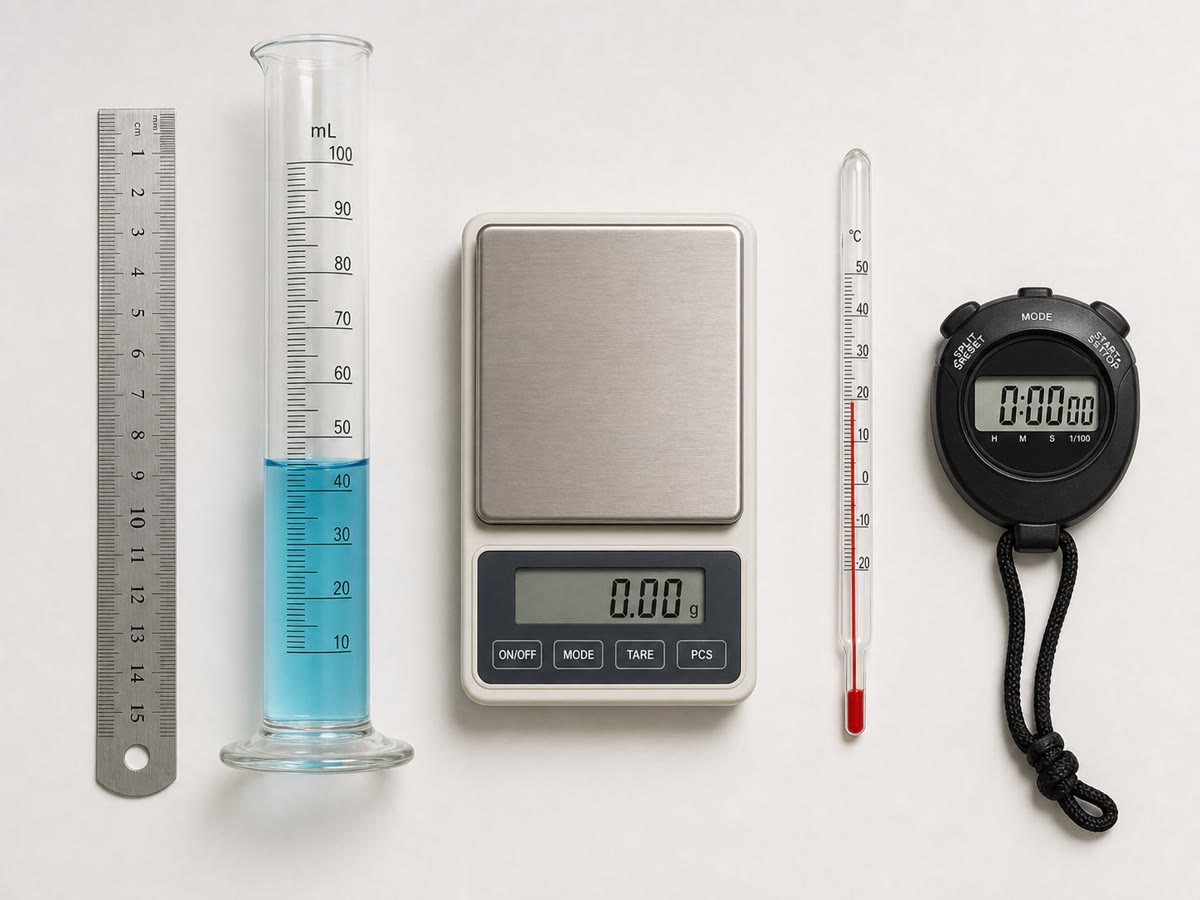
Five years of experiments have taught us a rhythm: eyes and hands guess, instruments decide. Ruler against seeming-longer; balance against seeming-heavier; thermometer against feeling-cold. Each time, the instrument’s verdict is a number with a unit — and that pair travels, compares, and can be checked by anyone, which no feeling ever could.
Definition 37.1 (Measuring a quantity)
To measure a quantity — a length, a mass, a duration, a temperature — is to count how many times its agreed unit fits into it, using an instrument built for the job. The result is always written as a number with its unit: , , . A number alone is a rumor; number-plus-unit is a measurement.
Example 37.2 (The price of a missing unit)
“Add 3 of flour.” Grams? Spoonfuls? Cups? The cake’s fate hangs on the missing word. Real disasters have followed missing or mixed-up units — pilots have run out of fuel mid-flight because kilograms were confused with pounds. Professionals write the unit every time, without exception; from this chapter on, so do we.
37.2 The world’s units
Definition 37.3 (The scientist’s starter kit)
The world has agreed on common units, one family per quantity:
- length: the metre (), with its offspring the kilometre (), centimetre () and millimetre ();
- mass: the kilogram (), with the gram () and milligram ();
- time: the second (), with the minute () and hour ();
- temperature: the degree Celsius ();
- volume of liquids: the litre (), which we measure out in the next chapter.
Example 37.4 (Converting like a scientist)
Conversions are rides on the decimal staircase. in centimetres: multiply by — the point slides two places right: . in kilograms: divide by : . Time is the rebel of the family — its steps are , not : is not seconds but . Respect the rebel.
Remark 37.5 (Who guards the metre?)
For two centuries, the world’s metre was a bar of precious metal in a guarded vault near a great European capital, and the kilogram a gleaming cylinder beside it: every nation’s rulers and weights were copies of copies of those. Today the guards have been retired: the metre and its friends are now defined from unchangeable facts of nature itself — light and the inner clocks of atoms — so that any well-equipped laboratory on Earth (or beyond it!) can rebuild them exactly. Units are humankind’s longest-running peaceful agreement.
37.3 Using instruments well
Method 37.6 (Reading any graduated scale)
Rulers, thermometers, measuring jugs, dials: one skill reads them all.
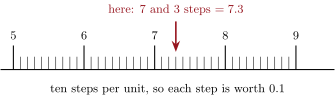
- find the graduation value: pick two neighboring numbered marks, subtract, and divide by the number of little steps between them — on a ruler numbered every centimetre with ten steps, each step is , one millimetre;
- put your eye squarely in front of the mark (a slanted view shifts the reading);
- count on from the last numbered mark: and little steps is ;
- write the number with its unit.
Method 37.7 (Estimate, measure, judge)
Professionals never measure cold:
- estimate first — “this table is about two metres”;
- choose the instrument whose range and steps fit the job (a ruler for a stamp, a tape for a corridor, kitchen scale for flour, bathroom scale for people);
- measure, by the reading rules;
- judge: does the result agree roughly with the estimate? A table measured at did not grow — you misread by a factor of ten, and the estimate just caught it.
The estimate is your safety net: it catches slipped decimal points before they catch you.
Example 37.8 (Choosing wisely)
To weigh a letter for posting, the bathroom scale is useless — the letter’s vanish between its steps; the kitchen scale, stepping by the gram, answers perfectly. To time a -metre sprint, the kitchen clock’s minute steps are hopeless; a stopwatch counts in hundredths of a second. Neither instrument is “better”: each has a territory, set by its range and its smallest step.
37.4 Honest numbers
Remark 37.9 (Between the marks)
Real needles love to land between marks. Honesty then has two levels: at least, name the two neighbors — “between and , closer to ”; better, estimate one digit beyond the marks — “about ”. What honesty forbids is inventing precision: reading off millimetre marks is fiction wearing a lab coat. An instrument’s marks set the limit of what it can promise.
Example 37.10 (Measure twice, trust more)
Three friends time the same toy car run with the same stopwatch: , , . Nobody blundered — fingers simply start and stop a hair apart. Small scatter is the normal breath of real measurement. The wise habits: repeat the measurement, watch the readings huddle, and distrust any single lonely number — especially your own.
37.5 Exercises
Exercise 37.1 ★
Complete each measurement with a sensible unit: a door is … tall; a coin has mass …; a school lesson lasts …; a fever is …
Solution
Solution of Exercise 37.1.
; ; ; .
Exercise 37.2 ★
Convert: to ; to ; to seconds; to .
Solution
Solution of Exercise 37.2.
; ; ; .
Exercise 37.3 ★
Why is time the rebel of the unit family? Convert to seconds — and say what wrong answer the decimal staircase would have given.
Solution
Solution of Exercise 37.3.
Its steps go by , not by , so the decimal staircase lies: , while the staircase would have wrongly given .
Exercise 37.4 ★
A jug is numbered every with five little steps between numbers. What is one step worth? The juice stands two steps above the mark — how much juice?
Solution
Solution of Exercise 37.4.
Each step: . Two steps above : .
Exercise 37.5 ★
Which instrument for each job, and why: weighing a pinch of yeast; timing a heartbeat count; the width of this page; the length of the schoolyard?
Exercise 37.6 ★
Nadia measures her pencil: . Which safety net of Method 37.7 should have caught this, and what is the likely true value?
Solution
Solution of Exercise 37.6.
The judging step: a pencil is estimated at under , so fails the sanity check at once. She read centimetres and wrote metres: the true value is .
Exercise 37.7 ★
A thermometer’s column stops between the and marks, nearer . Give one honest way to report it — and one dishonest report to avoid.
Solution
Solution of Exercise 37.7.
Honest: “between and , nearer ” (or “about ”). Dishonest: “” — precision the marks cannot promise.
Exercise 37.8 ★
Three stopwatch readings of one run: , , . Is someone at fault? What is the wise report?
Solution
Solution of Exercise 37.8.
No one is at fault: fingers start and stop a hair apart, and small scatter is measurement’s normal breath. Wise report: the readings huddle around — “about ”.
Exercise 37.9 ★★
A recipe abroad asks for “a quarter pound of butter”. Your kitchen scale speaks grams, and a full pound is about . How many grams do you weigh out? What does this errand teach about shared units?
Exercise 37.10 ★★
A ruler’s first centimetre is worn away, so its edge starts at the mark. A stamp laid from the edge reads at its far end. How wide is the stamp really? What habit defeats worn rulers?
Solution
Solution of Exercise 37.10.
The stamp spans from the mark to the mark: . The habit: never trust an instrument’s edge — start from a chosen mark and subtract, and worn rulers lose their power.
Exercise 37.11 ★★
The class measures the corridor with a tape twice: and . The teacher writes “”. Explain her choice, using Remark 37.9 and Example 37.10.
Solution
Solution of Exercise 37.11.
The two readings scatter by , so the last digit of either is not to be trusted; they huddle around . Writing “” keeps every digit the tape can honestly promise and no more.
Exercise 37.12 ★★★
An old tale: a king decreed his own foot the kingdom’s unit of length. List two practical disasters that follow (think of carpenters in distant towns, and of the king’s growing son as heir), and explain how the retired metal bar of Remark 37.5 solved both — and what problem even the bar left unsolved that nature’s own constants finally fixed.
Solution
Solution of Exercise 37.12.
Disasters: no two towns’ “feet” agree, so beams cut in one town never fit houses in another; and when the son inherits, the unit itself changes length — every measurement in the kingdom expires with the king. The metal bar fixed both: one unchanging length, copied for all towns, outliving all kings. Its own flaw: a single object can be scratched, stolen or slowly altered, and the world had to trek to its vault to check copies — until units were rebuilt on nature’s constants, which cannot wear out and are on duty everywhere at once.
37.6 Problem: The Instrument Inspector
Problem 37.1
Weekend problem — a day with the town’s instrument inspector; scales, jugs and clocks on trial; the apprentice’s notebook
Every year the town’s inspector tests the instruments of shops and schools. Today you are the apprentice, notebook in hand.
Part I — The bakery’s scale. The inspector carries certified blocks: , , , , .
- She checks that the empty scale’s needle stands exactly on zero. Why must this be the first test of all?
- She loads the and one block. What should an honest scale read?
- The needle shows instead. Does this scale flatter the baker or the customers? Explain who loses money on every sale.
- Which combinations of her blocks let her test the reading ? Give one.
- The bakery’s scale steps by . Could the inspector use it to check a letter stamp? Why not?
Part II — The school’s measuring jugs.
- A jug is numbered every , with four steps between numbers. What is each step worth?
- Water stands one step above the mark. The teacher’s log says “about ”. Grade that report: honest, too vague, or fiction?
- A pupil reads the jug from a low chair, eye well below the water line, and gets a different number than the inspector. Which reading rule was broken?
- The inspector pours the jug’s declared into a certified jug, which shows . By how much is the school jug off, and is that worse or better than one of its own steps?
Part III — Clocks, and the apprentice’s verdict.
- The station clock is checked against the radio time signal: it shows the signal’s noon at h min. Fast or slow, and by how much?
- If nobody corrects it, how far ahead will it be after a week? (It gains the same each day.)
- Three shops’ clocks show h min, h min, and h exactly at the signal’s noon. The inspector says: “Averaging would be silly here — fix each clock.” What repair does each need?
- Evening. In your notebook, write the inspector’s three golden rules — one about zero, one about reading, one about units — each in a single sentence of your own.
Solution
Solution of Problem 37.1.
1. Every weighing adds the load to whatever the needle already showed; a non-zero start poisons all the day’s readings — the fair-start check must come first. 2. . 3. It reads light. Pouring flour until the needle says , the baker has really poured : the scale makes the baker hand over more goods than the customer pays for — it flatters the customers, and the baker loses on every sale. 4. . 5. No: a stamp vanishes below the scale’s steps — outside its territory. 6. per step. 7. Water at ; “about ” rounds away a full step — too vague for an instrument this good. 8. Eye level with the mark: reading from below shifts the apparent water line — the squarely-in-front rule was broken. 9. Off by — better (smaller) than its own step: acceptable for a school jug. 10. Fast, by minutes. 11. minutes ahead after a week. 12. First clock: set back min; second: forward min; third: nothing — it is right. (Averaging the three would “fix” nothing and falsify the one honest clock.) 13. For example: Zero: check the empty instrument reads zero before trusting anything it says. Reading: learn the step’s worth and read squarely in front, between marks with honest modesty. Units: a number without its unit is not a measurement — write the unit, always.