Primary & Middle School Physics · Grades 1–9
28Light Travels in Straight Lines
Sunbeams slant through the morning mist between the trees — straight as stretched strings, every one. A torch in a dusty attic throws a straight-edged blade of light. You can hear a friend calling from around the corner, but you cannot see them there. All these are one law wearing different clothes — the oldest law of light.
28.1 The law of the straight line
Proposition 28.1 (Light travels in straight lines)
In air (as in water, glass, or empty space), light travels in straight lines. It does not curve around corners, does not drift like smoke, does not bend to find you behind a wall. Where a straight line from the source cannot reach, no light from that source arrives.
Definition 28.2 (Light ray)
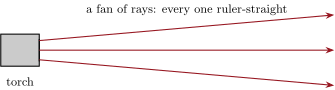
To draw light, physicists use the light ray: a straight line with an arrow, showing one thread of light and the way it runs. A torch beam is drawn as a fan of rays; a thin laser beam as a single ray. Like the force arrow, the ray is a little drawing that carries a law inside it: light’s roads are ruler-straight.
Example 28.3 (Where the law shows itself)
Once you know the law, you see it everywhere: the straight sunbeams through mist or blinds; the sharp straight edge of a torch beam in dusty air; the laser pointer’s dead-straight thread; and every lighthouse sweeping straight blades of light across the night sea. Bent light is never seen — fountains and forests may curve, light will not.

28.2 Proving it with three cards
Method 28.4 (The three-card experiment)
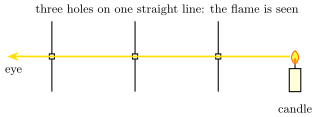
- Punch a small hole in the middle of three stiff cards, at the same height;
- stand the cards upright in a row, a hand-span apart, and a lit candle (or torch) beyond the last one;
- move your head until you see the flame through all three holes — possible only when the three holes and the flame stand on one straight line (check: a taut string through the holes reaches the flame);
- now slide the middle card sideways, just a finger’s width.
The flame vanishes. Light that could have zigzagged — through hole one, a jog sideways, through the shifted hole, and on to your eye — simply does not: no straight line, no light.
Example 28.5 (Shadows explained for good)
Now the shadow of your first school year gives up its secret. Rays run straight from the lamp; the ball stops the ones that hit it; the rays just missing its edge run straight on. Behind the ball lies exactly the space that no straight ray can reach — the shadow, with its sharp edge drawn by the last rays to slip past. Straight rays, sharp shadows: crooked light would smear every shadow into fog.
28.3 Seeing is receiving light
Proposition 28.6 (How seeing works)
You see a thing when light from it travels in a straight line into your eye — its own light if it is a source, bounced sunlight or lamplight otherwise. Nothing leaves your eye to grab the world: seeing is receiving, catching rays like a net catches balls.
Example 28.7 (Around the corner)
Your friend calls from around the corner of the school: you hear them, but cannot see them. Sound spreads like pond rings and washes around the corner’s edge; light holds its straight roads, and no straight line joins your friend’s face to your eye through the brick. To see around corners, you must fold the road — give the ray a hard, shiny surface to bounce off. That trick is called the mirror, and it owns the next year’s first light chapter.
Remark 28.8 (The champion runner)
Sound, we measured, jogs at each second. Light on its straight roads is in another league entirely: it crosses the whole sky faster than any counting could catch — which is why the flash arrives “at once” and the thunder trudges in seconds behind. How fast exactly? The number is so outrageous that we save it for a later year — with the tale of the clever tricks it took to measure it at all.
28.4 Exercises
Exercise 28.1 ★
State the law of this chapter. Name two sightings of it outdoors.
Exercise 28.2 ★
What is a light ray, and what two things does its drawing show?
Exercise 28.3 ★
In the three-card experiment, when exactly can you see the flame? What single move makes it vanish, and why?
Exercise 28.4 ★
How does the straight-line law explain the sharp edge of a shadow?
Solution
Solution of Exercise 28.4.
Rays run straight from the lamp; the blocker stops some, and the rays just missing its edge run straight on. The boundary between reached and unreached ground is drawn by straight lines — hence the crisp edge.
Exercise 28.5 ★
You see this book right now. Tell the journey of the light that makes that possible, from a lamp to your eye.
Solution
Solution of Exercise 28.5.
Light leaves the lamp, runs straight to the page, bounces off the paper, and runs straight from the page into your eye — which receives it. Two straight legs with one bounce between.
Exercise 28.6 ★
Why can you hear a friend around the corner but not see them? What does each traveler — sound and light — do at the corner?
Exercise 28.7 ★
A keyhole, a lit room beyond, and your eye: from where in the dark corridor can you see the lamp through the keyhole? Answer with a straight line.
Solution
Solution of Exercise 28.7.
Only from the spots where a straight line through the keyhole reaches the lamp — eye, keyhole and lamp aligned. Step aside and the line breaks on the door.
Exercise 28.8 ★
Which arrives first from a distant firework, the bang or the flash? Which law and which measurement from this year explain the gap?
Solution
Solution of Exercise 28.8.
The flash: light’s trip counts as instant, while the bang jogs over at per second — three silent seconds per kilometre of distance.
Exercise 28.9 ★
“When I look at a star, something shoots out of my eye to touch it.” Correct this old belief with Proposition 28.6 — what travels, and which way?
Exercise 28.10 ★★
Design, with a drawing of rays, a way to watch the corridor from inside your room using the mirror trick teased in Example 28.7: where must the shiny surface stand at the doorway, and what does it do to the ray’s road? (Submarines use exactly this, stacked twice, to see above the waves.)
Solution
Solution of Exercise 28.10.
Stand the shiny surface at the doorway, tilted at a slant (half a right angle) to the corridor. A ray running along the corridor hits the tilted mirror and its road folds: it turns the corner and runs straight through the doorway into the room to your eye. Two such folds, one above the other, make the submarine’s periscope.
Exercise 28.11 ★★
On a misty morning, sunbeams fan out between the trees in visibly straight lines — yet your friend says: “We see the beams, so light must be visible stuff hanging in the air.” What are you both actually seeing when a “beam” shows in mist or dust, and what would the beam look like in perfectly clean air?
Solution
Solution of Exercise 28.11.
You are not seeing the light in flight — you are seeing the countless tiny droplets and dust specks that the beam strikes on its way, each one bouncing a little light to your eye. In perfectly clean air there is nothing to strike, and the beam is invisible from the side: only the bright spot where it lands betrays it.