Primary & Middle School Physics · Grades 1–9
15Temperature and Thermometers
Two winters ago, three bowls of water fooled your two hands: the same water felt warm to one and cool to the other. We promised then that an instrument would one day settle such arguments. Here it is — the thermometer, the little glass judge that turns hot and cold into a number.
15.1 Why touch is not enough
Example 15.1 (The unfair judges)
Touch judges unfairly in every season: the metal slide feels colder than the wooden bench standing in the same shade; lukewarm water feels warm to a cold hand and cool to a warm one; and after sledding, the chilly hallway feels toasty. To compare hot and cold honestly — across rooms, across days, across people — we need a judge that never changes its mind: an instrument.
15.2 The thermometer and its degrees
Definition 15.2 (Temperature)
The temperature of a thing is the number that says exactly how hot or cold it is. Higher number, hotter thing; lower number, colder thing. Temperature is measured in degrees Celsius, written , with a thermometer.
Proposition 15.3 (Water’s two milestones)
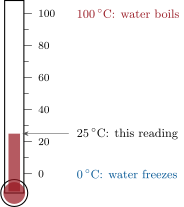
The Celsius scale is pegged to water’s two great changes of state:
Between the two milestones, the scale is cut into equal degrees — a staircase of littler steps from ice to steam.
Example 15.4 (How the glass judge works)
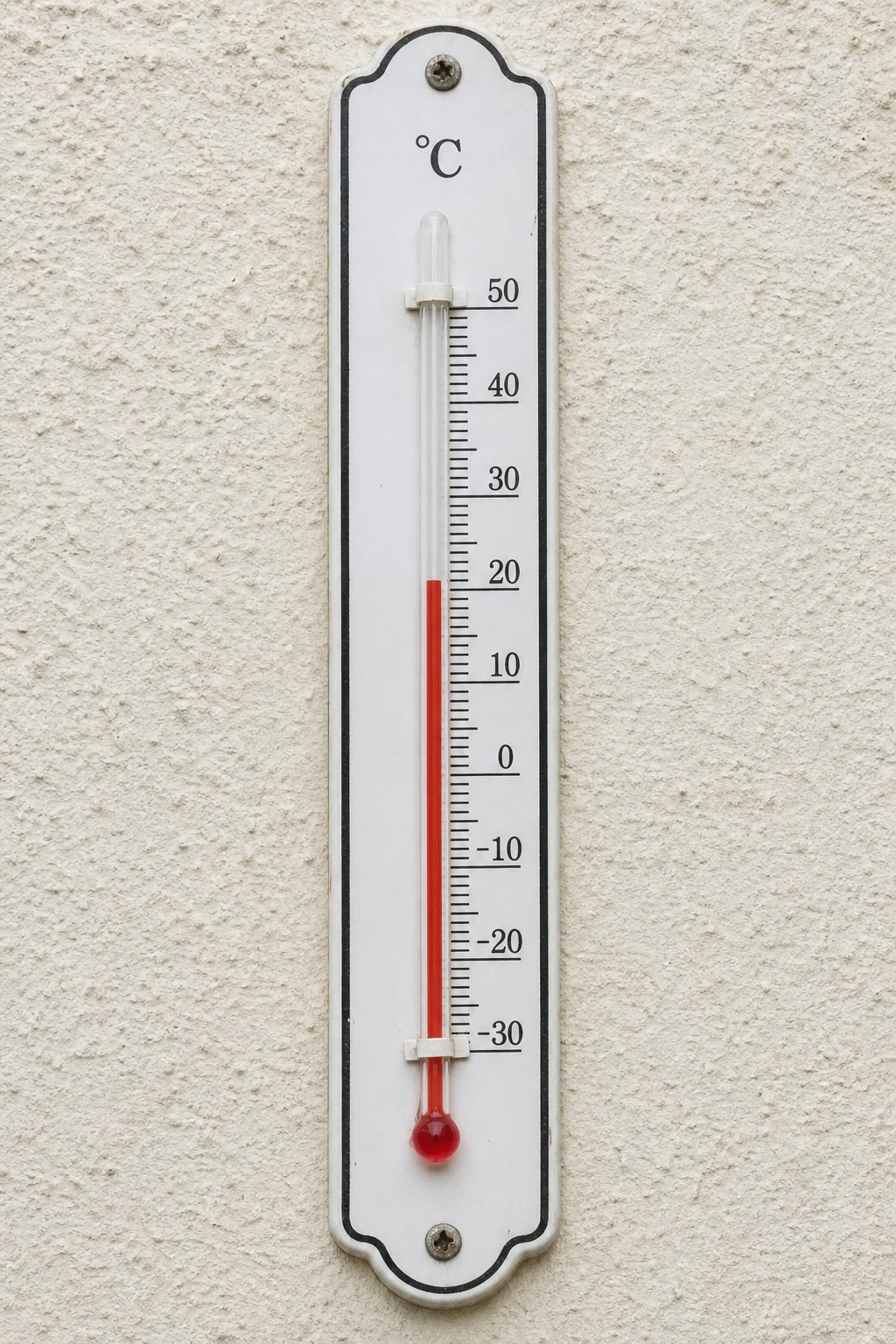
Inside the thermometer’s thin tube sits a trapped colored liquid. Warmth makes that liquid swell just a little — and in a tube so thin, a little swelling pushes the column visibly up. Cold shrinks it back down. The liquid cannot be fooled like a hand: it swells the same for the same warmth, today, tomorrow, for everyone.
15.3 Reading a thermometer
Method 15.5 (Reading a thermometer)
- Put the thermometer where you want the temperature — in the water, in the shade outdoors, under the tongue;
- wait — the liquid needs time to finish climbing or sinking; watch until it stops moving;
- bring your eye level with the top of the column;
- read the number at the mark the column reaches, and write it with its unit: .
Reading too soon, or from an angle, gives a wrong number — the judge is honest, but it must be questioned properly.
Example 15.6 (Temperatures to live by)
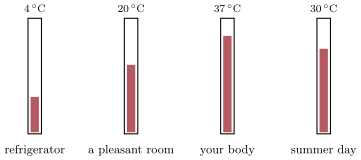
Some numbers worth knowing by heart: a pleasant room is about ; your body keeps itself at about , in summer and winter alike (much above that is a fever — the doctor’s thermometer knows); the refrigerator holds about ; a hot summer day reaches ; bath water is pleasant near .
15.4 Below zero
Example 15.7 (Winter numbers)
On a freezing morning the column sinks below the mark. The marks keep going down there, and we read them with the word “minus”: one mark below zero is minus one degree, five marks below is minus five, written . Minus numbers are colder than zero, and the lower they go, the harder the freeze: a morning bites colder than a one. The weather report says them every winter evening.
Remark 15.8 (Zero is not “nothing”)
On this scale, does not mean “no temperature” — it is simply the mark where water freezes, a milestone like a road sign. Weather can be warmer than the milestone or colder than it; the thermometer just tells you on which side, and by how many marks. (Numbers below zero have a whole arithmetic of their own — your mathematics course will take them up properly in a later year.)
15.5 Exercises
Exercise 15.1 ★
Why is a thermometer a fairer judge of hot and cold than your hand? Name one way hands were fooled in earlier chapters.
Solution
Solution of Exercise 15.1.
The thermometer gives the same number for the same warmth, whoever reads it, whenever. Hands were fooled by the three bowls (the same lukewarm water felt warm and cool at once) and by metal feeling colder than wood in the same shade.
Exercise 15.2 ★
At what temperature does water freeze? Boil? Which unit are both numbers in?
Exercise 15.3 ★
What happens to the liquid in the thin tube when the thermometer is warmed? When it is cooled? Why does such a small change show so clearly?
Exercise 15.4 ★
List the two mistakes Method 15.5 warns about when reading a thermometer.
Solution
Solution of Exercise 15.4.
Reading too soon (before the column has stopped moving), and reading from an angle instead of with the eye level with the column’s top.
Exercise 15.5 ★
Match each thing with its likely temperature — , , , : boiling water; a cozy living room; the inside of the refrigerator; your own body.
Solution
Solution of Exercise 15.5.
Boiling water: . Cozy living room: . Refrigerator: . Your body: .
Exercise 15.6 ★
The bath thermometer reads ; the pot on the stove reads . Which is hotter, and is the pot safe to touch? By how many degrees is the pot hotter than the bath?
Solution
Solution of Exercise 15.6.
The pot is hotter, by degrees — far too hot to touch: it is at boiling temperature.
Exercise 15.7 ★
A winter thermometer shows the column marks below zero. How do we say and write that temperature? Is it colder or warmer than ?
Solution
Solution of Exercise 15.7.
Minus three degrees Celsius, written . It is warmer than : eight marks below zero is deeper into the freeze than three.
Exercise 15.8 ★
Yesterday the garden thermometer read at breakfast and at lunch. By how many degrees did the morning warm up?
Solution
Solution of Exercise 15.8.
: the morning warmed up by degrees.
Exercise 15.9 ★
Puddles on the pavement have turned to ice overnight. What can you say about the night’s temperature, without any thermometer? Which milestone are you using?
Solution
Solution of Exercise 15.9.
The night went below — water’s freezing milestone. Frozen puddles are a thermometer made of weather.
Exercise 15.10 ★★
Straight after sledding, Emma runs into the hallway and cries “It is boiling in here!” The hallway thermometer reads . Is the hallway hot? Why does Emma feel it so — and which judge should the family trust?
Solution
Solution of Exercise 15.10.
No — is on the cool side of pleasant. Emma’s skin compares the hallway with the freezing garden she just left, so it feels toasty to her. The family should trust the thermometer: it compares with the fixed marks of its scale, not with where it has just been.
Exercise 15.11 ★★
A cook wants to know whether soup at a rolling boil gets hotter the longer it boils. She measures: after one minute of boiling, ; after ten minutes, still . What does the thermometer teach her about boiling water — and about water’s milestones?
Solution
Solution of Exercise 15.11.
Boiling water stays at no matter how long it boils — the milestone is a ceiling: extra heating makes more steam, not hotter water. That is exactly why could be chosen as a reliable milestone in the first place.