Primary & Middle School Physics · Grades 1–9
42Rectilinear Propagation of Light
“Light travels in straight lines” has served you for two years — lighting shadows, aiming mirrors, aligning three cards and a candle. This year the old law gets its formal name, its drawing rules, and its most magical consequence: a camera with no lens, no glass, no moving parts — just a hole.
42.1 The law, stated properly
Proposition 42.1 (Rectilinear propagation of light)
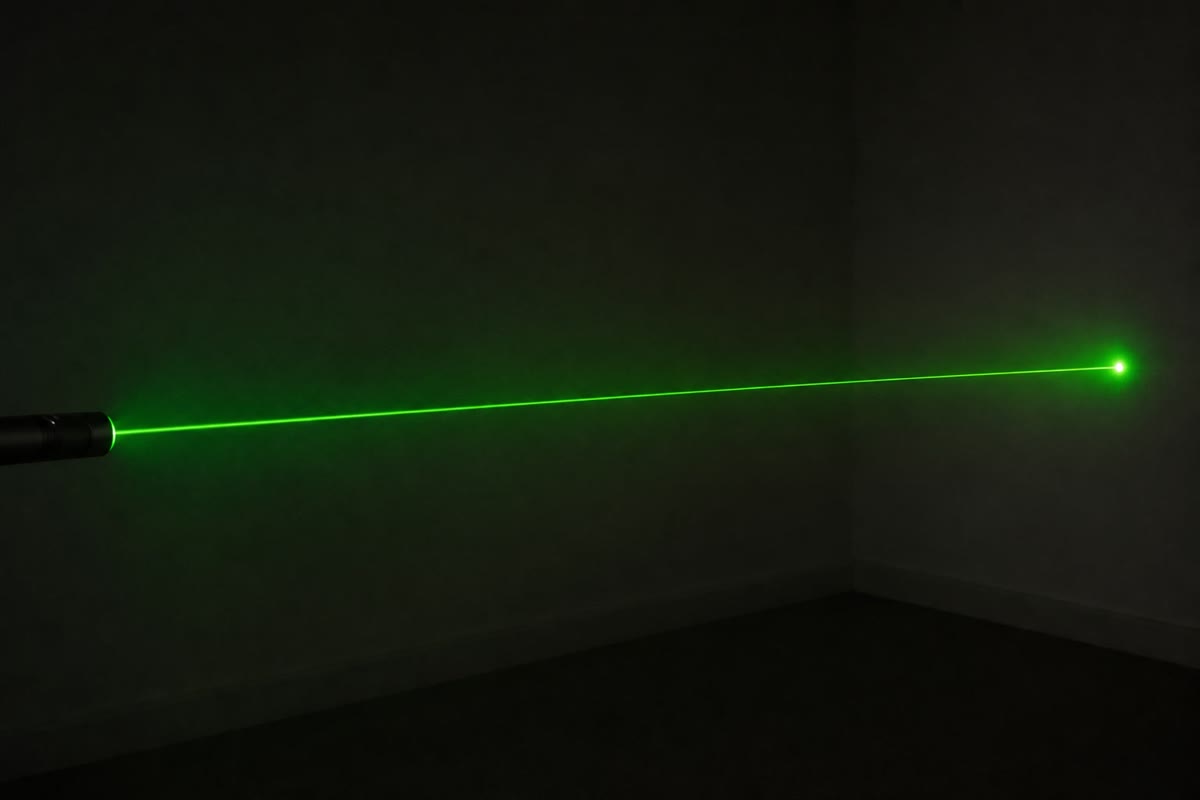
In clear air — and in any clear, well-mixed material such as still water or glass — light propagates in straight lines. This is the law of rectilinear propagation: rectilinear is simply Latin-flavored for “straight-lined”, and propagation names the traveling of light from place to place.
Definition 42.2 (Ray and beam)
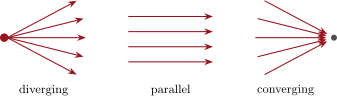
A light ray is the physicist’s drawing of one thread of light: a straight line with an arrow for its direction of travel. Real lamps pour out countless threads together: a bundle of rays is a beam. Three beam shapes cover practice: diverging (rays spreading from a point — any small lamp), parallel (rays side by side, neither meeting nor parting — sunlight, having traveled so far), and converging (rays closing toward a point — light gathered by instruments you will meet in two years).
Example 42.3 (The law at work, everywhere)
Builders sight along a straight plank’s edge to judge it — eye, edge and far end must line up, and light’s straightness is the judge’s oath. Surveyors set poles in a line by eye; archers and photographers “line up the shot”; and the three-cards experiment of two years ago now has a formal name: a test of rectilinear propagation. Every one of these trades a straight line of light for a straight line of matter.
42.2 Shadows, constructed
Method 42.4 (Constructing a shadow with a ruler)
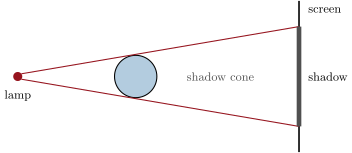
For a small lamp , a ball, and a screen behind it:
- draw the ray from that just grazes the ball’s top edge, and prolong it straight to the screen;
- likewise the ray grazing the bottom edge (and, in three dimensions, all around);
- between the two graze-points on the screen lies the shadow: the zone no straight ray from can reach;
- the space between ball and screen bounded by the grazing rays is the shadow cone: an eye inside it cannot see the lamp.
No guessing anywhere: two ruler lines fix the shadow’s exact size and place.
Example 42.5 (Bigger, smaller, sharper)
The construction predicts what the toy-and-torch games of your first year found by play: slide the ball toward the lamp and the grazing rays fan wider — giant shadow; slide it toward the screen and they land tighter — true-size shadow. And the prediction is exact: with the ball halfway from lamp to screen, the grazing rays spread twice the ball’s width — a shadow exactly twice the ball’s size. Proportionality, drawn in light.
42.3 The camera with no lens
Method 42.6 (Building a pinhole camera)
- take a box (a shoebox serves); in the middle of one end, make a clean pin-sized hole;
- replace the opposite end with tracing paper — the screen;
- drape a cloth over your head and the screen end, aim the hole at a bright scene — the window, a sunlit street;
- look at the tracing paper: the scene appears, in color, moving as the scene moves — upside down.
Proposition 42.7 (Why the image is upside down)
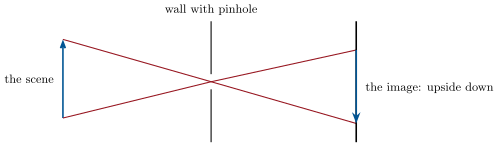
Rectilinear propagation builds the picture and inverts it in the same stroke. From the scene’s top, rays travel straight through the hole — and straight lines through a low hole from a high point must continue downward: the top lands at the screen’s bottom. From the scene’s bottom, upward through the hole to the screen’s top. Every point of the scene sends its thread through the one little gate, the threads cross at the gate, and the picture assembles reversed — top for bottom, left for right.
Remark 42.8 (An old and honorable box)
The pinhole room — camera obscura, “dark chamber” — is centuries older than photography: astronomers watched eclipses safely on its screen, and painters traced its images to get perspective right. Every modern camera, and your own eye, keeps its architecture: a small gate for the light, a screen for the image — and yes, the image on the back of your eye stands upside down too; your brain politely turns it over. One straight-line law, patiently followed, explains the family camera and half the history of picture-making.
42.4 Exercises
Exercise 42.1 ★
Say the law of rectilinear propagation in your own words, and unpack both long words.
Exercise 42.2 ★
Name the three beam shapes, with one real source or situation each. Which shape does sunlight arrive in, and why?
Exercise 42.3 ★
A builder sights along a shelf’s edge to check it is straight. What plays the ruler in this test? Which law is trusted?
Solution
Solution of Exercise 42.3.
A ray of light plays the ruler: eye, edge and far end are judged aligned exactly when light from the far end reaches the eye grazing the whole edge — rectilinear propagation is the oath.
Exercise 42.4 ★
In the shadow construction, what defines the shadow’s edge on the screen? What is true for an eye placed inside the shadow cone?
Solution
Solution of Exercise 42.4.
The landing points of the rays that just graze the blocker’s edges. An eye inside the shadow cone cannot see the lamp — no straight ray from the lamp reaches it.
Exercise 42.5 ★
Using Example 42.5: the ball sits halfway between lamp and screen. The ball is wide — how wide is its shadow? And if the ball moves close to the screen?
Exercise 42.6 ★
In the pinhole camera, where does light from the scene’s top land on the screen? Trace the reason in one sentence.
Solution
Solution of Exercise 42.6.
At the screen’s bottom: a straight line from a high point through the low gate must keep going downward.
Exercise 42.7 ★
A friend waves their right hand in front of your pinhole camera. On the screen, which side waves, and which way up? (Careful — two reversals.)
Solution
Solution of Exercise 42.7.
Upside down, and left-right swapped: on the screen the hand waves low instead of high, and on the opposite side. Both reversals come from the threads crossing at the gate.
Exercise 42.8 ★
Give two historical or modern users of the camera obscura, and the job it did for each.
Solution
Solution of Exercise 42.8.
Astronomers: watching eclipses safely on the screen instead of the sky. Painters: tracing the projected scene to master perspective. (Modern kin: every camera, and the eye itself.)
Exercise 42.9 ★★
Construct (sketch with a ruler): lamp at the left, a coin-shaped blocker, screen at the right — then move the lamp twice as far from the coin, screen fixed. What happens to the shadow’s size, by your own drawing? Reconcile with the fan of grazing rays.
Solution
Solution of Exercise 42.9.
The shadow shrinks toward the coin’s true size: with the lamp farther away, the grazing rays leave it less steeply — a narrower fan — and land closer together. The construction shows it: flatter lines, tighter spread.
Exercise 42.10 ★★
On a sunny day, tree shadows are crisp; under an overcast sky, shadows almost vanish. Explain both skies with rays and sources — what kind of “lamp” is a whole gray cloud layer?
Solution
Solution of Exercise 42.10.
The Sun is compact and far: one tight fan of near-parallel rays, one crisp boundary — sharp shadows. A gray cloud layer is a lamp the size of the whole sky: light arrives from every direction at once, every point of ground is reached by some of it, and shadows wash away to almost nothing.
Exercise 42.11 ★★
The pinhole camera’s image brightens when the hole is widened — but blurs. Explain both effects with threads through the gate: what does a wide gate let each scene-point paint on the screen?
Solution
Solution of Exercise 42.11.
Brighter: a wide gate admits more threads from every scene-point. Blurred: through a wide gate, each scene-point’s threads reach a whole patch of screen instead of one spot — countless overlapping patches smear the picture. The pinhole’s sharpness is its smallness.
Exercise 42.12 ★★★
Under a leafy tree during a partial solar eclipse, the ground fills with hundreds of little crescents. Assemble the explanation from this chapter: what are the gaps between leaves, what is each bright patch on an ordinary day, and why do the patches turn crescent when the Sun does? (Next year’s eclipse chapter will be proud of you.)
Solution
Solution of Exercise 42.12.
Each gap between leaves is a natural pinhole; each bright patch on the ground is that pinhole’s image of the Sun — round on an ordinary day because the Sun is round. When the eclipse turns the Sun into a crescent, every leaf-gap faithfully projects the crescent: hundreds of little cameras, one celestial subject.
42.5 Problem: The Shadow Theater
Problem 42.1
Weekend problem — the family shadow theater; puppets sized by proportion, a pinhole finale; light’s straight lines run the show
A bedsheet screen, one small bright lamp, cardboard puppets: opening night is Saturday, and the stage crew works with rulers.
Part I — Setting the stage. The lamp stands from the screen.
- A puppet held against the screen throws a shadow of exactly its own size. Why?
- The dragon puppet is tall. Held halfway — from lamp and screen — how tall is its shadow?
- For the finale the dragon must tower tall. The crew slides it toward the lamp: at metre from the lamp, the grazing rays spread four times the puppet’s size. Check: does match, and what fraction of the lamp–screen distance is the puppet standing at?
- Why must the theater’s lamp be small and bare, not a broad frosted globe? (What would the globe do to the dragon’s crisp edges?)
Part II — Stagecraft with rays.
- The wolf puppet must grow menacingly during its scene without the puppeteer’s arm appearing. Which way is the puppet moved, and what happens to its shadow’s edges as it grows? (Edges soften slightly — accept and explain with the lamp’s small-but-not-point size.)
- Two puppets, held at the same distance, must not shadow each other. What must be true of the straight lines from the lamp through each puppet?
- A hand slips between lamp and dragon at a third of the way from the lamp. Whose shadow appears bigger on the screen, hand or dragon, and why?
- The villain must vanish instantly. Rays in hand, give two ways: one moving the puppet, one using a second, nearer blocker.
Part III — The pinhole finale. For the last scene, the crew turns the theater itself into a camera obscura: streetlight outside, pinhole in the shutter, screen-sheet across the room.
- The streetlamp hangs high outside. Where does its image land on the sheet — high or low? Why?
- A late cyclist rides past from left to right. Which way does the cyclist’s image glide across the sheet?
- The audience wants a brighter picture, so the crew enlarges the pinhole to a coin-sized opening. What becomes of the show, and why?
- Closing line of the program notes: in one sentence, name the single law that ran the whole evening — both theaters, all shadows, and the upside-down street.
Solution
Solution of Problem 42.1.
1. Against the screen, the grazing rays have no distance left to spread: the shadow hugs the puppet’s own outline. 2. Halfway doubles it: . 3. Four times is exactly — it matches; the puppet stands at one quarter of the lamp–screen distance. 4. A broad glowing globe is many lamps at once: each part throws its own slightly shifted shadow, and the dragon’s edges smear soft and gray. Crisp theater needs a small, bare, point-like source. 5. Toward the lamp: the fan of grazing rays widens and the wolf grows; the arm stays low, out of the fan. As the puppet nears the small-but-real lamp, edge softening grows a little — the lamp’s width matters more, close up. 6. The straight lines from the lamp through the two puppets must run to separate regions of the screen — the puppets stand far enough apart sideways that neither sits in the other’s shadow cone. 7. The hand’s: closer to the lamp, at a third of the way, its grazing rays fan three times wide, while the mid-stage dragon’s only double — near the lamp, even small hands play giants. 8. Move the villain flat against the screen and it shrinks to its plain self (or out of the beam entirely); or slip a second blocker close to the lamp — its giant shadow swallows the villain’s, and the villain “vanishes” inside another darkness. 9. Low on the sheet: from the high lamp, the straight thread through the hole continues downward — the pinhole inverts. 10. From right to left: the gate swaps left and right along with up and down. 11. Brighter but hopelessly blurred: each point of the street now paints a coin-sized patch, the patches overlap, and the picture dissolves — the finale dies with the sharpness. 12. “Tonight’s entire program — every shadow, every giant, and one upside-down street — was performed by a single law: light travels in straight lines.”