Primary & Middle School Physics · Grades 1–9
18The Sun in the Sky: Days and Seasons
In June you play outside after dinner in golden light; in December the streetlamps come on before you are home from school. The Sun keeps its old habit — up one side, over the top, down the other — but its road through the sky is not the same road all year. Follow it for a whole year, and you discover the seasons.
18.1 The Sun’s changing road
Example 18.1 (Summer road, winter road)
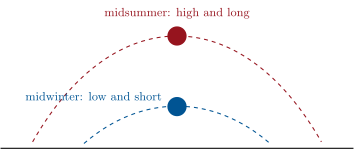
Watch the Sun’s arc in midsummer: it rises early, climbs very high — almost overhead at midday — and sets late: a long, high road, and a long day. In midwinter, the arc is low and short: the Sun rises late, never climbs far above the rooftops, and sets in the middle of the afternoon. Between the two, in spring and autumn, the road is middling — and day and night share the hours almost equally.
Proposition 18.2 (The midday rule)
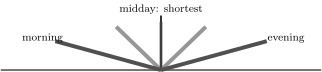
In every season, the Sun stands highest in the middle of the day — and at that moment every shadow is at its shortest for the day and points in the same direction as yesterday’s midday shadow, and tomorrow’s. Midday shadows are the most reliable arrows in nature.
Example 18.3 (Reading the season from a shadow)
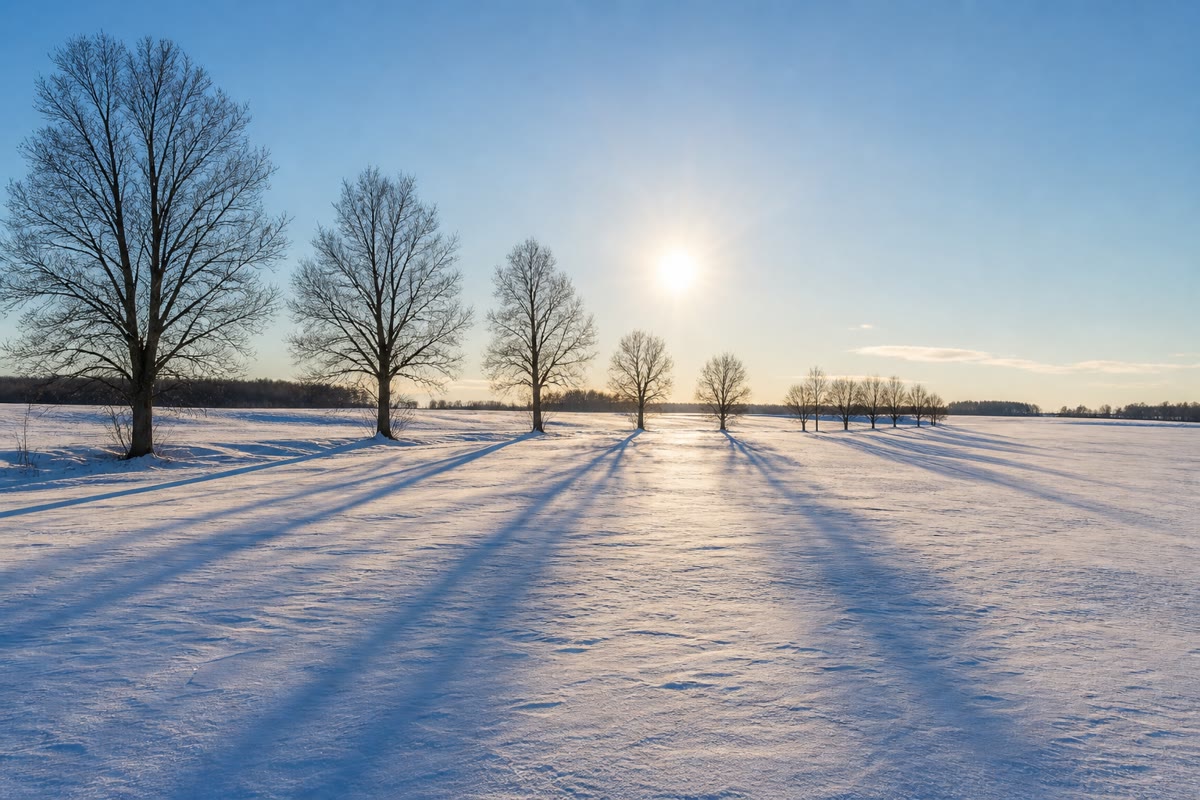
The length of the midday shadow changes with the season: in summer, with the Sun nearly overhead, the midday shadow of a post is a short stump; in winter, with the Sun hanging low, the same post throws a long midday shadow. Mark the tip of the midday shadow on the ground once a month, and the marks will crawl back and forth through the year like a slow pendulum.
18.2 The shadow clock
Definition 18.4 (Sundial)
A sundial is a clock made of a shadow: a stick or blade standing in the sun, with marks around it showing where the shadow falls at each hour. As the Sun travels its arc, the shadow sweeps around the marks — slowly, silently, and without a single moving part.
Method 18.5 (Building a shadow clock)
On a sunny morning, in a spot that stays sunny all day:
- plant a straight stick upright in flat ground (or stand it in a bucket of sand);
- every hour, on the hour, mark the tip of its shadow with a pebble and write the hour on the pebble with chalk;
- keep going until evening.
Tomorrow, the shadow will visit your pebbles on schedule: your stick now tells the time. (For a while, at least — as the season slides, the shadows slide too, and your pebbles will slowly drift wrong.)
18.3 The year and its seasons
Definition 18.6 (The year and the seasons)
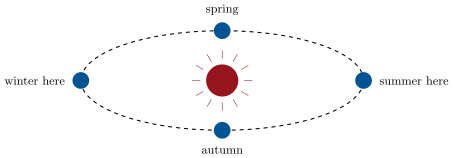
While the Earth spins once a day, it also travels along a huge journey around the Sun — one full lap takes a year, about days. Along the lap, the Sun’s road through our sky slowly rises and falls, and we pass through the four seasons: spring, summer, autumn, winter — then spring again, lap after lap.
Example 18.7 (The four quarters)
Summer: high Sun, long days, short midday shadows. Winter: low Sun, short days, long midday shadows. Spring and autumn sit between — and in each of them comes one special day when daytime and night last equally long. Farmers, sailors and builders of old learned to read this calendar straight from the sky.
Remark 18.8 (Winter is not “farther”)
It is tempting to guess that winter is cold because the Earth drifts farther from the Sun. Not so — the distance barely changes, and when it is winter here, it is summer for children on the far half of the Earth at the very same moment, which no “farther away” could explain! The real key is the Sun’s low road: low Sun, slanted light, weak warming. The full explanation is promised for a later chapter.
18.4 Exercises
Exercise 18.1 ★
In which season is the Sun’s arc highest and longest? Lowest and shortest? What does that do to the length of the day?
Solution
Solution of Exercise 18.1.
Highest and longest in summer — making long days; lowest and shortest in winter — making short days.
Exercise 18.2 ★
At what moment of the day is a post’s shadow shortest? What else is special about the midday shadow, day after day?
Solution
Solution of Exercise 18.2.
At midday, when the Sun stands highest. The midday shadow also points in the same direction every day of the year — nature’s most reliable arrow.
Exercise 18.3 ★
The same post throws a midday shadow of boots’ length in June and boots in December. Explain the difference with the Sun’s two roads.
Exercise 18.4 ★
How does a sundial tell the time? What is its moving hand made of?
Exercise 18.5 ★
In Method 18.5, why must the stick stay in a spot that is sunny all day? What happens to the clock in cloudy weather — and at night?
Exercise 18.6 ★
How long does the Earth take for one lap around the Sun? How many seasons fit in one lap? Put them in order, starting from spring.
Solution
Solution of Exercise 18.6.
One year — about days. Four seasons per lap: spring, summer, autumn, winter.
Exercise 18.7 ★
About how many days are in a year? And — from an earlier chapter — how many hours in a day? Which journey of the Earth makes each?
Solution
Solution of Exercise 18.7.
About days in a year; hours in a day. The day is one spin of the Earth on itself; the year is one lap of the Earth around the Sun.
Exercise 18.8 ★
Name two clues, visible from your window in a single week, that tell you whether you are in midsummer or midwinter without a calendar.
Solution
Solution of Exercise 18.8.
For example: how early the streetlamps come on (dark before dinner means winter); how high the midday Sun stands; how long the midday shadows are; whether you can play outside in daylight after dinner.
Exercise 18.9 ★
When it is winter where you live, what season is it for children on the far half of the Earth? What does this prove about the guess “winter happens because the whole Earth is farther from the Sun”?
Solution
Solution of Exercise 18.9.
It is summer for them, at the same moment. If the whole Earth were farther from the Sun, everyone would have winter at once — so the guess must be wrong. The real cause is the low road and its slanted light.
Exercise 18.10 ★★
A gardener plants her shadow-clock pebbles in March. In June the shadow no longer touches the pebbles at the marked hours. Has the stick moved? Explain what drifted, using Example 18.3.
Exercise 18.11 ★★
An explorer wakes with no watch and no phone, sees the Sun exactly at its highest, and an hour later finds her tent’s shadow already longer than the tent is tall. Roughly what time was it when she woke, and is she closer to midsummer or midwinter? Argue from the midday rule and the shadow’s length.
Solution
Solution of Exercise 18.11.
The Sun at its highest means she woke at midday. If only one hour later the tent’s shadow is already longer than the tent, the Sun must be hanging very low even near midday — the low winter road: she is closer to midwinter.