Primary & Middle School Physics · Grades 1–9
62Sound: Speed, Pitch, Loudness
Short strings sing high, hard plucks sing loud — your rubber-band guitar found the rules years ago. This year the rules get numbers: a count-per-second for pitch, a swing-size for loudness, and a window — with edges — on what human ears can catch at all. Beyond one edge, bats are laughing at us.
62.1 Frequency: pitch counted
Definition 62.1 (Frequency)
The frequency of a vibration is the number of complete back-and-forth swings it makes each second. Its unit is the hertz (): one swing per second — honoring the physicist who first made and caught invisible waves. A guitar string trembling times a second vibrates at ; a mosquito’s wings, near ; the slow flap of a big flag, a few hertz.
Proposition 62.2 (Pitch is frequency)
What the ear calls pitch is frequency and nothing else: the faster the source trembles, the higher the note. The rubber-band rules translate at once — short, tight, thin things tremble at higher . Music’s anchor: concert instruments the world over tune to the note A at . Doubling any note’s frequency raises it by the most consonant of all intervals — the octave: A again, an octave up, at .
Method 62.3 (Seeing sound)
The rice-grain drum showed sound’s trembling; a microphone draws it.
- run a sound-analyzer application on a phone or computer — its screen plots the microphone’s swing against time, a modern oscilloscope;
- hum low and steady: a lazy, wide-spaced trace; sing high: the peaks crowd together;
- read the frequency readout while whistling: most whistles land between and ;
- strike the tuning fork marked “A 440” and check the readout honors its engraving.
One screen replaces a chapter of guesswork: pitch counted before your eyes.
62.2 The ear’s window
Proposition 62.4 (The range of human hearing)
Healthy young ears catch vibrations between about and . Below the window lies infrasound — felt sometimes as rumble in the chest, heard never; above it, ultrasound — silence to us, however violent the trembling. The window narrows with age and with abuse: the highest octave is usually the first casualty of loud habits.
Example 62.5 (Beyond the edges)
Nature and industry both work beyond our window. Bats hunt by ultrasonic clicks near , reading echoes finer than any audible sound could paint — dolphins likewise, in the sonar chapter’s spirit. Dogs answer “silent” whistles pitched just over our edge. Medical scanners image unborn children with harmless ultrasound echoes. At the other edge, elephants converse in infrasonic rumbles across kilometres, and storms and earthquakes announce themselves in tones no ear attends.
62.3 Loudness: the swing’s size
Proposition 62.6 (Loudness is amplitude)
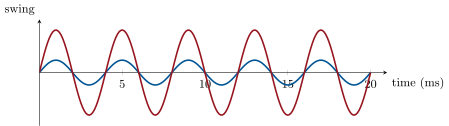
What the ear calls loudness corresponds to the amplitude of the vibration — the size of the swing, the strength of the traveling squeeze. Pluck gently or savagely: the trace’s peaks stand low or tall while their spacing — the pitch — stays untouched. Amplitude and frequency are independent dials: any pitch may be whispered or bellowed.
Example 62.7 (The decibel ladder)
Loudness is graded in decibels () — a ladder built for the ear’s astonishing range, on which each tenfold strengthening of the sound adds the same number of rungs. Landmarks: rustling leaves, ; quiet conversation, ; busy traffic, ; a rock concert’s front rows, ; pain and instant harm, near . The ladder’s strange arithmetic — equal steps for tenfold strengths — is a logarithm, one of the great inventions awaiting you in high school mathematics.
Remark 62.8 (The ear’s budget)
The little drum in your ear, met in your third-year chapter, keeps lifetime accounts. Above about , damage accrues with exposure time — a workday’s limit at a loud factory, minutes only at concert-front levels; headphones at full volume sit squarely in the danger band. Hearing lost to the tall swings never returns: the highest notes leave first, quietly, permanently. Ears have no eyelids — and no spare parts.
Example 62.9 (Speed, unmoved by either dial)
Neither dial touches the delivery. High and low, loud and soft, all sounds ride the medium’s one relay at the medium’s one pace — in air. The proof performs nightly: an orchestra heard across a park arrives in tune and in time — were high notes swifter than low, every distant chord would smear into arpeggios. (Loudness fades with distance — the spreading shells of the g7 chapter — but fading is weakening, never slowing.)
62.4 Exercises
Exercise 62.1 ★
Define frequency and its unit. What is the pitch of concert A, and of the A one octave above?
Exercise 62.2 ★
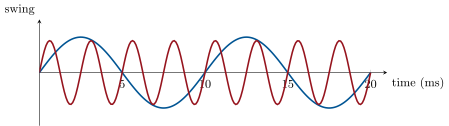
Two traces span the same milliseconds: one shows complete swings, the other . Compute both frequencies; which sounds higher?
Solution
Solution of Exercise 62.2.
swings in : ; swings: — the second sounds higher (two octaves, in fact).
Exercise 62.3 ★
Give the human hearing window, and the names of the two countries beyond its borders — with one inhabitant of each.
Solution
Solution of Exercise 62.3.
About to . Below: infrasound — elephants’ long-range rumbles. Above: ultrasound — the bat’s hunting clicks.
Exercise 62.4 ★
On the analyzer’s screen, what changes when you sing the same note louder? And when you sing a higher note equally loud?
Solution
Solution of Exercise 62.4.
Louder, same note: the peaks grow taller, spacing unchanged. Higher, same loudness: the peaks crowd closer, height unchanged. Two independent dials.
Exercise 62.5 ★
Translate the old rubber-band rules into frequency-language: what do short, tight and thin each do to ?
Solution
Solution of Exercise 62.5.
Each raises the frequency: shorter, tighter and thinner strings all tremble more times per second — higher , higher pitch.
Exercise 62.6 ★
Place on the decibel ladder: whispering leaves; traffic; the concert’s front row; pain. Where does the danger band begin?
Solution
Solution of Exercise 62.6.
Leaves ; traffic ; front row ; pain near . The damage band opens around .
Exercise 62.7 ★
Why do dog whistles seem broken to their owners? And why does the dog disagree?
Solution
Solution of Exercise 62.7.
The whistle’s pitch sits just above — outside the owner’s window, inside the dog’s. Broken to one pair of ears, piercing to the other: windows differ by species.
Exercise 62.8 ★
A distant orchestra arrives in tune and in time. What does this prove about sound’s speed across pitch and loudness?
Exercise 62.9 ★★
A bat clicks at . How many complete swings does one click contain? Why must fine echo imaging use such rapid trembling? (Recall what the finest paintbrushes have in common.)
Solution
Solution of Exercise 62.9.
swings per click. Fine painting needs fine brushes: only vibrations with very short swings — very high — can feel out small details in their echoes; coarse low-frequency rumbles wash over a moth unnoticed.
Exercise 62.10 ★★
The lowest key of a grand piano vibrates near ; the highest, near . Locate both within (or against) the hearing window — and explain why an aging piano tuner may need the analyzer’s help at one end of the keyboard first.
Solution
Solution of Exercise 62.10.
Both keys sit inside the window — just above the floor, comfortably below the ceiling. But age erodes the window from the top: the tuner’s own ear dulls first in the treble, so the analyzer is summoned for the highest octaves before the lowest.
Exercise 62.11 ★★
Concert rules allow hours at but only minutes near , halving the budget every few rungs. What kind of growth hides in the ladder’s equal steps — and what does the budget’s collapse teach about “just a bit louder”?
Exercise 62.12 ★★★
Design the full sound-check of a school hall with one analyzer phone: how to verify the piano’s A against ; how to find the hall’s loudness at the back row during a drum test; how to catch whether the ventilation emits an infrasonic rumble the ear misses; and which of the three findings the phone’s microphone is least equipped to certify (consult the phone’s own hearing window — built for voices).
Solution
Solution of Exercise 62.12.
Piano check: analyzer beside the string, compare its readout with . Back-row loudness: stand there with the decibel readout during the drum test. Ventilation: aim the analyzer’s spectrum display at the low end and look for a spike below . Least trustworthy: the infrasound verdict — phone microphones are built for voices and go deaf near the window’s floor, so a silent screen proves little down there.
62.5 Problem: The Sound Check
Problem 62.1
Weekend problem — sound check at the school festival; one analyzer, three bands and a nervous nurse; the mixing desk’s evening
Festival eve: you run the analyzer at the mixing desk, with the school nurse watching the decibel meter over your shoulder.
Part I — Tuning hour.
- The choir’s tuning fork sings at ; the analyzer shows the piano’s A at . Diagnose the piano, and name the dial — pitch or loudness — that needs the tuner.
- The bass guitar’s lowest string reads . Locate it in the hearing window — and explain why the audience will feel it in the chest as much as hear it.
- The lead singer’s held note shows peaks spaced exactly as the fork’s, but three times taller. Compare the two sounds in both dials.
- A young roadie claims the hall’s new speakers “reproduce up to ”. Who in the audience will certify the top of that range — and who cannot?
Part II — The nurse’s ledger.
- Rehearsal levels: acoustic set ; rock set ; finale planned “a touch above” at . Which sets does the nurse flag, against which budget line?
- The nurse issues foam earplugs rated to soften sounds by . What does the rock set become behind them — and why do wise roadies wear plugs at every show?
- Standing twice as far from the stage, the meter drops noticeably. Which old law of spreading shells is at work — and which dial (pitch or loudness) does distance turn?
- The drummer protests: “Quieter means duller — high notes die first when we play soft!” Untangle the two dials for him: what does playing softly actually change?
Part III — Festival physics.
- Fireworks close the show away. Compute the flash-to-bang delay the crowd will notice — and the frequency of the rumble if the big shells thump twice per second (window check: heard or felt?).
- The night’s last mystery: a phone video of the concert, played back, sounds thin — the chest rumble is gone. Consult exercise 12’s caveat: what was the microphone never built to catch?
- The nurse’s report requests “one sentence each” on the evening’s two dials and the third thing neither dial can touch. Draft them.
- Pack-down: the caretaker’s ultrasonic pest repeller, running all evening by the stage door, bothered no listener and, allegedly, many mice. Explain both audiences with one window proposition.
Solution
Solution of Problem 62.1.
1. The piano is flat — every A trembling eight swings a second too few. The pitch dial: a tuner’s key, not an amplifier. 2. sits just above the window’s floor: heard, deeply — and with swings that slow, the chest’s own drum answers along: felt as much as heard. 3. Same pitch (equal spacing, ), three times the amplitude: the singer sings the fork’s note, much louder. 4. Only the youngest ears — the window’s ceiling near belongs to children; most adults’ windows have already lowered, and no listener certifies . 5. The rock set () and the finale () both stand above the damage line: minutes-only territory; the acoustic set passes. 6. About behind the plugs — back below the damage line: an evening’s exposure made survivable, which is why the wise wear them always. 7. The spreading shells: each squeeze is shared over a vaster shell with distance — loudness (amplitude) fades. Pitch rides unchanged: distance turns one dial only. 8. Playing softly turns the amplitude dial alone — every note’s frequency, high and low, stays exactly put. (His “duller” is the ear’s own trick at low loudness, not the physics of the strings.) 9. flash-to-bang. Two thumps per second: — far below the floor: felt in the chest, never heard as tone. 10. The bass’s lowest swings: near the window’s floor and below, exactly where the voice-built microphone goes deaf — the rumble was real; the phone never caught it. 11. For example: “Pitch is frequency — the count of swings per second, and the tuner’s whole business. Loudness is amplitude — the swings’ size, the nurse’s whole ledger. And neither dial touches the speed: every note tonight crossed the hall at the same .” 12. The window proposition: repeller pitched above — outside every human window, inside the mouse’s. One trembling, two audiences, no contradiction.