Primary & Middle School Physics · Grades 1–9
39Water in All Its States
You have chased water through its states since your second school year: ice, water, steam; melting snowmen and misty windows. This year the chase becomes bookkeeping. When ice melts, is any stuff lost? When water freezes, why do pipes burst? With balances and cylinders in hand, we audit all three of water’s states.
39.1 The three states, with proper labels
Definition 39.1 (The six changes of state)
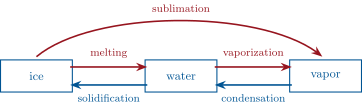
Between its three states, water has six doors, each with its scientific name:
- solid liquid: melting; liquid solid: solidification (freezing);
- liquid gas: vaporization — roaring fast at the boil, quiet and cool as evaporation; gas liquid: condensation;
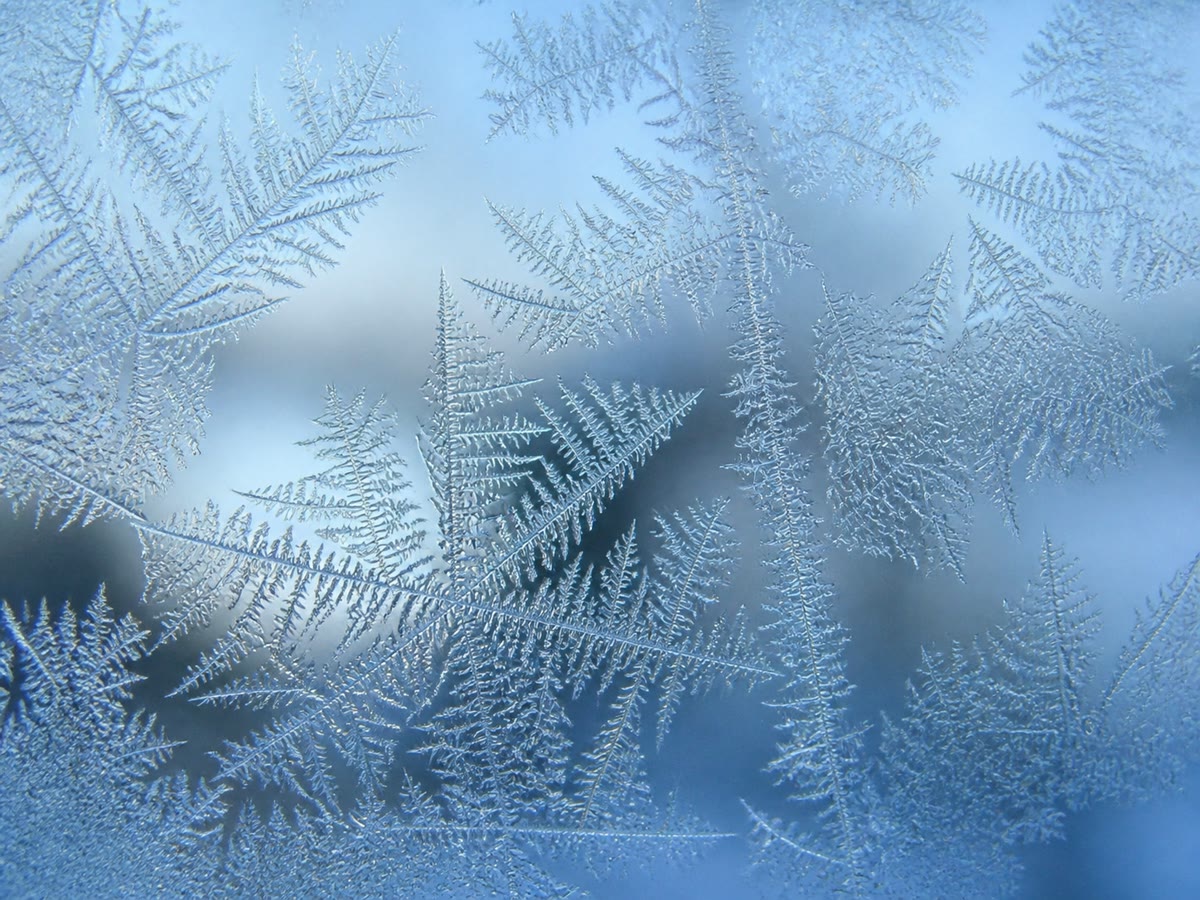
- solid gas directly: sublimation, and gas solid directly — rarer doors, but real: frost feathers on a freezing window grow straight from invisible vapor, skipping the liquid entirely.
Example 39.2 (Doors all around you)
Morning frost melting off the grass; laundry evaporating on the line; a cold mirror condensing your shower’s vapor; the freezer solidifying tomorrow’s ice cubes; frost feathers grown overnight on the pane. One substance, six doors, all within a day of ordinary life — name them and you own them.
39.2 The audit: is stuff lost?
Method 39.3 (Weighing a change of state)
Put the question to the balance:
- pour some water into a small plastic bottle, screw the cap tight, dry the outside;
- weigh it: say — write it down;
- lay it in the freezer overnight: solidification;
- weigh the frozen bottle at once (dry off any frost).
The balance answers: , to the gram. Melt it back on the windowsill and weigh again: . The state changed twice; the stuff never blinked.
Proposition 39.4 (Mass survives changes of state)
A change of state changes a substance’s appearance, not its amount: the mass before equals the mass after, exactly. Melting, freezing, boiling in a sealed pot, condensing — through every door, the balance reads the same. (Leave the cap off, though, and vapor drifts away with its grams: the stuff still exists, but your audit no longer contains it.)
Example 39.5 (Where the puddle’s grams went)
A puddle dries up. Vanished? Weighed nothing? No: of water now ride the air as invisible vapor, every gram intact — some to fall as next week’s rain. Evaporation fools the eye, never the bookkeeping. The chalk line of your childhood puddle experiment was an audit; now it has numbers.
39.3 The audit: is room kept?
Proposition 39.6 (Water swells as it freezes)
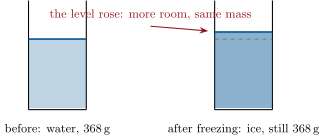
Mass survives the doors — volume does not. Water is a curious substance: turning solid, it expands. A litre of water makes about litres of ice: same mass, about a tenth more room. Most substances shrink when they solidify; water swells — and that oddity redraws landscapes.
Example 39.7 (The burst pipe and the cracked mountain)
Forgotten in the freezer, a full glass bottle of water cracks: the swelling ice needs its extra tenth of room and takes it, glass or no glass. Winter does the same to plumbing — water freezing in a pipe bursts it as surely as a hammer — and to mountains: rain seeps into rock cracks, freezes at night, swells, and wedges the crack wider. Year by year, freeze by freeze, the odd little swelling of Proposition 39.6 splits boulders and crumbles peaks.
Remark 39.8 (Why ice floats)
The same oddity answers a question you asked years ago at bath time. Ice holds a litre’s stuff in litres of room: for equal room, ice is lighter than water — so ice floats on its own liquid. Icebergs ride the sea, ponds freeze from the top down (saving the fish beneath), and your lemonade’s cubes bob instead of sinking. Few substances float on themselves; life on frozen ponds is glad water does.
39.4 The water cycle, audited
Example 39.9 (The great round trip, with vocabulary)
The childhood story of sea, cloud and rain now reads like a ledger. The Sun’s warmth drives vaporization from the seas — tonnes upon tonnes rise invisibly. High and cold, the vapor condenses into cloud droplets; colder still, droplets freeze into snow. Snow piles into glaciers; glaciers melt into rivers; rivers return every gram to the sea. Around the whole circuit, Proposition 39.4 holds: the planet neither gains nor loses a drop — the water in your glass has sailed this loop since before the dinosaurs.
39.5 Exercises
Exercise 39.1 ★
Name the six doors of Definition 39.1, each with one everyday sighting.
Solution
Solution of Exercise 39.1.
Melting (frost off the morning grass); solidification (the freezer’s ice cubes); vaporization (laundry drying, the boiling pot); condensation (mist on the cold mirror); sublimation (a snowbank shrinking in dry frost); gas to solid directly (frost feathers on the pane).
Exercise 39.2 ★
Which door: dew forming on cold grass at dawn? a snowman shrinking on a sunny day, with no puddle appearing? ice cubes clouding the freezer with “smoke”?
Solution
Solution of Exercise 39.2.
Dew: condensation. The puddle-less shrinking snowman: sublimation — solid straight to vapor in the cold dry air. The freezer’s “smoke”: condensation — room vapor condensing into a little cloud in the cold air (droplets, not gas).
Exercise 39.3 ★
A sealed bottle of water weighs . It freezes solid overnight. What does it weigh now, and which proposition answers?
Solution
Solution of Exercise 39.3.
Still : mass survives changes of state — the sealed bottle lost and gained nothing.
Exercise 39.4 ★
In Method 39.3, why must the bottle be capped — and why dried before each weighing?
Exercise 39.5 ★
A pot of water boils uncovered for ten minutes and its mass drops by . Was mass destroyed? Where are those grams?
Solution
Solution of Exercise 39.5.
Not destroyed: of water left as vapor through the kitchen air — vaporization moved the grams out of the pot, not out of the world.
Exercise 39.6 ★
One litre of water goes into the freezer. About what volume of ice comes out? Same question for the mass.
Solution
Solution of Exercise 39.6.
About of ice — a tenth more room. The mass is unchanged: going in, coming out.
Exercise 39.7 ★
Why do water pipes burst in hard winters — and why do gardeners drain their outdoor taps in autumn?
Solution
Solution of Exercise 39.7.
Water trapped in a pipe swells as it freezes, and the pipe, like the glass bottle, gives way. Gardeners drain autumn taps so there is nothing left inside to swell.
Exercise 39.8 ★
Why does ice float on water? Connect Proposition 39.6 to the floating rule — lighter or heavier for the same room?
Exercise 39.9 ★★
Tell the water cycle as a ledger: follow of sea water around the full loop, naming each door it passes and stating its mass at every stage.
Solution
Solution of Exercise 39.9.
Sea (, liquid) — vaporization — vapor () — condensation — cloud droplets () — solidification — snow () — melting — meltwater () — river to sea (). Six stages, one unchanging mass.
Exercise 39.10 ★★
A lemonade glass is filled to the very brim, ice cubes bobbing. A guest worries it will overflow as the ice melts. Use the two audits (mass kept, ice’s extra room given back) to reassure — or alarm — the guest, with your reasoning.
Solution
Solution of Exercise 39.10.
Reassure. The bobbing ice already displaces its own weight of lemonade; melting returns exactly that water, shrunk back by the tenth it had swollen — it slips into the room the cube was already using below the surface. The glass stays brim-full, overflowing not a drop.
Exercise 39.11 ★★
Frost feathers appear on a freezing window pane overnight in a dry room, with no rain and no wet pane at bedtime. Which door did the water take, from where, and why is this door’s name not “freezing”?
Exercise 39.12 ★★★
Ponds freeze from the top down. Explain the whole chain: why the coldest water’s ice forms at the surface and stays there, what the floating lid does to the heat flow beneath (an insulation idea from last year), and why the fish below owe their winters to water’s strange swelling.
Solution
Solution of Exercise 39.12.
The pond loses heat to the winter air at its surface, so surface water reaches first and its ice forms there — and floats, being lighter than water for the same room, so it stays on top. The lid of ice (and snow) is a slow lane: it insulates the water beneath, whose heat now leaks only slowly upward. The deep water hovers above freezing all winter, and the fish swim under a roof their strange, swelling water built for them.
39.6 Problem: A Kilogram Around the World
Problem 39.1
Weekend problem — one kilogram of sea water on its grand tour; six doors, three mountains, one unbroken ledger
We stamp an imaginary label on of sea water and follow it for a year.
Part I — Up.
- June: the Sun warms the sea surface and our kilogram rises into the air, invisibly. Name the door it took.
- What is the mass of our (now invisible) kilogram of water? Which proposition guarantees it?
- At , the air is cold: the water becomes a cloud of droplets. Name this door.
- Colder still, the droplets become snowflakes. Name that door — solidification — and state the temperature at which cloud droplets of pure water begin to freeze.
Part II — The glacier’s ledger. Our kilogram lands on a glacier and is pressed into glacier ice.
- As water, our kilogram occupied . About what volume does it occupy as ice?
- The glacier’s snout melts in summer. Our kilogram becomes meltwater: what is its mass now, and its volume (back as liquid water)?
- On the way down the mountain, of our kilogram evaporates from a sunlit waterfall pool. How much of the labeled water continues as liquid in the stream?
- Has the evaporated quarter left the audit? Say where its are, and what door they will most likely take next.
Part III — Home, and the books balanced.
- The stream’s reach the sea in October. The evaporated fell as rain over the coast in August and ran to the sea in September. Add up what the sea got back of our kilogram.
- Along the whole tour, our kilogram was weightless exactly never — but it was invisible twice. At which stages, and in which state?
- A classmate objects: “Snow is fluffy and light — surely the kilogram weighed less as snow.” Untangle the mix-up with the right pair of words from this year.
- Write the tour as a chain of doors, in order, using only the six proper names of Definition 39.1.
Solution
Solution of Problem 39.1.
1. Vaporization (evaporation from the warm surface). 2. Still — mass survives changes of state. 3. Condensation. 4. At . 5. About . 6. Mass ; volume back to . 7. continue in the stream. 8. No: the ride the air as vapor, intact; their likeliest next door is condensation — into cloud, then rain. 9. : the whole kilogram came home. 10. Twice invisible: as vapor just after leaving the sea, and as vapor again over the waterfall pool — both in the gas state. 11. Fluffy is about volume: snow is ice crystals laced with air, taking generous room. The mass of our labeled water stayed exactly — light-per-room is not light-in-stuff: the pair of words is mass and volume. 12. Vaporization, condensation, solidification, melting — and for the evaporated quarter: vaporization, condensation (rain), rejoining as liquid. Four doors used; sublimation and the gas-to-solid door were not needed on this tour.