Primary & Middle School Physics · Grades 1–9
31Simple Machines: Levers, Pulleys, Inclined Planes
No engine, no electricity — yet with a few beams, ropes and ramps, ancient builders raised stones that whole teams of oxen could not drag. Their toolbox held the simple machines: inventions with no motor at all, which turn a weak, comfortable pull into a mighty one. You already own the first; meet the family.
31.1 The family of effort-savers
Definition 31.1 (Simple machine)
A simple machine is a device without a motor that changes a force to suit us: making it stronger, or changing its direction, or both. The classics: the lever you know from the seesaw and crowbar, the pulley, and the inclined plane — the humble ramp.
Example 31.2 (The lever, revisited)
The lever’s rule you already own: coins times marks — your small force far from the pivot beats a big load close to it. Notice something else now: your end of the crowbar sweeps a long way down while the boulder rises only a little. Keep that observation in your pocket; it is about to become a law.
31.2 Pulleys
Definition 31.3 (Pulley)
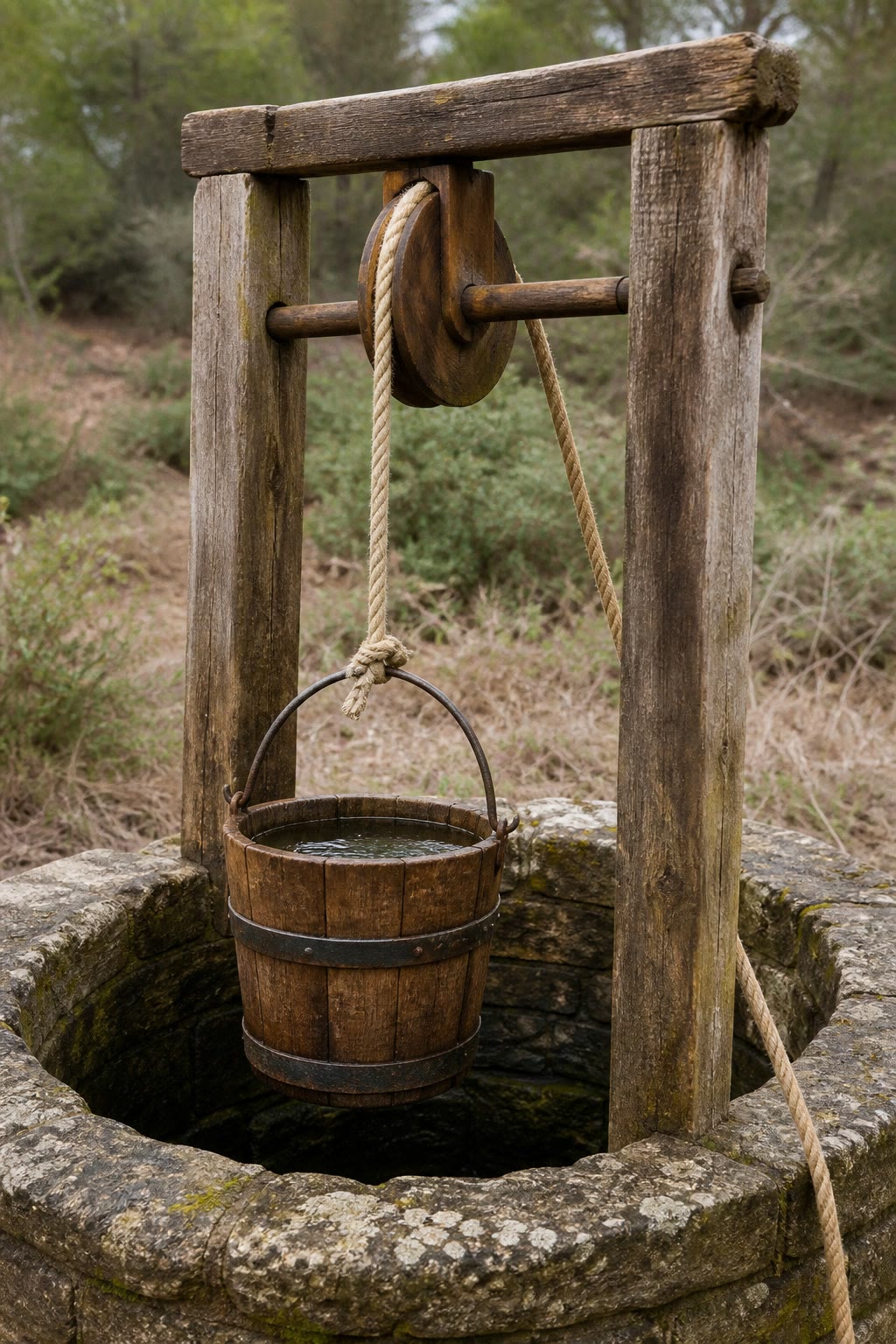
A pulley is a wheel with a groove for a rope. A fixed pulley hangs from a beam and only changes the pull’s direction: haul down, the load goes up. A movable pulley rides on the rope with the load hooked to it: the load then hangs from two strands of rope, and each strand carries only half the weight.
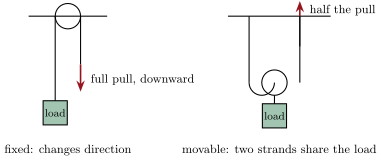
Example 31.4 (Pulleys at work)
The flag rises up its pole while your hands pull comfortably down: a fixed pulley at the top — direction changed, effort unchanged, but hauling down lets your own weight help. The builder’s block-and-tackle chains several pulleys so the load hangs from four or six strands: each strand carries a quarter or a sixth of the weight, and one worker raises a piano. Watch the worker, though: metre after metre of rope races through their hands, while the piano creeps upward slowly.
31.3 The inclined plane
Definition 31.5 (Inclined plane)
An inclined plane — a ramp — is a slope for raising loads without lifting them straight up. The gentler the slope, the smaller the push needed to move the load along it: rolling a barrel up a long, gentle ramp is easy; up a short, steep one, brutal; straight up, impossible.
Method 31.6 (Feel it with the rubber-band scale)
Your rubber-band scale from last year can taste the difference:
- load a toy car onto a plank and hook the rubber band to it;
- prop the plank as a gentle ramp onto a low book pile; drag the car slowly up by the band and note the stretch;
- prop the same plank much steeper, onto a chair seat, and drag again.
The steep drag stretches the band far more: steeper slope, bigger effort. Gentle slopes really are gentle — your instrument says so.
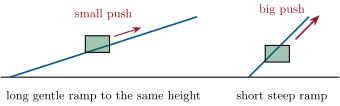
Example 31.7 (Ramps in the landscape)
Wheelchair ramps run long and shallow beside short staircases — gentleness on purpose. Mountain roads zigzag: rather than attack the summit straight up, they wrap a long, gentle inclined plane back and forth across the slope. And the screw is a ramp in disguise — a slope wrapped around a rod, so each easy turn of the screwdriver sneaks the screw a tiny step deeper.
31.4 The golden rule
Proposition 31.8 (The golden rule of machines)
No simple machine gives something for nothing: whatever it saves in force, it charges back in distance. Half the force — twice the rope hauled, or twice the road traveled; a tenth of the force — ten times the road. Machine after machine, the trade is exact: comfort is bought with metres.
Example 31.9 (Checking the rule)
The movable pulley: your hand pulls with half the force, and to raise the load you haul in of rope — both strands must shorten by a metre. The crowbar: your end sweeps a long arc, the boulder barely stirs. The ramp: the crate reaches the same height, but you pushed it along the whole slope. Every saving paid for, precisely.
Remark 31.10 (Why the rule cannot be cheated)
Hiding under the golden rule is our old friend from the energy chapter: lifting a load to a height costs a fixed helping of energy, and no arrangement of ropes and planks changes the price. Machines only let you pay it in smaller coins — more of them. A small force over a long road hands over the same energy as a big force over a short one. The forever-machines failed for this very reason: the bill is always the bill.
31.5 Exercises
Exercise 31.1 ★
Name the three classic simple machines, and one everyday place each is found.
Solution
Solution of Exercise 31.1.
The lever (crowbar, seesaw, scissors), the pulley (flagpole, well, crane), the inclined plane (wheelchair ramp, mountain road, loading ramp).
Exercise 31.2 ★
What does a fixed pulley change about your pull? What does a movable pulley change?
Exercise 31.3 ★
Why is hauling a flag downward to raise it more comfortable than lifting the same weight straight up, even though the effort is the same size?
Solution
Solution of Exercise 31.3.
Pulling down recruits your own weight: you can lean or even hang on the rope, letting the Earth’s pull help your muscles. Lifting upward, your arms fight alone.
Exercise 31.4 ★
With one movable pulley, the load hangs from two strands. What share of the weight does your hand hold? To raise the load , how much rope must you haul?
Solution
Solution of Exercise 31.4.
Half the weight. To raise the load , both strands must shorten by : your hand hauls of rope.
Exercise 31.5 ★
In Method 31.6, which ramp stretches the rubber band more? What pays for the gentler ramp’s smaller stretch?
Solution
Solution of Exercise 31.5.
The steep ramp stretches it more. The gentle ramp’s smaller effort is paid for in distance: the same height is gained along a much longer road — the golden rule’s trade.
Exercise 31.6 ★
Why do mountain roads zigzag instead of running straight up the slope? Which simple machine is the whole road?
Solution
Solution of Exercise 31.6.
Straight up the slope, the pull needed would defeat any engine or mule team; the zigzags wrap a long, gentle inclined plane across the mountainside — small effort, long road. The whole road is one stretched-out ramp.
Exercise 31.7 ★
State the golden rule of machines. A machine lets you pull with a tenth of the force — what does it charge you?
Exercise 31.8 ★
How is a screw an inclined plane in disguise? What plays the role of the long gentle road?
Solution
Solution of Exercise 31.8.
Its thread is a long gentle slope wrapped around the rod. The many easy turns of the screwdriver are the long road; the tiny sinking of the screw each turn is the small height gained.
Exercise 31.9 ★★
A block-and-tackle hangs a piano from four strands. What fraction of the piano’s weight does the worker’s hand pull? To raise the piano , how many metres of rope pass through their hands?
Solution
Solution of Exercise 31.9.
A quarter of the weight. Each of the four strands must shorten by : of rope pass through the worker’s hands.
Exercise 31.10 ★★
A loading ramp is long and rises ; pushing a crate up it takes a modest push. The impatient movers cut a new ramp only long to the same platform. Using the golden rule, compare the new push with the old one — and explain why “half the road” was no bargain.
Solution
Solution of Exercise 31.10.
The new ramp climbs the same in half the road, so it is twice as steep, and the push roughly doubles. The golden rule collected instantly: road halved, force doubled — the crate’s climb costs the same either way, and the movers merely traded many comfortable coins for a few heavy ones.
Exercise 31.11 ★★
An advertisement offers a pulley set “so clever that you pull one metre of rope with half the force — and the load rises a full metre”. Put the claim on trial before the golden rule and the energy bill of Remark 31.10: could any arrangement of wheels and ropes honor it?
Solution
Solution of Exercise 31.11.
No arrangement can honor it. Raising the load one metre costs a fixed helping of energy; paying with half the force, the seller must haul two metres of rope — half-force along just one metre hands over only half the bill. The advertisement promises a paid lift at half price: exactly the free lunch that the golden rule, and the failed forever-machines, forbid.